Updated on July 9th, 2026 by Josh Arnold
We believe that long-term investors should focus on the highest-quality dividend-growth stocks. These are companies with long histories of raising their dividends, and durable competitive advantages to fuel continued dividend growth.
Therefore, we tend to steer investors toward the Dividend Kings, a group of just 58 stocks that have maintained at least 50 years of consecutive dividend increases.
You can also download an Excel spreadsheet with the full list of all 58 Dividend Kings (plus important metrics such as price-to-earnings ratios and dividend yields) by clicking on the link below:
We review each of the Dividend Kings every year. The following stock to be reviewed in this year’s edition is AbbVie (ABBV).
There are questions regarding AbbVie’s future growth, as its flagship drug, Humira, is facing patent expiration in various stages across the globe. However, the company has a plan to continue growing in the years ahead. This article will focus on AbbVie’s prospects as a core dividend holding.
Business Overview
AbbVie is a global pharmaceutical giant. It began trading as an independent company in 2013, having been spun off from Abbott Laboratories (ABT). Since the spin-off, AbbVie has generated strong growth. Earnings-per-share have increased on an average annual pace of about 12.5% from 2016 to 2025.
Today, AbbVie focuses on a single main business segment: pharmaceuticals. It focuses on several key treatment areas, including immunology, hematologic oncology, neuroscience, and others.
Since the spin-off from Abbott, AbbVie has experienced excellent growth, primarily driven by Humira, a multi-purpose drug. The challenge for AbbVie is that Humira is now facing biosimilar competition after it has lost patent exclusivity.
Even so, AbbVie remains a giant in the healthcare sector, with an extensive and diversified product portfolio.
Earnings came to $2.65 per share during the quarter, which was higher by 8% compared to the year-ago period. That did, however, miss estimates by two cents. The gain in profit was driven by higher revenue and some profit margin expansion. Guidance was updated to $14.08 to $14.28 per share in earnings, and if achieved, would represent a new record for the company. We’ve set our estimate right in the middle at $14.18.
Growth Prospects
The significant risk for global pharmaceutical manufacturers is the loss of patent protection. When a particular drug loses patent, the market is typically flooded with competition, especially for the world’s top-selling products.
AbbVie’s biggest risk is the impending competition to its flagship drug, Humira. This multi-purpose drug is used to treat a variety of conditions, including rheumatoid arthritis, plaque psoriasis, Crohn’s disease, ulcerative colitis, and more.
Humira once generated over half of AbbVie’s annual sales. Loss of patent exclusivity is a significant overhang; as a result, AbbVie’s total sales declined in 2023. Despite this, revenue growth returned in 2025 and is expected to grow for the foreseeable future.
Fortunately, the company prepared for the loss of patent exclusivity on Humira by investing heavily in new products and acquisitions to boost its growth. For example, Rinvoq and Skyrizi are two key products that represent long-term growth catalysts.
In addition, it fairly regularly makes acquisitions, such as its very recent announcement of the acquisition of Apogee Therapeutics, Inc. (APGE) for about $11 billion.
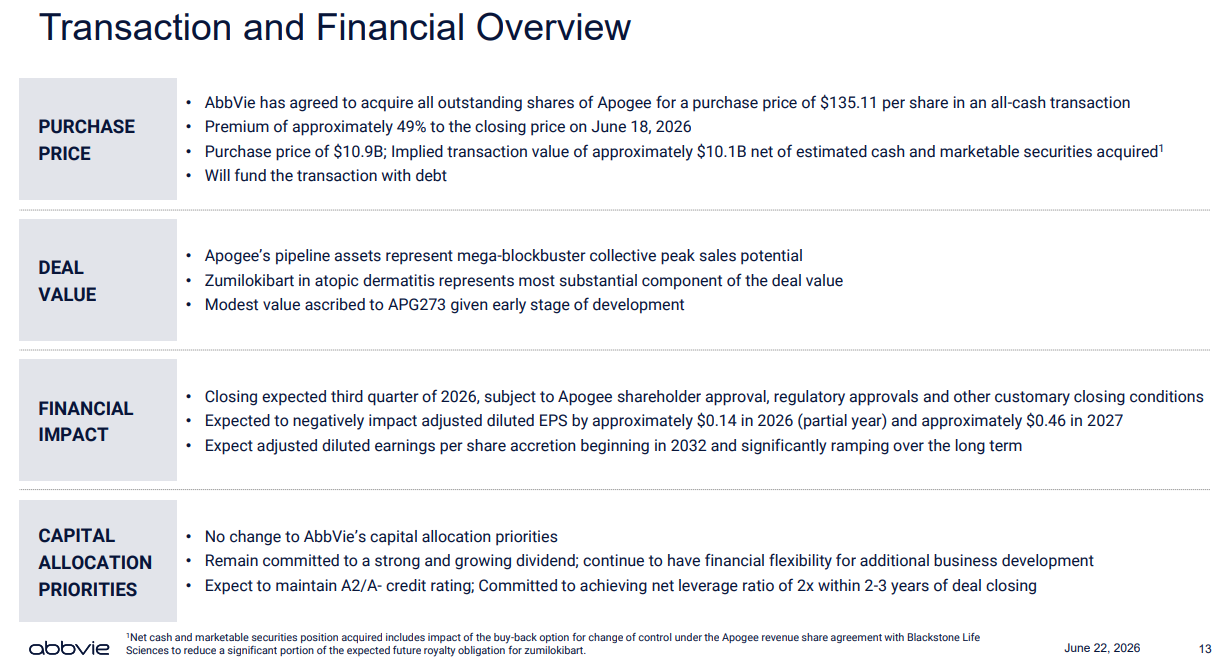
Source: Investor presentation
AbbVie also completed the $63 billion acquisition of Allergan a few years ago, which was an enormous purchase. Allergan’s flagship product is Botox, which diversifies AbbVie’s portfolio by exposing it to the global aesthetics market.
We expect AbbVie to achieve 6% EPS growth over the next five years. We believe the growth outlook will improve once the Humira overhang is resolved, but we not the uncertainty surrounding revenue growth with the Humira expiration is largely being resolved, and the outlook is brighter than it’s been in recent years.
Competitive Advantages & Recession Performance
The most critical competitive advantage for AbbVie and any pharmaceutical company is its patent portfolio. Pharmaceutical giants must invest heavily in developing new drugs and therapies when one of their blockbusters loses patent protection.
AbbVie has over 60 clinical programs. It has multiple growth opportunities to replace Humira, particularly in the therapeutic areas of immunology, hematology, and neuroscience. The result of its significant investment in R&D is a well-stocked pipeline. This is complimentary to its targeted acquisition strategy.
AbbVie was not a standalone company during the last financial crisis, so it does not have a recession track record. However, since sick people require treatment regardless of the economy’s strength, it is highly likely that AbbVie would continue to perform well during a recession.
AbbVie’s earnings are likely to decline somewhat during a recession, but the dividend is expected to remain secure. AbbVie has a projected dividend payout ratio of ~49% for 2026.
Valuation & Expected Returns
AbbVie is expected to generate adjusted EPS of $14.18 for 2026 at the midpoint of guidance. At this EPS level, the stock currently has a price-to-earnings ratio of 17.8.
Our fair value estimate for AbbVie is a price-to-earnings ratio of 13, indicating that the stock is currently materially overvalued. A declining P/E multiple could reduce shareholder returns by approximately 5% per year over the next 5 years.
Additionally, we anticipate annual earnings growth of 6% through 2030.
Lastly, the stock has a current dividend yield of 2.7%. Given these inputs, we expect annual returns of 2% or 3% per year over the next five years, making AbbVie stock a hold despite its exemplary dividend history.
Final Thoughts
AbbVie is a high-quality business, boasting a strong pharmaceutical pipeline and significant growth potential. It is also a shareholder-friendly company that returns excess cash flow to investors through stock buybacks and dividends.
AbbVie faces a significant challenge in replacing lost Humira sales, as it competes with other companies in the U.S. and Europe. This is why we have fairly low assumptions for the company’s future EPS growth and fair value P/E multiple.
Still, the company has built an extensive portfolio of new products that should help maintain its growth, as well as acquisitions. However, the expected returns make the stock a hold.
Additional Reading
The following databases of stocks contain stocks with very long dividend or corporate histories, ripe for selection for dividend growth investors.
Thanks for reading this article. Please send any feedback, corrections, or questions to [email protected].