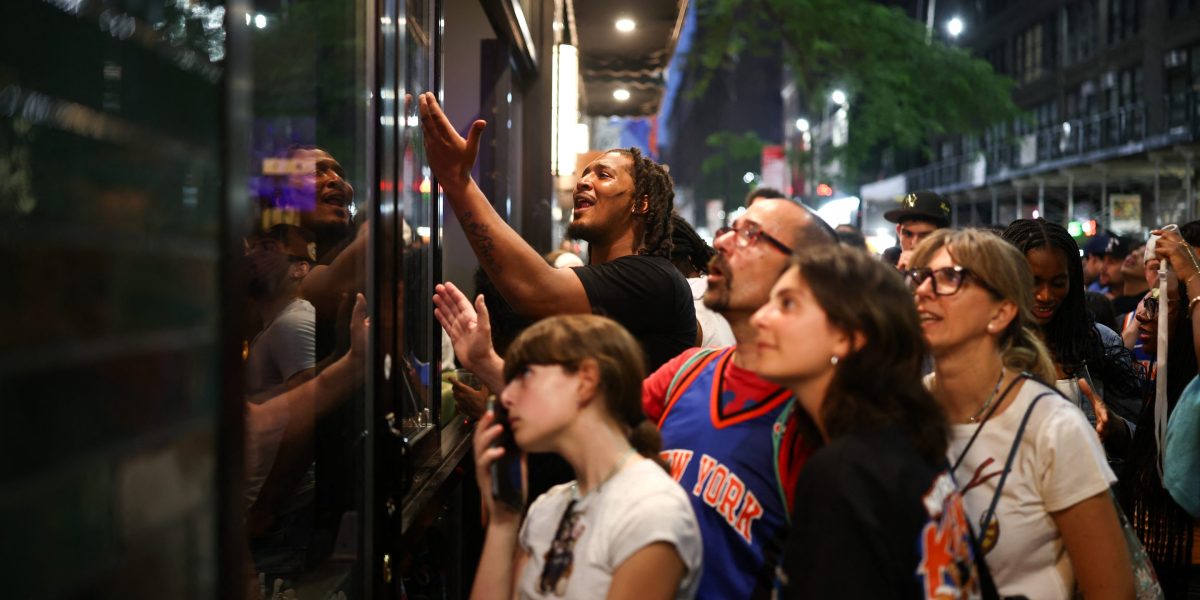
For one extraordinary week in June, American sports fans faced a choice no previous generation had confronted at this scale: the New York Knicks chasing their first NBA championship in 53 years, or the U.S. men’s national soccer team playing its opening World Cup match on home soil.
Both events delivered historic numbers. Both are now being studied by media executives, sports economists, and brand strategists as a preview of the most consequential battle in the industry’s future—not on the court or the pitch, but in the boardroom and on the balance sheet.
Two records, one week
The numbers from both sides of this collision are staggering. The 2026 NBA Finals averaged 19.6 million viewers through four games on ABC and ESPN—the highest Finals viewership since Michael Jordan’s final championship in 1998—with Game 4 alone drawing 20.4 million viewers, peaking at 23.2 million as the Knicks mounted a 29-point comeback. Through three games, the Finals were averaging 19.1 million viewers, and the series ultimately finished as the most-watched NBA Finals since 1998—up 116% over the prior year’s Finals.
Meanwhile, soccer was rewriting its own records. The USMNT’s opening 4-1 win over Paraguay drew an average of 24.9 million viewers combined across Fox, Telemundo, and all streaming platforms, peaking at 18.86 million on Fox alone between 10:45 p.m. and 11 p.m. ET—making it the most-watched USMNT broadcast in history. Even the tournament opener between Mexico and South Africa, featuring no American team, averaged 6.31 million viewers on Fox, a record for a World Cup opening match on English-language television, up 97% from 2022.
Google Trends data from the same week shows states actively splitting between “last Knicks championship” and “FIFA World Cup 2026” searches—a behavioral signal the two events drew on overlapping pools of American sports attention, not separate ones.
The rights architecture behind the clash
To understand why media executives are watching this convergence so closely, follow the money—and the contracts.
The NBA’s 11-year, $77 billion media rights deal—signed in 2024 and running through the 2035-36 season—distributes games across Disney (ABC and ESPN), NBCUniversal (NBC and Peacock), and Amazon Prime Video, with ABC remaining the exclusive home of the NBA Finals. That deal nets the league roughly $7 billion annually and represents the most expensive domestic sports rights package in basketball history.
On the soccer side, the rights math is more complicated—and, by one reading, more revealing. FIFA is expected to generate over $3.8 billion from 2026 World Cup media rights alone, representing more than 60% of the tournament’s total projected revenue of roughly $6 billion. Fox paid approximately $485 million for English-language U.S. rights and Telemundo paid around $465 million for Spanish-language rights, bringing North American rights alone past $1 billion. And, yet, Fox may be getting a bargain: The New York Times reported Fox’s deal could be worth up to three times the deal figure given the tournament’s home-soil premium. The Observer went further, calling the 2026 World Cup “the last great sports TV bargain,” noting North America’s Big Four sports leagues now command more than $15 billion annually in combined domestic rights.
The Apple question
The most strategically interesting subplot in the rights war is what didn’t happen: Apple’s widely anticipated global FIFA deal.
In April 2024, the New York Times reported FIFA was close to a landmark global streaming deal with Apple that would have given the tech company worldwide rights for a major tournament—a deal that could have restructured how billions of fans access soccer globally. Those talks ultimately collapsed. FIFA instead sealed a streaming deal with DAZN for its 2025 Club World Cup, valued at roughly $1 billion, while the 2026 World Cup itself landed across Fox, Telemundo, and a constellation of streaming platforms.
Apple’s absence from the 2026 picture is not an exit from sports media ambitions: It’s a deferral. The company already holds MLS rights through its landmark Apple TV+ deal, and the collapse of FIFA negotiations is widely read in the industry as a pricing disagreement, not a strategic retreat. The next World Cup cycle will be a dramatically different negotiation, with Fox’s bargain-rate deal expiring and the 2026 ratings bonanza on the table as evidence of what the rights are actually worth.
The overlap audience is the prize
What makes the NBA-FIFA collision commercially unique is the audience it reveals. Nearly one-third of U.S. consumers—32%—planned to watch the 2026 FIFA World Cup, up from 26% just months earlier, according to Numerator. Hispanic (54%) and Asian (51%) consumers were the most likely groups to watch. Those demographics also index highly for NBA viewership and represent the fastest-growing consumer spending segments in the country. The World Cup’s projected consumer spending impact of $7.5 billion—exceeding the Winter Olympics but trailing only the Super Bowl—gives brands and networks a tangible stakes figure.
Google Trends data captures this overlap in real time: The same tristate area consuming Knicks search queries at record levels also registered FIFA World Cup interest, and San Antonio—the Spurs’ market, already searching “courtside seats” at all-time highs—was simultaneously one of the most soccer-passionate cities in the American South. The audience is not divided, but shared, and enormous.
What comes next
The 2026 summer is less an endpoint than a negotiating document. Every record rating, every Google search spike, every sold-out courtside seat is data that will be cited in the next round of rights negotiations—for the 2030 World Cup, for the NBA’s next deal tier, for whatever Apple, Amazon, and Netflix are prepared to pay to sit at the sports table.
Fox’s 2026 deal may be the last major sports broadcast rights secured at a genuine discount. The NBA’s $77 billion deal set the floor for what premium live sports commands. What this summer proved is that when the two biggest live sports events in the world land in the same two-week window on American soil, the combined commercial value exceeds what either party’s accountants modeled. For the next round of bidders, this summer is looking more like a blueprint.
For this story, Fortune journalists used generative AI as a research tool. An editor verified the accuracy of the information before publishing.