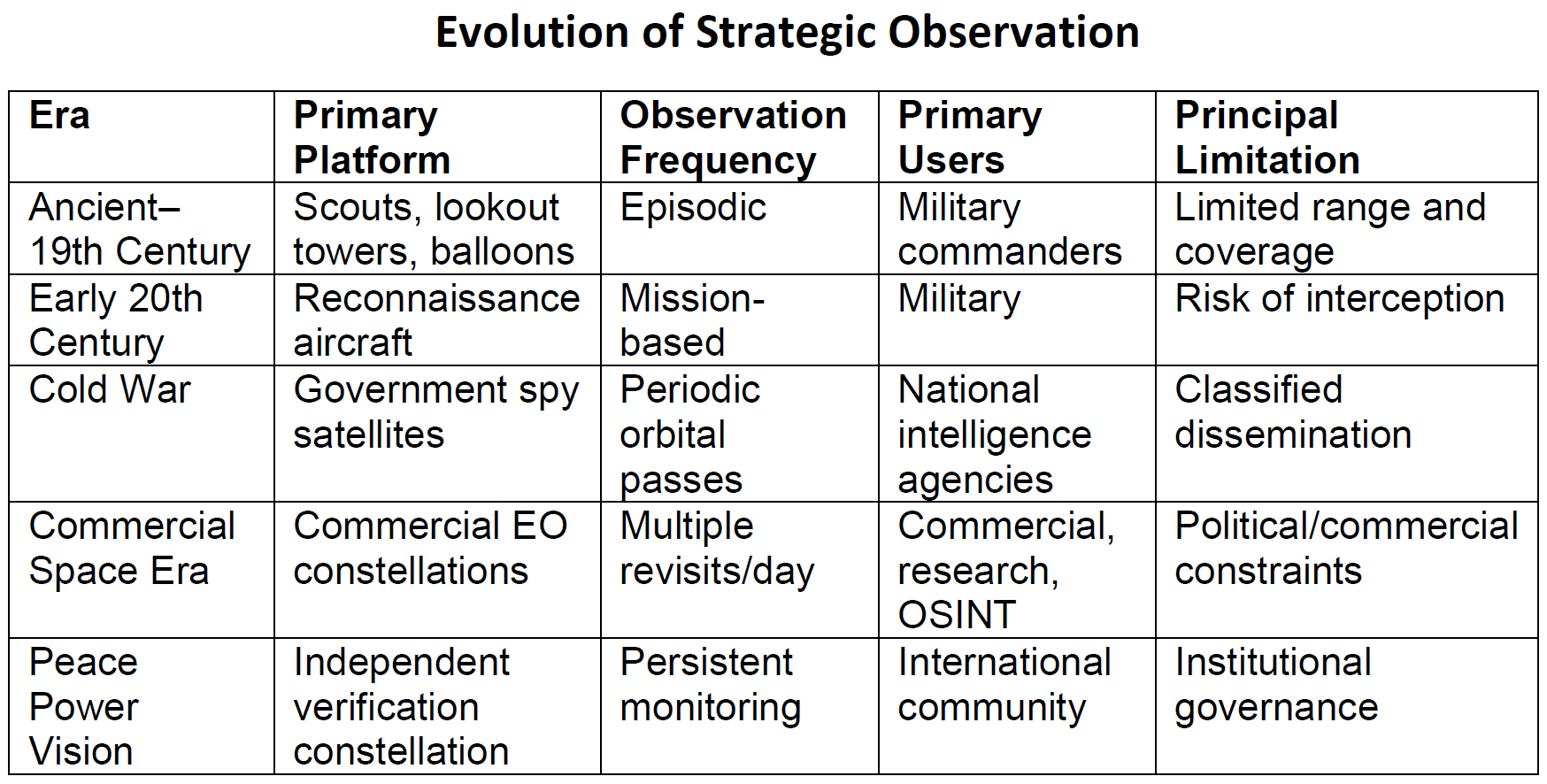
Modern warfare has produced a remarkable paradox. Never before have governments possessed such detailed knowledge of events unfolding across the globe. Military reconnaissance satellites can detect missile deployments, monitor naval movements, identify new construction at military installations, and observe activity across vast regions with remarkable precision. At the same time, international crises increasingly become contests over competing claims about reality. Allegations of treaty violations, disputed border incursions, attacks on civilians, or military mobilizations are often met with conflicting narratives, each supported by selectively released evidence and politically aligned interpretations.
The problem is therefore no longer simply one of information scarcity. It is one of trusted information. Modern intelligence systems reduce uncertainty for individual governments while preserving strategic advantage over potential adversaries. Because their products remain largely classified or selectively disclosed, revolutionary advances in military observation have not produced a corresponding revolution in shared international understanding.
Over the past two decades, however, an important transformation has quietly begun. Commercial earth observation has expanded rapidly through lower launch costs, satellite miniaturization, reusable launch systems, advanced sensors, artificial intelligence, and large constellations capable of observing the Earth’s surface with unprecedented frequency. Capabilities once monopolized by a handful of governments are increasingly available to commercial firms, researchers, humanitarian organizations, journalists, and open-source intelligence investigators. This technological democratization has begun to erode the historic monopoly over strategic observation.
Yet the most significant implications may prove to be institutional rather than technological. Traditional reconnaissance satellites are designed primarily to produce intelligence for individual nations. A new generation of independently governed observation systems could instead produce trusted evidence serving the broader international community. Their principal contribution would not be military superiority but the reduction of uncertainty between states.
This article argues that such systems may represent one of the first practical building blocks of a broader Peace Power architecture. Peace Power seeks to strengthen international security not by reducing defensive capability, but by increasing the production of trusted public evidence. Rather than relying primarily upon idealistic appeals or legal constraints, Peace Power seeks to engineer institutions that reduce the incentives for conflict by improving the quality of trusted information available to all parties. Independent Earth observation cannot eliminate war any more than weather satellites eliminate storms. It can, however, reduce uncertainty, strengthen verification, support diplomacy, and make peaceful resolution more attainable.
The evolution from spy satellites to trust satellites illustrates a broader transition from institutions optimized for information advantage toward institutions capable of producing trusted public knowledge. As persistent global observation matures, the decisive question will no longer be whether humanity possesses the capability to observe the world, but whether it possesses the institutional imagination to use that capability in the service of peace.
The Development of Strategic Observation
Throughout history, the ability to observe an adversary has been one of the principal determinants of military effectiveness. From mounted scouts and signal fires to reconnaissance aircraft and satellites, each advance in observation has reduced uncertainty and expanded the range over which military and political leaders could make informed decisions. The history of reconnaissance is therefore not merely a history of sensors and signals, but of extending humanity’s ability to observe events over progressively greater distances.
The modern era of strategic satellite observation began during the Cold War. Before satellites, governments relied primarily on aircraft reconnaissance, human intelligence, and intercepted communications. These methods often yielded valuable information but remained constrained by geography, weather, political risk, and the possibility of interception. The 1960 downing of the American U-2 reconnaissance aircraft piloted by Francis Gary Powers dramatically illustrated the diplomatic risks of airborne surveillance over hostile territory.
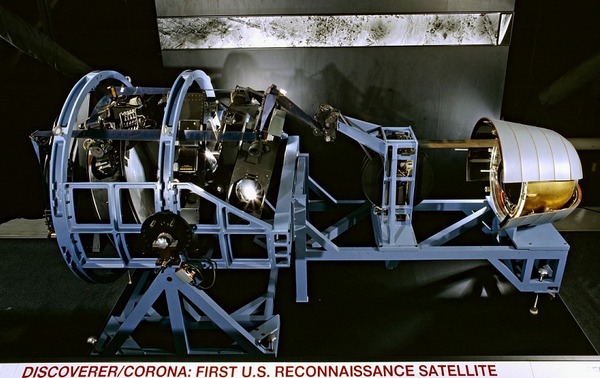
Reconnaissance satellites transformed this landscape. Early systems such as the American CORONA program routinely photographed vast regions from orbit, allowing national leaders to observe missile deployments, military installations, airfields, naval bases, and industrial activity deep within rival territories without violating sovereign airspace. Satellite reconnaissance became one of the quiet stabilizing influences of the Cold War by substantially reducing uncertainty about the strategic capabilities of potential adversaries.
Subsequent decades brought rapid advances in digital imaging, radar sensing, thermal detection, computing, and satellite miniaturization. At the same time, commercial Earth observation emerged as a diverse international industry composed of commercial operators, universities, research organizations, humanitarian groups, and private analytical firms. Hundreds of satellites now operate in coordinated constellations, allowing many locations on Earth to be revisited multiple times each day, while artificial intelligence increasingly assists analysts by identifying changes and detecting anomalies across enormous imagery archives.
This evolution has also changed the meaning of observation. Traditionally, reconnaissance emphasized spatial coverage: What is located at a particular place? Modern Earth observation increasingly emphasizes the temporal dimension: What is changing, how rapidly is it changing, and what patterns emerge through continuous observation? Revisit frequency—the ability to observe the same location repeatedly over time—has become as strategically valuable as geographic coverage itself. Persistent observation can reveal gradual force mobilization, treaty compliance, construction activity, refugee movements, environmental degradation, and repeated ceasefire violations that isolated snapshots cannot detect.
This distinction between observing events and observing behaviors represents one of the most consequential developments in remote sensing. A single satellite image may document military vehicles at a border. A continuous series of observations can reveal whether those vehicles are participating in routine exercises, preparing for invasion, or withdrawing under a negotiated agreement. Trust, whether between individuals or nations, is rarely based on isolated events. It emerges from repeated observation of behavior over time. Modern satellite constellations are therefore creating not simply better imagery, but the technological foundation for persistent, independently verifiable records of behavior.
The next question is not whether humanity can observe the Earth with extraordinary precision. It already can. The more important question is who controls those observations, who can verify them independently, and how they might be transformed from instruments of national advantage into institutions capable of producing trusted public knowledge. Those institutional questions mark the transition from reconnaissance technology to the politics of observation.
The Politics of Observation
Technological capability alone does not determine how information shapes international affairs. Equally important is who controls access to that information, who can examine it independently, and whose interpretation ultimately becomes authoritative. Throughout modern history, strategic observation has been as much an institutional and political resource as a technological achievement.
During the Cold War, satellite reconnaissance substantially reduced uncertainty within governments while doing comparatively little to reduce uncertainty between them. Intelligence agencies acquired unprecedented visibility into military capabilities, missile deployments, and force postures, yet the resulting information remained highly classified. National leaders could make better-informed decisions, but allies, international organizations, journalists, and the broader public remained dependent upon official accounts of what reconnaissance systems had observed.
This asymmetry produced an enduring paradox. The world’s most sophisticated observation systems frequently generated evidence that could not itself become evidence in international debate. Governments understandably protected intelligence sources and methods, but secrecy also meant that many consequential claims could not be independently verified. Foreign governments and international institutions were often asked to accept assertions rather than examine the underlying observations. Trust therefore continued to depend more upon political credibility than transparent evidence.
History offers numerous examples of this dilemma. Intelligence concerning strategic weapons programs, military mobilizations, or treaty compliance has often shaped major policy decisions while remaining inaccessible to outside scrutiny. In some cases, classified assessments proved remarkably accurate. In others, governments reached incorrect conclusions or selectively emphasized evidence supporting preferred policies. The institutional problem was not simply that intelligence could be mistaken. It was that independent verification was frequently impossible.
Commercial Earth observation has begun to alter this relationship. High-resolution imagery is increasingly available from multiple providers operating under different national jurisdictions. Humanitarian organizations document refugee movements. Environmental researchers monitor deforestation and illegal fishing. Journalists and open-source intelligence (OSINT) investigators routinely analyze military activity using commercially available satellite imagery, producing assessments that can be replicated, challenged, and refined by others.
This represents an important shift in the political economy of information. Strategic observation is gradually evolving from a government monopoly toward a distributed ecosystem of evidence production. Multiple observers, using different sensors and operating under different institutional incentives, can increasingly examine the same events and compare their conclusions.
Yet commercial ownership does not automatically produce institutional independence. Governments continue to influence commercial imagery through licensing requirements, export controls, contractual restrictions, national security regulations, and, at times, direct requests to delay or limit publication during military operations. Commercial providers remain subject to national laws, political pressures, shareholder interests, and operational risk.
Recent events illustrate these constraints. For many years, dissemination of high-resolution commercial satellite imagery of Israel and the Palestinian territories was restricted under the United States’ Kyl-Bingaman Amendment. Although those restrictions were substantially relaxed in 2020, widely used public mapping platforms continued for some time to display imagery at lower resolution than was technically available elsewhere. The result was not merely reduced visual fidelity. It complicated independent assessment of settlement expansion, infrastructure development, environmental change, and the humanitarian consequences of armed conflict.
A similar pattern emerged during the recent war with Iran. Several leading commercial Earth observation providers delayed or restricted public access to imagery covering portions of the conflict zone. Some actions reportedly followed government requests, while others reflected company decisions concerning operational security and commercial policy. Regardless of the motivation, the episode demonstrated that commercially operated observation systems remain vulnerable to political and institutional pressures during periods of crisis. Reduced access complicated efforts by journalists, humanitarian organizations, and independent analysts to verify battlefield claims, assess infrastructure damage, and evaluate competing official narratives.
Taken together, these examples illustrate an important distinction. The evolution from government reconnaissance to commercial Earth observation represents a significant advance in transparency, but it does not by itself guarantee independent verification. Commercial imagery democratizes access, yet its availability can still be constrained precisely when objective evidence is most needed.
The central political question has therefore evolved beyond who possesses the most capable satellites. It increasingly concerns who controls access to trusted representations of reality, under what conditions those observations remain available, and whether independent verification can continue during international crises. Those questions point naturally toward the next stage in the evolution of Earth observation: treating satellite observation as a form of international public infrastructure.
Satellite Observation as International Public Infrastructure
If modern Earth observation has transformed humanity’s ability to observe the planet, the next challenge is determining how those capabilities should be organized. The central question is no longer whether satellite systems can collect extraordinary quantities of information. It is whether that information can be transformed into a trusted public resource capable of reducing uncertainty before political disagreements become military confrontations.
Modern societies already rely upon forms of shared infrastructure whose value lies not in serving individual competitors but in providing common services that benefit everyone. Air traffic control enables competing airlines to share the same airspace safely. Weather satellites provide forecasts used simultaneously by governments, farmers, shipping companies, airlines, emergency managers, and ordinary citizens. Global navigation satellite systems support countless commercial and public activities regardless of political affiliation. Their success derives not from serving one participant better than another, but from producing information sufficiently reliable that all participants can coordinate their behavior.
International verification can be understood in much the same way. Rather than functioning as another intelligence service competing with national agencies, an independently governed observation system would provide a common evidentiary foundation upon which diplomacy, humanitarian action, environmental stewardship, and conflict prevention could all depend. Its mission would not be to determine policy or assign political blame. It would be considerably narrower—and ultimately more valuable—to produce trusted observations whose integrity could be independently examined by all interested parties.
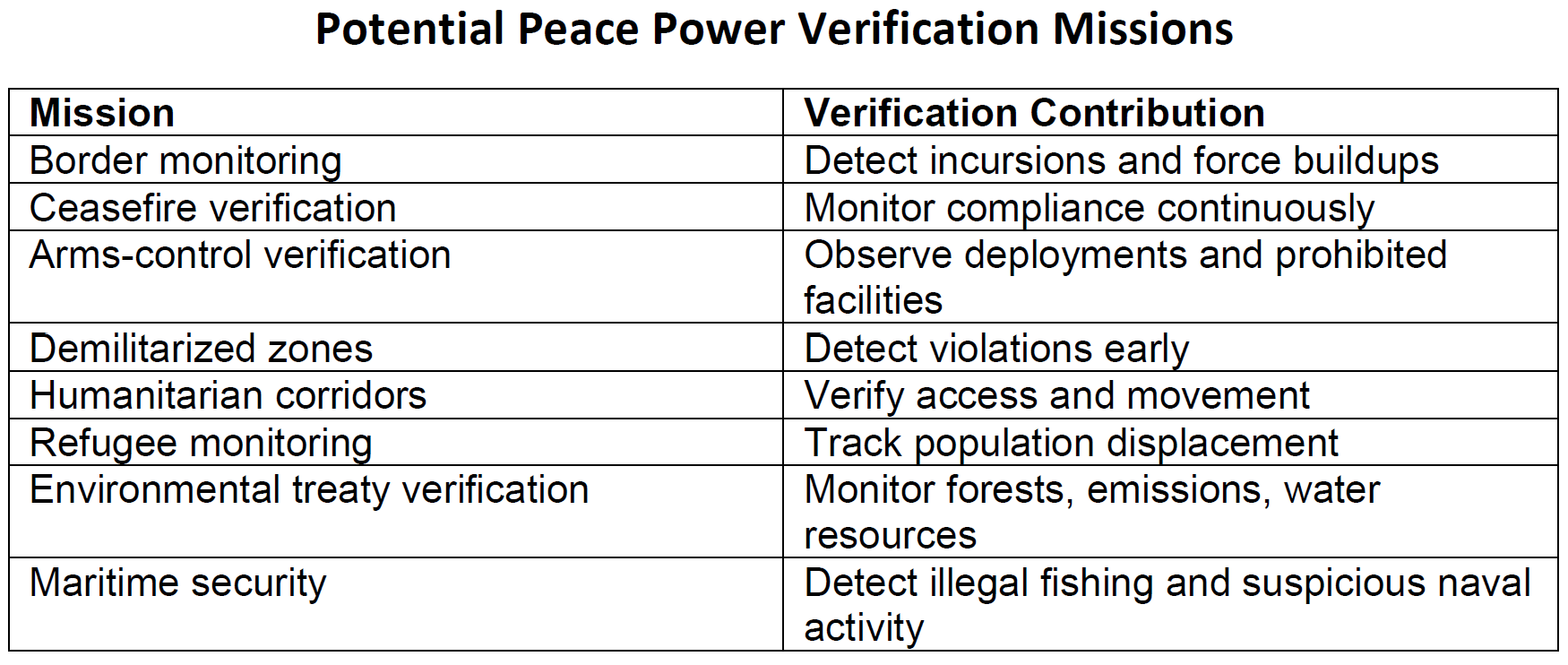
Such a capability would support a remarkably diverse range of applications. Persistent observation could document force mobilizations, monitor demilitarized zones, verify ceasefire compliance, detect prohibited military construction, support future arms-control agreements, assess disaster damage, monitor refugee movements, verify environmental treaties, and document illegal fishing, deforestation, pollution, mining activity, and other changes of international significance. The same technical infrastructure would simultaneously serve scientific, humanitarian, environmental, diplomatic, commercial, and security objectives.
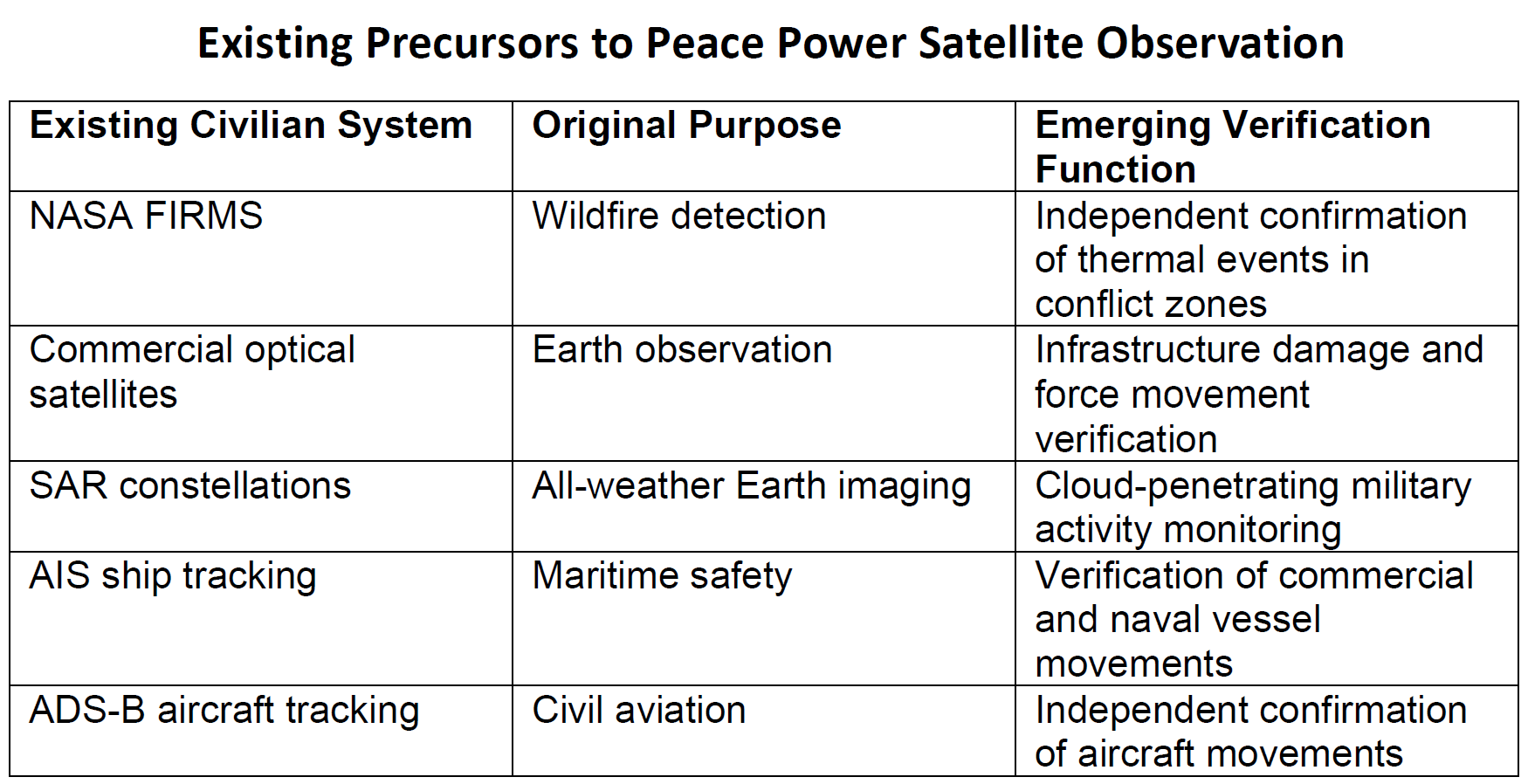
The transition toward publicly accessible verification has already begun. One illustrative example is NASA’s Fire Information for Resource Management System (FIRMS). Developed to provide near-real-time wildfire detection, FIRMS was never intended as a military observation platform. Nevertheless, open-source intelligence investigators increasingly use its publicly available thermal anomaly data to corroborate reports of missile strikes, artillery attacks, ammunition depot explosions, and other battlefield events. Although FIRMS cannot identify the cause of a thermal event or assign responsibility for an attack, it frequently provides independent confirmation that significant activity occurred at a particular place and time.
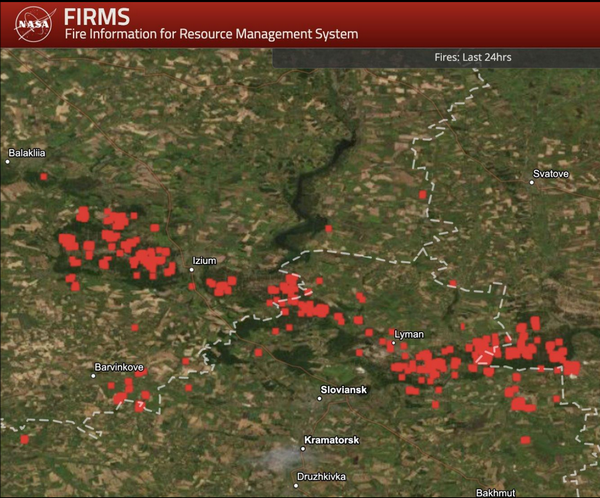
FIRMS image of fire anomalies in region of Ukraine (May, 2022)
FIRMS illustrates a broader principle. Verification capabilities often emerge as secondary applications of systems designed for entirely different civilian purposes. Environmental monitoring, disaster response, agricultural observation, maritime surveillance, and climate science increasingly generate publicly accessible data that can also contribute to independent verification during international crises. Rather than requiring an entirely new technological revolution, Peace Power may evolve by integrating existing civilian observation capabilities into institutions explicitly designed to produce trusted public evidence.
Perhaps the most significant contribution of persistent observation is that it transforms isolated events into measurable patterns of behavior. A single satellite image may reveal military equipment crossing a border. A continuous sequence of observations can distinguish between a temporary exercise, a sustained mobilization, a negotiated withdrawal, or repeated violations of an international agreement. Intelligence traditionally seeks to explain events. Verification seeks to characterize behavior. Trust, whether between individuals, organizations, or nations, depends far more upon consistent patterns of behavior than upon isolated observations.
This distinction has profound institutional implications. Diplomatic negotiations frequently stall because parties disagree about basic factual questions: Has a withdrawal actually occurred? Is a prohibited facility under construction? Are humanitarian corridors functioning? Have environmental commitments been honored? Independent verification cannot eliminate political disagreement, but it can substantially narrow the domain of factual uncertainty within which those disagreements occur.
Better evidence does not guarantee better decisions, but it improves the informational foundation upon which decisions are made. History contains many examples of leaders disregarding objective evidence for political, ideological, or strategic reasons. The purpose of independent verification is therefore not to eliminate error or disagreement, but to reduce the probability that ignorance, misperception, or deception become dispositive in consequential decisions. This systematic engineering of trust-producing institutions is the central idea of Trust Engineering. Like any engineering discipline, it seeks not perfection, but a systematic reduction in the frequency and severity of consequential trust failures.
An independent international observation capability would therefore differ fundamentally from traditional intelligence systems. Rather than producing information that governments may choose to disclose, it would generate evidence designed from its inception to withstand independent scrutiny. Transparency, redundancy, archival permanence, multiple sensor modalities, and publicly auditable analytical methods would become engineering requirements rather than administrative preferences. Confidence would derive not from institutional authority but from the reproducibility of the evidentiary process itself.
Seen from this perspective, independent Earth observation begins to resemble a new category of international infrastructure. Just as weather satellites transformed humanity’s understanding of atmospheric processes, persistent verification systems could transform humanity’s understanding of geopolitical processes. Their greatest contribution would not be improving military targeting. It would be reducing uncertainty sufficiently to support more stable diplomacy, more effective treaty verification, and earlier intervention before local crises evolve into international catastrophes.
Peace Satellites: A Key Enabler of Peace Power
The preceding discussion suggests that the greatest remaining challenge in Earth observation is no longer technological. It is institutional. Humanity already possesses the ability to observe much of the planet with extraordinary precision and increasing persistence. What remains largely absent is an international capability explicitly designed to transform those observations into trusted public evidence. This distinction is fundamental. Spy satellites serve competing national interests. Peace Satellites serve the interest of global security.
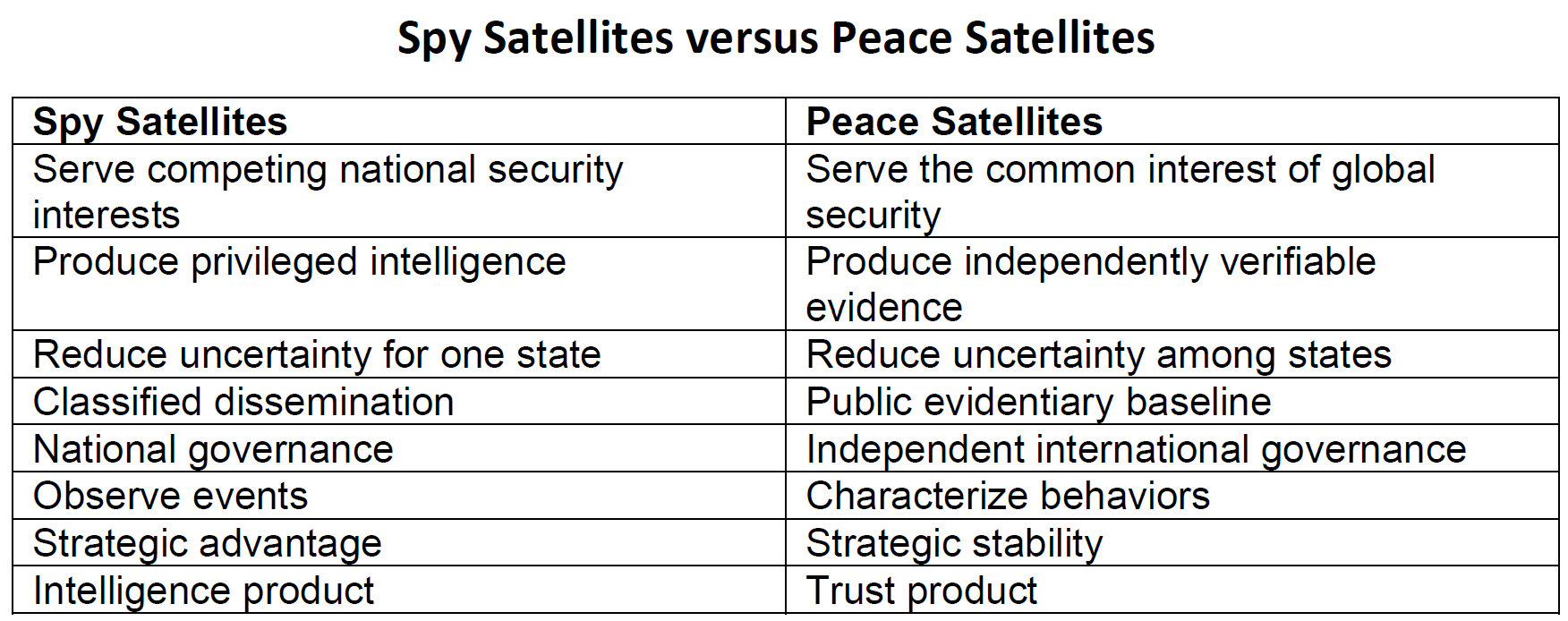
Traditional reconnaissance systems advance the security interests of individual states operating within a competitive international system. Peace Satellites would pursue a different objective: producing independently verifiable evidence that reduces uncertainty among all participants. Their purpose would not be to replace national intelligence capabilities, but to complement them with a trusted evidentiary foundation supporting diplomacy, treaty verification, humanitarian action, and conflict prevention. The defining characteristics of a Peace Satellite system therefore lie less in its sensors than in its governance.Five institutional principles follow naturally.
Operational independence. Observation priorities, data collection, and publication policies should not be subject to unilateral direction by any participating nation. Institutional independence distinguishes an international verification capability from another national reconnaissance system.
Transparency. The methods used to collect, process, archive, and analyze observations should themselves be open to independent examination. Confidence should derive from the reproducibility of the process rather than confidence in the institution.
Redundancy. Multiple satellites, sensor types, analytical methods, and independent organizations should observe the same events whenever practical. Modern engineering routinely achieves reliable systems from imperfect components through redundancy. Trust production should follow the same principle.
Persistence. Continuous observation transforms isolated events into behavioral histories, permitting independent evaluation of treaty compliance, military restraint, environmental stewardship, and humanitarian conditions over time. Trust depends upon demonstrated patterns of conduct rather than isolated observations.
Open access. Governments will continue to possess classified intelligence capabilities for legitimate national security purposes. A Peace Satellite system would instead establish a common evidentiary foundation available to governments, international organizations, humanitarian agencies, researchers, journalists, and the public. National intelligence would remain free to supplement this shared foundation, but it would no longer constitute the only basis upon which important international claims could be evaluated.
These principles also illustrate an important characteristic of Peace Power itself. Peace Power is not conceived as a single institution or comprehensive treaty. Like other mature public infrastructures, it emerges incrementally as interoperable capabilities are developed to solve specific trust problems. Independent satellite verification represents one such capability. Future components might include distributed treaty monitoring, international sensor networks, authenticated digital evidence systems, AI-assisted verification platforms, and other trust-producing institutions yet to be developed.
This incremental approach reflects a broader engineering philosophy. Complex systems rarely appear fully formed. They evolve by adding reliable components that strengthen the architecture as a whole. Trust Satellites therefore represent not the completion of Peace Power, but one of its first practical building blocks.
Their significance ultimately extends beyond remote sensing. They illustrate a broader proposition underlying Trust Engineering: institutions can be deliberately designed to produce trust through independently verifiable evidence rather than relying primarily upon authority, reputation, or coercive power. If successful, the principles demonstrated in Earth observation could gradually inform the design of many other international institutions whose effectiveness likewise depends upon reducing uncertainty before conflict emerges.
The Feasibility of Independent Global Satellite Observation
The proposal for an independently governed global verification capability may initially appear ambitious. Yet recent developments in Earth observation suggest precisely the opposite. During the past two decades, the cost of placing sophisticated sensing capabilities into orbit has fallen dramatically while their performance has increased at an extraordinary pace. What once required the resources of a superpower is increasingly within the reach of commercial firms, research institutions, and international partnerships.
Several technological trends have driven this transformation. Reusable launch systems, satellite miniaturization, large commercial constellations, cloud computing, and artificial intelligence have collectively reduced costs while expanding observational capability. Many locations on Earth can now be revisited multiple times each day, and AI increasingly assists analysts by detecting changes and identifying significant patterns across vast imagery archives. The technological foundations of persistent global observation already exist.
The significance of these developments is institutional rather than technological. During much of the Cold War, independent global verification would have been prohibitively expensive and technically impractical. Today, many of the required capabilities already exist within the commercial marketplace. The remaining challenge is no longer one of engineering feasibility but of institutional organization.
This also reframes the traditional “swords to plowshares” debate. Rather than converting military industries into entirely different forms of production, the same aerospace companies, launch providers, software developers, sensor manufacturers, and AI specialists that currently support national security missions already possess the expertise required to support an international verification infrastructure. The engineering disciplines remain largely unchanged. What changes is the institutional purpose toward which those capabilities are directed.
The value of such a system would extend well beyond conflict prevention. The same observation infrastructure could simultaneously support agriculture, disaster response, climate monitoring, environmental treaty verification, maritime safety, infrastructure planning, humanitarian relief, insurance, scientific research, and public health. Like weather satellites, global navigation systems, and the Internet, an international verification capability would generate benefits across numerous domains while strengthening the reliability of the global information environment.
Perhaps most importantly, independently verifiable evidence possesses economic value that conventional accounting rarely captures. Military conflict, humanitarian disasters, sanctions, disrupted trade, refugee flows, and reconstruction impose enormous costs upon the international system. If persistent verification can prevent even a small number of crises from escalating into armed conflict, its return would be measured not merely in financial savings but in preserved human lives, political stability, and avoided destruction. Trust, in this sense, is not simply an ethical aspiration. It is productive infrastructure.
The evolution of Earth observation has therefore reached an important inflection point. For the first time in history, humanity possesses both the technological capability and the economic means to construct institutions dedicated not merely to observing the planet, but to producing trusted public evidence on behalf of the international community. The remaining challenge is political, institutional, and ultimately civilizational.
Trust Engineering and the Future of Arms Control
The history of arms control illustrates a recurring paradox. Nations repeatedly recognize the mutual benefits of limiting dangerous weapons systems, reducing military deployments, or constraining destabilizing technologies, yet many agreements gradually weaken because confidence in compliance erodes over time. The fundamental challenge is often not diplomacy itself, but verification.
Verification has always occupied an uneasy position within international security. States understandably hesitate to expose sensitive military capabilities to foreign inspection, while inspections that are too infrequent or too limited provide insufficient confidence that agreements are being honored. As strategic competition intensifies, incentives to conceal prohibited activities, exploit ambiguities, or exaggerate compliance increase correspondingly. Confidence gradually gives way to suspicion, and suspicion eventually undermines the agreement itself.
As the historical examples summarized in the table below illustrate, major arms-control agreements have repeatedly encountered the same engineering challenge: sustaining confidence in compliance as political conditions evolve. Initial confidence encourages cooperation, but as independent verification weakens, uncertainty gradually accumulates. Suspicion replaces confidence, reciprocal accusations replace shared evidence, and the political incentives sustaining the agreement begin to erode. What is commonly interpreted as treaty failure is often more accurately understood as an institutional failure of trust production.
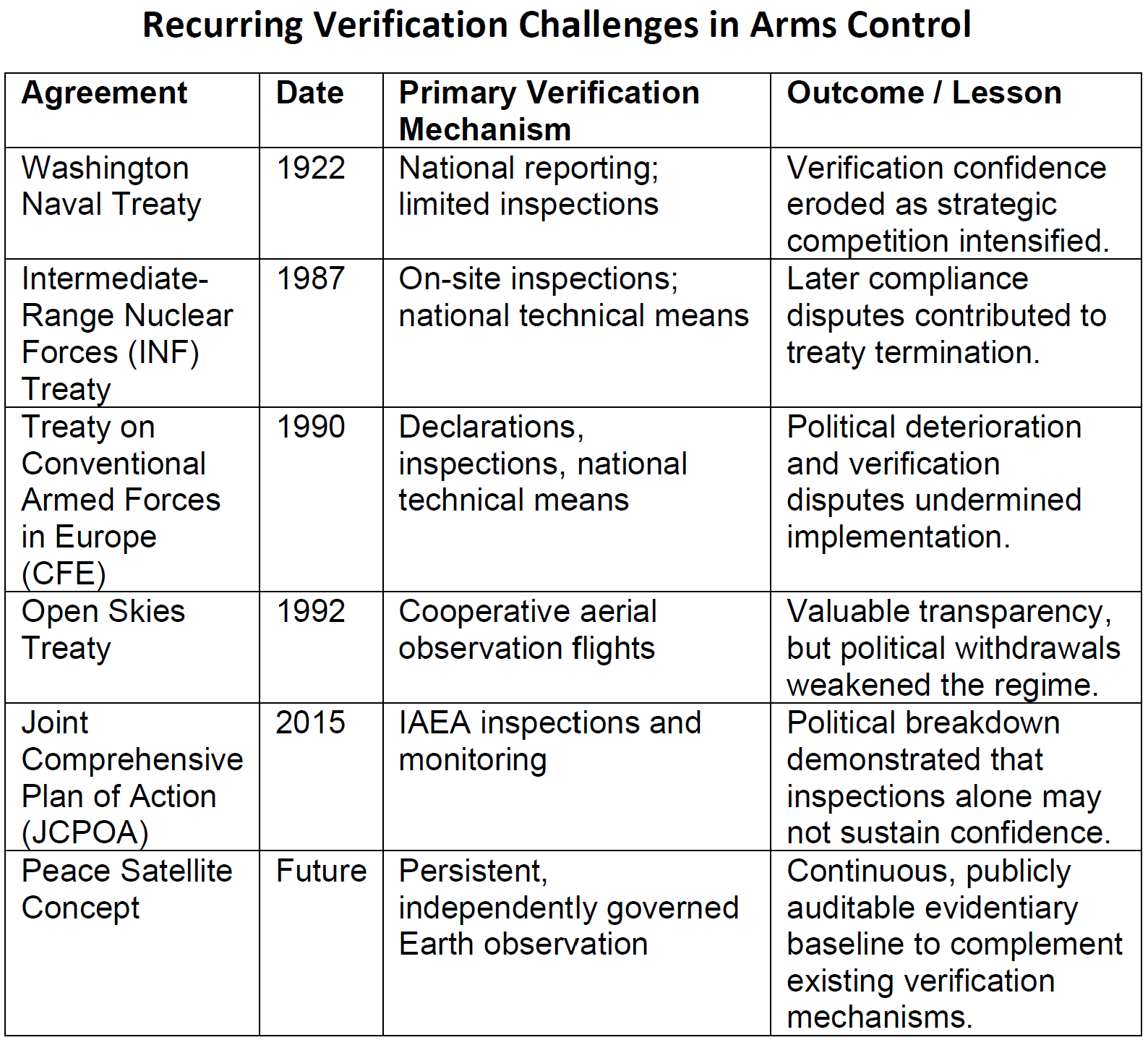
From the perspective of Trust Engineering, this outcome is predictable. Durable cooperation cannot be sustained when participants possess fundamentally different views of observable reality. Every consequential agreement depends upon the continued production of trusted evidence. When that evidence becomes fragmented, inaccessible, or politically contested, the agreement itself begins to lose structural integrity.
Persistent, independently governed Earth observation offers a fundamentally different model. Rather than relying primarily upon episodic inspections, classified intelligence, or competing national claims, future verification architectures could generate continuous, independently reproducible records of relevant activities. Military construction, force mobilization, missile deployments, buffer-zone compliance, ceasefire observance, and environmental treaty provisions could all be evaluated against shared evidentiary baselines available to every participant.
The significance of this shift extends well beyond technical verification. Continuous observation transforms verification from an occasional diplomatic event into an ongoing institutional process. Instead of investigating compliance only after suspicions arise, independently governed verification systems could continuously monitor behavior, identify anomalies requiring investigation, and provide early warning before confidence deteriorates into confrontation. Trust becomes a continuously maintained property of the verification architecture rather than a fragile political assumption.
Such capabilities would not eliminate the need for diplomacy, negotiation, or national intelligence. States would continue to maintain independent reconnaissance systems and pursue legitimate security interests. Peace Power proposes something different: a complementary layer of trusted public verification that reduces uncertainty among all participants. National intelligence would remain competitive, while the evidentiary foundation supporting diplomacy would increasingly become cooperative.
Successful engineering systems rarely rely upon single points of trust. Aviation depends upon redundant navigation, independent inspections, standardized procedures, and continuous monitoring. Financial systems employ auditing and distributed verification. Digital communications achieve reliability through error detection and correction rather than assuming perfect transmission. Arms control has historically lacked comparable trust-producing architecture. Independent Earth observation offers the opportunity to begin constructing one.
Viewed in this light, Peace Satellites represent considerably more than another application of remote sensing technology. They become one of the enabling institutions through which Peace Power may gradually emerge by improving the quality of shared evidence before disagreement escalates into conflict.
Conclusion
The development of satellite reconnaissance now affords the world an opportunity to apply this technology to the cause of world peace. Commercial Earth observation, artificial intelligence, extensive satellite constellations, and distributed analytical communities have fundamentally altered humanity’s ability to observe events almost anywhere on Earth. This capability promises new means of providing accurate, unbiased information to help avert and resolve conflicts.
The remaining challenge is institutional. Modern societies have repeatedly demonstrated that shared infrastructure can produce public goods unavailable through purely competitive systems. Weather satellites, global navigation systems, and air traffic control all generate trusted information upon which participants with differing interests routinely depend. Extending this principle to international security represents the next logical step in the evolution of Earth observation.
Peace Satellites would not replace national intelligence services or diminish legitimate national security interests. Spy satellites serve competing national interests. Peace Satellites serve the common interest of global security. By producing independently verifiable evidence, they would complement existing institutions with a trusted evidentiary foundation supporting diplomacy, humanitarian action, environmental stewardship, crisis management, and future arms-control agreements.
Peace Power should therefore not be understood as a utopian alternative to existing security institutions. It is better understood as a missing layer of civilizational infrastructure. Throughout history, societies have invested enormous resources in projecting power, deterring adversaries, and preparing for war. Comparatively little effort has been devoted to engineering institutions whose primary purpose is the systematic production of trusted public knowledge to secure peace.
More than half a century ago, anti-war demonstrators adopted the slogan, “The whole world is watching.” At the time, the phrase expressed the hope that public visibility might restrain violence. Today, advances in Earth observation make it possible to transform that aspiration into a permanent institutional capability supporting peace. If independently governed verification systems become part of a future Peace Power architecture, the whole world really will be watching—not to celebrate conflict or assign blame after the fact, but to produce the trusted evidence needed to help prevent destructive conflict before it begins.
The evolution from spy satellites to Peace Satellites therefore represents more than an advance in remote sensing. It marks the beginning of a broader transition from restricted knowledge for competitive national military advantage toward trusted public knowledge as an instrument of international security. If that transition succeeds, future historians may conclude that the greatest contribution of satellite reconnaissance was not that it helped nations prepare for war, but that it helped humanity to secure peace.