via gainspainscapital
A couple of weeks. That’s all it took to erase three months’ worth of gains.
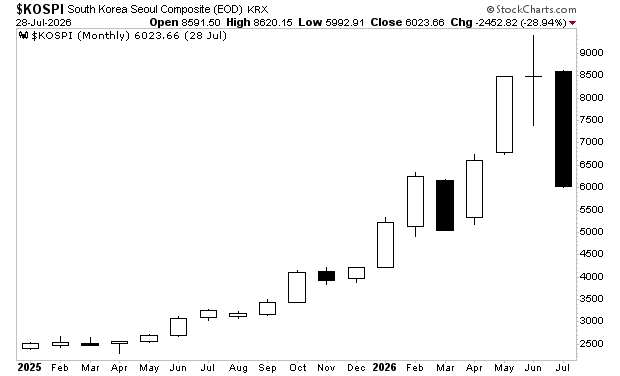
The Kospi tanked 11.4 percent on Wednesday to 5,338.56, with SK Hynix down 18 percent and Samsung falling 12.5 percent, extending an almost 11 percent dive from the day before. The two day decline now exceeds 18 percent, and the Kospi is on course for a record monthly loss after slumping more than 30 percent in July alone.
Thirty percent in one month. That is what happens when an entire national index gets reduced to a bet on two companies, and when everyone in the country decides to lever up on that bet at the same time.
Start with the money that came in before this.
Samsung and SK Hynix were set to pay out a combined 67 trillion won, roughly 44 billion dollars, in performance bonuses to employees this year. Some Samsung workers were in line for payouts up to 626 million won, more than 400,000 dollars, after the company broke its own bonus cap. Semiconductor employees in their 30s and 40s started flooding Ferrari, Porsche, and Mercedes showrooms near the Icheon and Hwaseong plants. Apartment prices in the surrounding districts of Gyeonggi Province climbed week after week. That is not a stock market story anymore. That is an entire regional economy built on the assumption that two companies’ profits would keep compounding forever.
Then the retail public piled in on top of it, on borrowed money. In late May, Korea opened its market to single stock 2x leveraged ETFs tied to Samsung and SK Hynix for the first time. Retail investors poured in so hard that these products accounted for as much as 92 percent retail ownership, and at their peak the three largest SK Hynix leveraged ETFs held more than 23 billion dollars combined, over two and a half times the stock’s average daily trading volume. Traditional margin lending hit a record 38.6 trillion won, about 26 billion dollars, on June 24. Margin loans tied to just these two stocks went from 2.53 trillion won at the end of last year to 9.1 trillion won by June, a nearly fourfold increase in six months.
The Bank of Korea warned about exactly this in a report last month, flagging that leveraged retail positioning had hit record highs and was heavily concentrated in semiconductors, with fear of missing out driving people to borrow to chase the rally. Regulators eventually raised the minimum cash margin on these leveraged products from 3 million won to 30 million won. It didn’t matter. The mechanism was already loaded.
Leveraged ETFs rebalance daily, which means they amplify losses on the way down the same way they amplified gains on the way up. Once SK Hynix and Samsung started falling, the ETFs sold into the decline mechanically, which pushed prices lower, which triggered more selling. In a single week, an estimated 320,000 to 460,000 retail accounts were fully liquidated, 1.2 million people received margin calls, and roughly 34 trillion won, about 23 billion dollars, evaporated from retail margin accounts. That is one in every 30 adults in the country getting a margin call notice. SK Hynix fell nearly 40 percent from its peak and Samsung nearly 30 percent before this week’s fresh leg down even started. Traders who thought they’d found a way to make five years of salary in a few months are now describing losing five years of savings instead.
Samsung and SK Hynix are not the problem. They manufacture chips with real, growing demand behind them, and their earnings back that up. The problem was a market where two stocks became half the index, where a national bonus windfall turned into a luxury spending spree, and where retail traders layered leveraged ETFs and margin debt on top of an already concentrated bet. That combination doesn’t need a crisis to unwind. It just needs one disappointing earnings call.