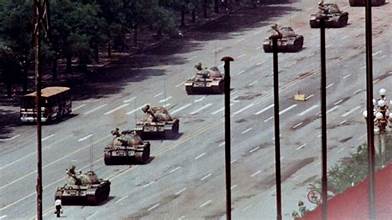
Thirty-seven years have passed since the events of June 4, 1989, and yet the Chinese government continues to devote enormous resources to preventing people from remembering it. That fact alone should tell you how significant the event remains.
According to reports, authorities this year blocked relatives of victims from visiting graves in Beijing. Members of the Tiananmen Mothers group, who for decades quietly visited cemeteries to honor family members killed during the crackdown, were reportedly warned not to attend. In Hong Kong, police maintained a heavy security presence around Victoria Park, where annual candlelight vigils once drew tens of thousands of people. Even symbolic acts of remembrance have increasingly resulted in police intervention.
Governments always claim that history belongs in the past. Yet when they continue fighting battles over memory decades later, it reveals that history is still influencing the present. The Soviet Union spent generations attempting to control historical narratives. Eastern European governments did the same. Military regimes throughout Latin America followed similar patterns. Every government eventually discovers that controlling information is far easier than controlling memory.
What interests me is the contrast between economic and political development. Since 1989, China transformed itself from a developing nation into the world’s second-largest economy. Hundreds of millions of people were lifted out of poverty. Entire cities emerged where farmland once stood. High-speed rail networks, modern ports, and industrial infrastructure appeared on a scale rarely seen in human history. Yet despite all of that economic progress, June 4 remains one of the most tightly controlled subjects in the country.
The official death toll from the crackdown remains disputed. Estimates have ranged from hundreds to potentially thousands of casualties. What is not disputed is that the event fundamentally changed China’s future. Political liberalization largely ended. Economic development accelerated, and stability became the overriding objective of government policy. The modern Chinese state that emerged over the following three decades was shaped directly by those decisions.
Today, China faces a very different set of challenges. Economic growth has slowed from the extraordinary rates that characterized earlier decades. Demographic pressures are mounting. Debt levels have risen substantially. Relations with the United States and its allies have deteriorated. Military tensions surrounding Taiwan continue to increase. Yet despite these new concerns, authorities remain determined to prevent any public discussion of the events of 1989.
History has always been one of the most powerful forces in politics. Politicians believe they shape history. More often than not, history shapes them. The fact that governments, activists, families, and foreign leaders are still arguing over events that occurred thirty-seven years ago demonstrates that certain moments never truly disappear. They simply become part of the foundation upon which future generations build their understanding of the world.
The lesson is not unique to China. Every government wants to write its own version of history. Very few succeed in making people forget it.