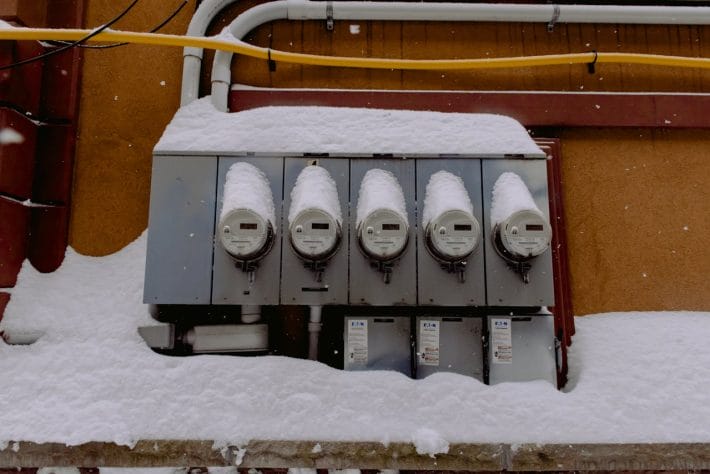
With all eyes on the winter storm raging through America last month, a silent hero was working in the background to keep the lights on. And I don’t primarily mean the emergency workers or the teams of electricians, foresters, and engineers that keep the power lines up and ice-free; these guys operate very much in the foreground, the public well aware of their critical work.
Before and during winter storms, the electricity supply becomes strained and household demand spikes—think space heaters, heat pumps requiring more juice, more lights turned on, and the natural gas system requiring more electricity for ordinary functions. In Econ101 lingo, the grid is hit with a simultaneous leftward shift in supply and rightward shift in demand, explaining why electricity prices and natural gas prices shot up in recent days.
Most people think of electricity (or “energy” more broadly) as a static resource, at civilization’s disposal and always available at the literal flick of a switch. That’s true for gasoline in a car tank, liquid and stable when unused. Electricity, rather, is a constant flow where the push of a button either redirects it from elsewhere or informs the generators or reactors to produce more, or idly spinning back-up turbines to re-engage.
Some countries, like my home Iceland, use aluminum smelters as this electrical grid backstop, a rapacious consumer that could use more or less electricity to run the Hall-Héroult process—dissolving aluminum oxide in molten cryolite—faster or slower. Some four-fifths of all electricity generated in the (electrically-isolated) island country is used for metal production, filling the gap between renewable production (dispatchable hydro and constant geothermal) and variable demand, always able to give back power to the grid when necessary.
The Texas grid, for instance, doesn’t have a vast aluminum industry backstopping its industry and millions of households. How, then, does the state and its grid operator ERCOT source the additional gigawatts on a whim, electricity being an on-demand, always-clearing, flow resource? You might think “more generation,” which to some extent is true: In a natural gas or hydroelectric plant, you turn up the dial; with excess wind turbines running idle, you can order them to re-engage. But in a grid like Texas’s that has outsourced so much of its electricity to nature (solar and wind), you also need other mechanisms for dealing with peak demands or winter storms; it’s too late to start building new generation a week before the storm lands.
While some media outlets have pointed to Texas having “nearly 10 times as much battery capacity on the grid” now compared to the devastating storm five years ago, the missing component is the arrival of Bitcoin miners, able and willing to shut off on short notice; from the grid’s point of view, miners are functionally the same as massive, spread-out batteries. In the last four years or so, the US’s role in global Bitcoin mining has increased considerably, fueled in part by the China exodus and accommodating policies in, for example, Texas and Tennessee. Federally, too, the current administration has famously (and mostly rhetorically since the statement doesn’t make any sense), said it wants the remaining Bitcoin “to be mined in America.”
Ordinarily, Bitcoin miners run electricity through a barebones computer to generate bitcoin. Most of the industrial-scale ones engage in demand-response programs that—when ordered by the grid (and reimbursed accordingly)—will shut off their machines and thus return the electricity flow back to the grid. This is akin to the grid taking out electricity supply insurance; like a battery, but less duplicative or wasteful. In contrast, backup power like unengaged wind turbines or topped-up battery facilities are expensive, overbuilt, and economically inefficient. By having a sizable number of Bitcoin miners around, you can effectively outsource this backup function to an always-on, always-hungry consumer like Bitcoin miners.
Even though Bitcoin miners only consume a few percentage points of ERCOT’s grid generation, they’re the most flexible percentages—able and willing to give it all back to the grid at a moment’s notice. “Bitcoin miners provide a flexible load in a way no other industrial use case can,” remarks Ella Hough for Cornell University on the Texas power grid. Riot Platforms—a Texas-based Bitcoin miner—reported curtailment credits of roughly 15 percent of its electricity cost in 2024.
Note that these payments are not subsidies, like so much in the green energy sector, but payments for specific services rendered: think of participating in demand-response programs like an insurance contract. The unique difference for a miner compared to any other user of electricity, AI or other data centers included, is that they’re untroubled by turning off—in fact, most mining facilities schedule specific maintenance or repairs during curtailment times. In exchange for a fee—or technically, a discount on their total electricity bill—their operations can be shut down (and turned on later) without operational loss.
When I explored these topics in an article for The Daily Economy two years ago, I wrote:
The reason that the grid is strained during a cold snap is the same reason power users place a very high value on their electricity use. The supply gets squeezed precisely at the time consumer demand becomes price inelastic, with heating and lighting homes becoming next to infinitely valuable in a pickle.
The hashrate—the amount of computing power operating on the Bitcoin blockchain at any given time—dropped by about a third in recent days, explained largely by the hundreds of etahash (a measure of Bitcoin mining output) of Bitcoin mining capacity participating in such demand-response programs.
Seeing the hashrate estimator on my home-miner device show hashrate around 650 EH/s rather than 1,150 EH/s a few days before was stunning and illustrative: Every bit of electricity that previously powered the Bitcoin network was instead redirected to power space heaters and light and urgently needed additional machinery in storm-affected areas. Wins all around: The remaining miners on the Bitcoin network temporarily earn higher rewards from less competition (though blocks came in somewhat slower), the miners receive lucrative curtailment credits, and consumers have more electricity at their disposal.
It is the ultimate electricity consumer of last resort, in ordinary times grateful for every watt assigned to it, yet happy to immediately surrender it when there’s more valuable usage elsewhere—functionally being outbid by millions of households in need of extra power. Bitcoin miners are the opposite, happy to absorb any and all excess, stranded, overbuilt energy—and then give it all back when the grid needs it the most.
Magic internet money Bitcoin may be, but its positive spill-over effects on electricity grids around the world might be even more important than the asset itself. Stress-tests like the storm that engulfed most of the eastern and southern US in January show the power of that institutional backup.