Celsius Holdings (CELH) update, earnings — insider buying this week
Goosehead, PAR Technology and Galaxy Digital have been unlocked, Lock Box returns have improved… but are also trailing much worse now, largely because they’ve missed out on most of the semiconductor surge this year (other than our InTEST position, which has joined the “almost doubled” club in that portfolio). Which at the least reminds us that it’s tough to beat a market cap-weighted index, and harder still when momentum stocks are doing well (or when, as I certainly did with several of these Lock Box positions, you overpay for the wrong stocks).
I’m holding PAR in my regular portfolio, though continue to believe that we’re “on hold” and I won’t be buying more until we see if they can really create the sustainable software business that they’ve been promising — it’s getting closer, but at the same time that investors are fairly dramatically losing their patience with PAR, and with small software stocks in general.
But I don’t think we have the growth to keep holding PAR in the Lock Box portfolio, and it will be useful to take some more losses to offset gains, so I’m selling that one.
Goosehead is a good story that hasn’t proven it can compete in a shifting and always-competitive insurance sales market. They’ve done some very good things, and been through a tough reorganization that took a couple years, and they have some real ambition to build a platform for online insurance comparison shopping and selling, on top of a franchised network of insurance salespeople. It’s admirable that they have been able to get growth going, at least a little bit, despite the much lower level of home sales, since home sales are their core “new customer” business and the realtors and mortgage brokers are the source of most of their leads. And it might work out… but given the competition in the insurance space, and the tough operating environment right now, I don’t think that Goosehead has the ability to build this business rapidly, that would just take dramatically more marketing spend than seems likely to come out of this very capital-light and family-controlled business. I like the agency business, and I really like the capital-efficient franchise business they’ve built on top of that, it had (and probably still has) the potential to work out magically well… but it hasn’t yet, and I think the competition has gotten much better for these core individual insurance policies (auto and homeowners), including the direct-sales competition from major operators like Progressive, who can spend more on advertising in a week than Goosehead can generate in sales in a year, and I just think the odds of success are much lower now than was my belief five years ago.
Maybe I’m wrong, time will tell… but much as I’m also concerned about their potential growth, I might even consider buying Lemonade (LMND) over Goosehead these days, just because they have at least built out a direct sales business that has some meaningful growth, and have begun to layer a little bit of rational spending control on top of that.
Galaxy Digital I own not just because I wanted some cryptocurrency exposure in the Lock Box, but because I thought they were well-positioned to be a real gatekeeper for cryptocurrency investment by institutions. That gatekeeper role has really become much less obvious now, with so many very easy ways to buy into all the major cryptocurrencies, so I no longer have a lot of confidence that Mike Novogratz is building something that might become a “Goldman Sachs of Crypto” type company, there just isn’t much evidence to support that today.
And that’s most easily evidenced by the relative performance of Galaxy Digital and Bitcoin since I added Galaxy to the Lock Box. Despite the boost of (eventually) getting that NY listing, which came much later than we had expected, and despite a decent recovery in Bitcoin prices and generally rising acceptance of Bitcoin as a “real” asset among institutional investors, Galaxy Digital has failed to really create shareholder value… and that’s despite the fact that their assets under management have ballooned during those five years, from just over $1 billion to more than $5 billion.
It’s not a terrible company, it has almost kept up with Bitcoin through the collapse and recovery during the past five years… but it’s also not profitable, and to my eyes it has not proven an ability to invest in great companies or be an unusually strong asset manager within the crypto space, so I’ll take my (modest) profit and go home. It’s probably still reasonable to have some speculative crypto investment in any kind of long-term growth portfolio, so it’s a shame that we lack that now, but I don’t see any great reasons to keep this investment locked up.
So that’s three more sales from the Lock Box… and yes, I’m also looking at potential buys for that portfolio, but none that were purchased this week — I may have a new Lock Box candidate to talk about soon.
I’ve written some general comments about being worried about market valuations this year, as some markets lunge into bubble territory and enthusiasm for the riskiest assets picks up, and the market booms on… but the reasons for caution keep popping up every week, too. Inflation remains hot and is generally getting a little worse, though investors seem very willing to look past the current war and imagine the nice, clean recovery, with oil prices falling sharply.
Higher living expenses have helped credit card and auto loan delinquencies creep steadily upward, with credit card delinquencies in particular almost back to the level they hit at the worst of the great financial crisis, and with auto loan delinquencies at new 21st century highs already (unemployment lingered near 10% for a while in 2009-2010, so it’s shocking that delinquencies are piling up at similar or higher rates when unemployment is at 4%, with about 13% of credit card balances and more than 5% of auto loan balances more than 90 days delinquent… really reinforcing how overextended the whole country got in the wake of COVID and the massive stimulus programs, and how unprepared we all were for the stress of the big spike in inflation that followed). People are perhaps not broadly in crisis, mortgage delinquencies remain historically low and un-worrisome… but home ownership among those under 50 is also historically pretty low right now, even after it bounced back a bit during the pandemic, before mortgage rates climbed in 2023, and credit card and auto loans feel like a harbinger of inflation stress.
And the stock market is in a historic boom — not quite an all-time bull market, but pretty close, and the signs of a potential bubble forming in some extremely popular sectors are everywhere. We are definitely in an “exuberance” stage, driven in large part by enthusiasm for the AI investment cycle, rising defense spending, and the somewhat related space and aerospace boom, though I don’t know if we’ve reached the “irrational exuberance” part of the cycle just yet.
What do I want to own in my portfolio? I want to build a portfolio that compounds in value over time at a rate meaningfully above inflation, and is more resilient than the S&P 500 during market downturns… and for that, I’m willing to risk a portfolio that might grow less than the S&P 500 during boom times (like now), even if that boom might continue for years before it runs out of steam.
That’s mostly just because we’ve rarely never seen the market boom like this, and the likelihood of a reversion to the mean is very high, eventually. The average total return of the S&P 500 over the past ten years is a hair above 15%/year now, which is not best market of the modern era, that title belongs to the extraordinary market of the late 1990s, when a couple of the rolling ten year periods generated total returns of 20%/year… but it’s getting pretty close, and the past six years have provided average annual returns in the 18% neighborhood.
There are few historical parallels to this kind of market boom, other than the tech boom of 1995-2000… and for those who are at a point in their lives where a 40% market drop would meaningfully reshape their financial plans (which mostly means “anyone within five years of retirement, or in retirement”), that’s potentially worrisome, because the 2000s were essentially a lost decade. Investors who bought into the S&P 500 in 2000, would have looked at their account in 2010 and seen just about the same amount of money they started with.
Everyone over a certain age knows that intuitively, I suppose, but shifting family priorities have brought that into clearer focus for me of late. Which means that although I do think that my portfolio is already pretty resilient, I’m not heavily overweight the AI story and haven’t double down on the most speculative stuff, I decided this week to do a little rebalancing around the edges. That means reducing my stock market exposure a little bit, beginning to add some more non-correlated asset exposure, and boosting my optionality for whatever the future brings.
Because of the fact that my portfolio has grown more stock-heavy over the years, rebalancing means selling some positions, either in whole or in part, that I like and would prefer to hold. The candidates for culling which come to my attention most are the stocks with meaningful outperformance that are trading above my “max buy” price, and, as I look over my portfolio with a more jaundiced eye, the stocks which are offering me “equity risk,” including meaningful risk of decline and permanent loss of value, but very little hope for near-term meaningful gains. Both of those are judgement calls, but I’m trying to also be a little bit mechanical in my judgement.
So I sifted through those candidates, tried to look at them with new eyes, and decided to sell 10% each of half a dozen “winning” positions that are above my buy range, and 100% of the large position in which I have the least confidence. The most rational ways to sell down some positions to generate capital to rebalance are either selling overvalued positions with strong recent performance, or selling positions which have hit stop loss levels, especially if my assessment about any of those companies has turned more negative… and I’ve effectively done a bit of both. That clears up enough cash to add some optionality to the portfolio, and also to begin to build a position in a nicely non-correlated asset class that I hope will become meaningful over time.
This period of reflection has also called my attention to some really weak performance in some mutual fund positions that I’ve mostly held and ignored for a very long time, so there’s also been a little shuffling in that area (more on that at the end, for the few who care about that portion of my portfolio).
There are some caveats to all of this, since I didn’t just go through and sell 10% of every stock that sits above my “max buy” price. And the two “exclusions” to that rebalancing, really, are the two major sector exposures that I own which are already designed to soften market cycles, property & casualty insurance companies and natural resources royalty companies (currently, that means mostly gold and oil).
I’m not going to sell any of my property & casualty insurance holdings, because those positions play a critical role in both compounding value at low beta (generally a quarter to a third less volatile than the market), and offering relatively non-correlated returns, (since their ups and downs are driven much more by weather and interest rates than by GDP growth, and they provide exposure to well-managed bond portfolios), and that’s roughly 20% of my overall portfolio, which is actually a little below what I’d like (I think of 25% as my general target). Several of my P&C stocks are above my “max buy” price, since I like to be a cautious buyer when it comes to these long-term positions that tend not to have major growth spikes (with one real exception in that group, in the form of Kinsale Capital (KNSL), but I don’t think that any of them are dramatically overvalued.
Likewise, I’m not selling any gold exposure, though I probably won’t fully exercise my options to build on my gold royalty positions (those will probably be partially exercised, as we head into expirations for those contracts later this year). Gold royalty companies are about 12% of my equity portfolio right now, and gold overall, including both physical metals and royalty companies, is about 15% of my total portfolio. I’d likely boost that if we get below 10%, and rebalance if we get above 20-25%, which came close to happening near the peak of the gold and silver prices… but we’re right in the range where I want to be, and most of those positions still represent pretty compelling long-term value as long as gold doesn’t fall more meaningfully from here (it might, the market is still absorbing the huge run to $5,500 and has already come down close to 20% from that recent high… but if it does fall more, probably a lot of other holdings will be doing well).
And I’m also not selling anything that’s brand new to the portfolio, added within the past year or so.
There is also some consideration to be made for taxes. If all else is equal, it’s better to sell profitable positions within my tax-sheltered accounts, and losing positions within taxable accounts.
The details? After all of that top-down thinking, which I admit can be dangerous if over-indulged, I’m selling to take profit on 10% of my holdings in each of Alphabet (GOOGL), BWX Technologies (BWXT), Keysight (KEYS), Brookfield Corp. (BN), and Shopify (SHOP).
And I’m also selling all of my position in Exor (EXO.AS, EXXRF).
That profit-taking among my positions, some of which are in the top-ten holdings and have excellent returns, is just mechanical — I don’t have anything bad to say about those companies, beyond the valuation being beyond what I’d want to pay, and I expect that if the market continues to do well, those stocks will also do well. And if market valuations fall meaningfully, I’d likely be quite willing to buy more of these same firms someday in the future. But rebalancing means selling good stuff, usually, and buying stuff that people like a lot less, so I will confess that even doing it around the margins like this is a little bit painful. Which is probably good for me, since I can tend to be complacent with long-term holdings.
But Exor is more of a company-specific sale, so let me go into that in a bit more detail.
Exor (maybe rethink? — current weakness of Ferrari is just a story, and it will probably fade… but maybe not, and a brand is really nothing but a story and about the feeling that brand generates, so it’s disappointing to see a pretty avoidable misstep, with Ferrari releasing an EV that essentially looks like every other EV. Even if that works out OK, the recovery of Stellantis will take longer, and to me it seems like the hope is now survival, not growth, so maybe I don’t have room for that in my portfolio any more, not when the market is at historically elevated valuations and I’m concerned about a relatively low-return future (yes, if the market crashes, it won’t just be the highfliers who come back to earth, the lousy performers will probably crash, too — when people sell, they sell everything).
NAV per share for Exor has fallen about 10% just this year, and there has been no indication at all that shareholders are showing any interest in shrinking the valuation discount — I started buying Exor about four years ago, and have been operating under the belief that it would be fair for this conglomerate to trade at perhaps a 20-25% discount, given a good history of NAV growth, and it was looking reasonably close to sticking to that level when I started buying… but ongoing weakness in Stellantis, particularly, and a clear lack of confidence among investors that Exor’s going to be able to fix that leader or drive meaningful growth at other major investments like Philips has been maintaining pressure on this stock for a long time, pressure which at this point is only getting worse — the discount really bottomed out around 30%, only briefly getting below that, and has often been more like 50-60% over the past year.
Exor’s growth in NAV per share has now dropped to about 9%/year during the time I’ve owned shares, and my position is sitting on an annualized loss of about 2%. In retrospect, it looks like what happened is that I was tempted by the fact that the discount had widened going into 2022 (when I bought), despite pretty strong NAV growth under current management (John Elkann took over in 2011), and I thought both that NAV growth would be good and that the discount was likely to shrink.
Now, I expect the NAV growth will continue to be weak, given my understanding of the potential for Stellantis, Philips and Ferrari, which are by far their most important holdings. And I have lost any confidence that the past several years of further widening of the discount is going to turn around within the next 5-10 years.
I want to hold this, I like the way they talk about their investments and I like the idea of outsourcing some patience to a “generational wealth” asset manager… but I can’t say that I like how things are going for European heavy manufacturers who aren’t in the defense business, and I haven’t seen any signs of traction when it comes to Elkann trying to turn around the faltering performance at Stellantis, specifically. Meanwhile, Ferrari, the crown jewel of the business (and a holding that is itself worth roughly 80-90% of Exor’s current market cap), is belatedly facing not just a PR backlash for their latest car, but also the same pressure as the other luxury names, and I think I may not have the luxury of waiting them out while the NAV is in long-term decline and the discount is in a long-term trend of widening.
Maybe it’s just my age talking, as I slip into the latter half of my 50s in a couple months, but I find that under the surface, I’ve been losing confidence in Exor management actually acting strongly enough to save Stellantis (particularly as Chinese EVs come to dominate Europe), or generate any growth in their other companies (outside of the Lingotto asset management business, which is doing really well — but is too small to move the needle).
Attention has continued to come to Exor from major financial writers a couple times a year, pointing out the huge discount and what is essentially an opportunity to buy Ferrari on the cheap… but I think I’ve given it enough time, and as I de-risk some of the portfolio I think I have other places where I want to put some long-term capital, with perhaps a better chance of offering me some steadier compounding and/or some better diversification.
So it’s time to part ways — I had hoped to be owning Exor for decades, but after four years I don’t see any of the progress I anticipated, which means it’s time for me to admit I was wrong to trust the process with this one. Particularly if I’m looking to build in some more resilience in the portfolio and do a little rebalancing. I think Exor is very likely to underperform… and, unfortunately, I think the large positions in Ferrari, Stellantis, Philips and CNH are likely to collapse pretty sharply if we have a real market crash, since crashes tend to be pretty indiscriminate, so it doesn’t even offer that level of “protection.”
So what am I doing with that cash? Well, I’m adding flexibility, which comes in the flavor of a somewhat larger cash position that I can put to work as opportunities present themselves (as well as some more into my “almost like cash” short term bond ETFs)… but I’m also going to put some of that capital to work building a position in a low-growth sector that I’ve been thinking of for a while, and couldn’t quite talk myself into buying last week: Timber.
And why am I a little more willing to dip my toes into a timber position than was the case a week ago, when I started to write to you in some detail about Rayonier? Part of that is the benefit of chewing on the idea for a bit longer and thinking about portfolio diversification some more this week… but I confess that some of that impetus also comes from reading Porter Stansberry’s short new book.
That book, titled 2029: The End of America : Why the Age of Paper Money Is Ending And How to Survive the Coming Global Monetary Reset, was released last month as an update to his long-running “End of America” thesis, but is also a meaningfully better read, and more interesting, than his original “End of America” work in 2011.
I disagree with Porter’s public comments and opinions on a lot of things — I am nowhere near as libertarian as he is, and I know that he is a lightning rod, mostly by design (being a writer and publisher means you are incentivized to say extreme and outlandish things, and that sticks in my craw, which is one reason why I’m not a much more successful writer). Many people hate Porter Stansberry, for a variety of reasons (I’ve talked to him a few times, but don’t really know him), and that’s OK, you get to have your feelings about the person or the public persona. But for my purposes, I find his investment analysis to usually be interesting, and we do have some common ground on that front, including a fondness for using P&C insurance stocks as a foundational bulwark for a portfolio, and a desire to always maintain a pretty high gold exposure (and favoring gold royalty companies as the best way to get some growth out of that position over time).
So I read the book, in large part because it was free in my Kindle Unlimited account, and the first half of it was more or less the same stuff I’ve been reading from Porter on Twitter and in emails over many years, with a lot of commentary about societal and currency decline (and an assertion that the former is caused by the latter), which is interesting but also heavily weighted by his perspective and his history of assertive marketing on those topics.
But one of the things you learn after reading dozens of investment promos a day for 20 years, is that hyperbolic commentary which makes your skin crawl and reasonable (and even insightful) analysis can and often do coexist in the mind of a pundit… which is why I spend so much time trying to help readers sift through the marketing of investment ideas and think instead about the ideas themselves.
And I found Porter’s the section on timber to be particularly interesting, since I’ve been spending some time on that asset class this year… and, perhaps more importantly, his analysis gave me some useful valuation tools for considering how I might want to build and manage a position in timber stocks. (The portfolio construction ideas he shares in the book are also interesting, including his interpretation of Harry Brown’s Permanent Portfolio, something he has written about many times in the past, and his ideas about building a “honeycomb” of equity holdings that are designed for non-correlated returns, but those are also longer-cycle “keep your wealth” ideas, generally speaking, and lean heavily on the math in the case of that “honeycomb,” and I know investors are usually more interested in “build wealth” ideas, so we’ll leave those aside for now.)
You can buy the book if you’re interested, the electronic edition is only five bucks (or like me, you can get it free if you’re a Kindle Unlimited subscriber), but I’ll share with you a little bit of what he said about timber:
“Trees grow at a rate that does not depend on the Federal Reserve. Every year, without exception, in every monetary regime, under every Fed chair, during every war and every peace and every boom and every bust, the Douglas firs in Weyerhaeuser’s Washington tract add another year’s growth to their trunks. A stand of Douglas fir in prime growing years — the kind that dominate Weyerhaeuser’s 11 million acres — puts on between 3% and 5% biomass per year. Every year. The board feet in the company’s inventory expand. Every year. The stumpage value, measured in actual lumber, grows. Every year. A forester calls this growth the biological growth increment. It is the single most important concept in timber economics. But what is even more important for investors is this: it has no analog in any other asset class.
“This is why timberland has been, across the last century, the best-performing major asset class in the United States. It has compounded at roughly 13% to 14% nominal per year over the last hundred years — higher than equities, higher than bonds, higher than real estate, higher than gold — with the lowest correlation to any of those other asset classes. Jeremy Grantham, founder of GMO and one of the great long-duration investors of the modern era, published a paper in 2005 showing that timber had delivered a real return of approximately 8% per year from 1900 through 2005, beating every other institutional asset class over the century. And the reason is not mysterious. The reason is biological. Trees grow. Paper does not. And what gold does for preservation, timber does for compounding.”
I think it’s pretty unlikely that we’re going to see real returns averaging 8% from timber in the next 100 years, since real pricing has probably risen pretty meaningfull as this has gradually become a meaningful institutional asset class in the past few decades of that time… but it’s possible. And more importantly, I think a real return is likely, even given what I expect to be pretty meaningful inflation pain over the next 20 years. Even half of that, 4% per year, would be a meaningful return if the value also keeps up with inflation.
And the specific timber investment he talks about is the biggest one, Weyerhaeuser. Here’s how Porter describes them:
“Thanks to Weyerhaeuser’s decision to restructure as a real estate investment trust in 2010, there is now a specific strategy for investing in that forest that is, in my judgment, the single most important concentrated equity position an investor can make today….
“I want you to pause here and recognize what is available to you, right now, that was not available to any previous generation of American investors. You can today, for the price of a single share of stock — about $24 on the day I am writing this — purchase a fractional ownership interest in 11 million acres of American timberland. Real land. Real trees. Real biological growth. Land that will continue to exist, and trees that will continue to grow, no matter what happens in Washington. And the dividend yield on that share, at current prices, is approximately 3.25% — paid quarterly, in real dollars, while you wait for the underlying biology to do its work. Frederick Weyerhaeuser paid $6 an acre in 1900. You can, as of this writing, buy an effective proportionate share of the modern Weyerhaeuser Company at a valuation that works out to roughly $2,000 per acre — not cheap in absolute terms, but well below replacement value for productive Pacific Northwest timberland, and enormously cheap relative to the biological compounding machine you are buying into.”
Get the latest from Stock Gumshoe
We’ll send you our Stock Gumshoe Daily Update most days, with new article notifications and teaser solutions. We will never sell or share your email address, you can unsubscribe anytime.
But we’ve talked about timber REITs before, and you mostly know that — the reason this section of his book stuck with me was Porter’s simple way to assess buy/sell levels for the company:
“I am not telling you to buy Weyerhaeuser stock indiscriminately at any price. I am telling you that Weyerhaeuser, at the right price, is the single most attractive long-duration holding I know of in the public equity markets….
“Weyerhaeuser’s stock price cycles — meaningfully, regularly, predictably — around its underlying book value. The book value itself is understated, because the REIT’s timberland is carried at historical cost rather than at market value, and the market value of American timberland has risen substantially over the last two decades. But even allowing for that understatement, the stock’s price-to-book ratio fluctuates in repeatable patterns, expanding during housing booms when lumber demand is strong and contracting during housing busts when lumber demand is weak. The reason this cycle is exploitable is that it has almost nothing to do with the long-term value of the asset.
“A stand of Douglas fir does not care whether single-family housing starts in a given quarter were 1.1 million or 1.5 million. It will be there next quarter, and next year, and next decade, growing at its own biological pace. But the market — which in its short-term mood swings is governed by quarterly earnings rather than century-long biomass accumulation — punishes Weyerhaeuser’s stock during housing downturns as though the underlying forest were evaporating. But it is not evaporating. It is growing.
“The right approach, therefore, is to build a cycle-aware position. You want to accumulate shares when the price-to-book ratio is in the lower quartile of its historical range — that is, when the market has given up on housing and is offering you the forest at a discount to replacement value. You want to hold those shares through the full cycle, collecting the dividend along the way, and you want to trim or sell when the price-to-book ratio is in the upper quartile of its historical range — that is, when the market has temporarily fallen in love with housing and is offering you a premium to replacement value for the same forest.”
OK, so what kind of returns does he say that would have generated?
“Over the period from January 2011 through April 2026 — the entire 15 years since Weyerhaeuser’s REIT conversion — a disciplined cycle-aware approach to this single stock has delivered approximately 20% annualized returns against the S&P 500’s approximately 14% annualized returns over the same period. That is roughly 600 basis points of annual outperformance from a single holding, generated not through clever trading or inside information but through the straightforward discipline of buying biological assets at a discount and selling them at a premium.”
We can quibble with the data a little, since WY announced its intention to convert to a REIT in December of 2009, and actually converted in 2010, with the conversion retroactive to January 1, 2010 for tax purposes, and with a big special dividend (paid in stock) to make that conversion possible… but that only really makes a difference because the valuation shifted pretty sharply during that first year of conversion, which is cleaned out by the averages, to a large degree, in the fullness of time.
For our purposes, and using data going back 25 years, those general guidelines would have us buying when WY is below 1.85X book value and selling when it is above 2.75X book value. Which strikes me as a sensible strategy, largely because it’s easy to manage.
Book value per share at WY is $13.09, as of March 31. So today, it’s maybe not fully into “distressed” territory, but in the $24-25 range the stock is pretty close to the top of that “buyable” range of lowest-quartile valuation, at about 1.85X book value. There’s nothing magical to that ~1.85X book number — If we use the 2010-present timeframe instead, the right cutoff might be 1.7X book… and if you go back further, say, 30 years, to capture the late 1990s decline in timber values, then the bottom quartile might be lower still, something more like 1.5X book. The top quartile similarly fluctuates a bit, depending on your timeframe.
But I’m pretty comfortable with using more recent history, particularly because timber has become a more mainstream investment in recent decades and is generally depressed right now because of low homebuilding activity, and because REITs almost always trade at higher price/book valuations than otherwise similar operating companies, largely because they pay out higher dividends (which takes away from book value compounding, all else being equal), and just because of their more attractive tax status.
So I’ll simplify that, and say that we can reasonably plan to buy WY below 1.9X book value, with a preference for a price a bit lower, we’ll say below 1.7X book… and sell somewhere above 2.8X book, which is roughly the top quartile of the valuation range and has historically indicated “cyclical peaks,” often driven by strong housing starts. With the intention of owning the stock most of the time, reinvesting dividends as long as it is below that 2.8X book level, and having the discipline, after we sell during a relatively overvalued period, to buy back in during that next dip.
That puts our “max buy” price at ~$24.87… so we are just barely in the “we can start buying” neighborhood today. Over the past year, WY has dipped down into the $20-22 range a few times, so we’ll probably see a buying opportunity at some point below 1.7X book value (today, that would be $22.25). These numbers are not carved in stone, and you can tweak them to come up with a different range… but I do think it’s important to have some discipline, particularly for a stock that is very unlikely to ever put up dramatic growth numbers.
What if we did the same math for Rayonier (RYN)? It’s a bit different as a company, mostly because they have historically been much more focused on just selling raw timber and less on processing that timber, though that’s changing with the addition of PotlatchDeltic. It’s also a somewhat different portfolio, with probably different land values to some degree.
How else do these companies and their portfolios differ? Rayonier has about 23% of its timberland in the Pacific Northwest, but that land is mostly in Idaho, and is not as historically valuable as Weyerhaueser’s land in Washington and Oregon, on the Pacific side of the mountains (for good reason, trees grow faster in the temperate areas closer to the coast than they do in the higher elevations in Idaho)… though Rayonier owns some land in the better regions, too, and their larger Idaho portfolio, like WY’s northern timber land, is still more valuable than the southern timberlands, generally speaking — they’re still mostly harvesting species like Douglas Fir that carry a higher value than southern softwoods, have a longer growth cycle, and are used primarily for lumber, they just don’t grow as fast or big as the closer-to-the-coast versions.
Weyerhauser, like Rayonier, also has most of its timber land in the South, spread from Arkansas to Florida, and that’s also where most of the “Higher and Better Use” land sales can goose returns a bit, mostly due to solar and housing demand (though WY also has a good number of quarries on its land, which is an interesting little boost for royalty revenue from aggregate, even though it’s not particularly a big business, they value those “mineral rights” at about $175 million and it probably only caught my eye because of our ownership of Amrize, which has me thinking about quarries).
But for WY, that “southern exposure” is only about 60%, and it does have more exposure to northern forests. Weyerhaueser has 2.5 million of its 10.4 million acres in the Pacific Northwest, so that’s similar to RYN’s 23% in Idaho and Washington, and it also owns another (almost) million acres in New England, mostly in Maine, along with a bit in West Virginia.
For RYN, the math works out to put their lowest price/book quartile at below about 1.4X book, and the highest quartile at 1.9-2X book. If we restrict that to just the period during which RYN has been a REIT, starting in 2004, then the numbers would move to about 1.5X and 2.2X, meaning that if we port over Porter’s WY strategy we’d buy below 1.5X book and sell above 2.2X book. Rayonier has a book value per share of $17.67 as of last quarter, which does include the PotlatchDeltic assets (and higher share count), so that would mean buying below $26.50. That’s our “Max buy” level, and for “preferred buy” we’ll hope for a little bigger discount, 1.3X book, which would be $23. We’re well below that today, thanks to a lack of interest in the stock after their big merger update and, most likely, some concern about the continuing weakness in housing and worries about higher interest rates, which means that going by current book value, Rayonier is not just cheaper than Weyerhaueser right now, but also cheaper than it has ever been, even if we go back to the pre-REIT days in the 1990s.
Here’s the historic price/book valuation chart for both of these surviving timber REITs — note that they both went through big changes in the relatively recent past, with Rayonier spinning off its advanced materials business in 2014 and Weyerhaueser converting to a REIT in 2010. (You can also see that RYN got a lift when they converted to REIT status, in 2004)
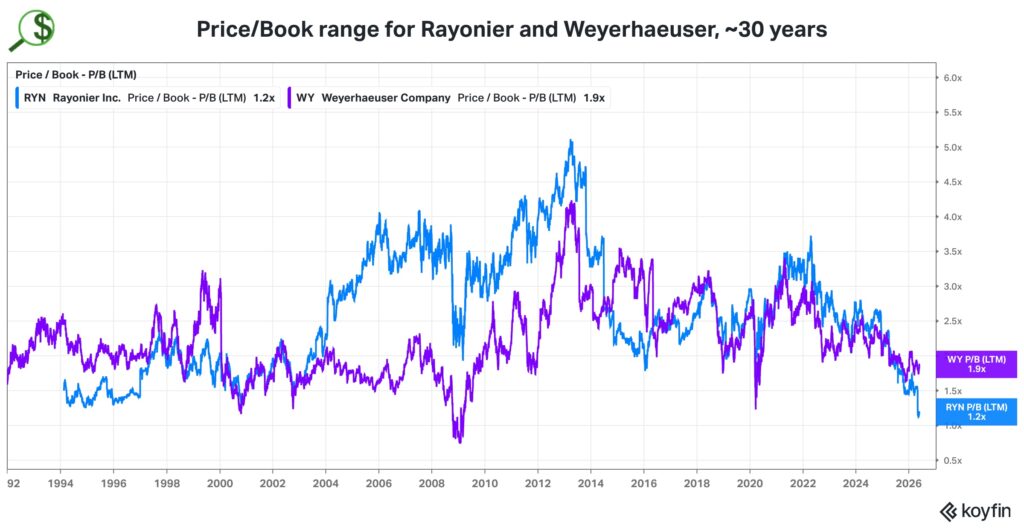
Again, that’s going by book value, and we know that’s very unlikely to be very close to the true value of their timberland assets, since that land is carried on the book at purchase price and also depreciated over time.
Altogether, Weyerhauser values its timber land at cost, minus depreciation, of about $11 billion. If they were to sell it to a timber investor, that would likely be worth much more — probably an average of $1,800-2,000/acre for the southern stuff and the Maine land (totaling almost $14 billion at $1,800/acre), and quite possibly more like $4,000/acre in the Pacific Northwest (totaling $10 billion). Take those values and subtract $5.5 billion in debt, and you get to $18.5 billion… which is pretty close to the market cap of $17.7 billion, and we’re not giving them any value for their large wood products business or any “HBU” potential from their land.
So WY may not be at historically extreme-low valuations, but it’s pretty easy to justify buying the stock near the current level, at about a 5% discount to the likely net value of their timberland, ignoring the vertically integrated wood products business they’ve built on top of that, which generates a good chunk of their profits (they are the largest or one of the couple largest producers in both lumber and engineered wood products in the country, and also distribute those products in major homebuilding regions, so they benefit from both scale and vertical integration), and ignoring their large leases in Canada.
And, of course, the point is to get exposure to the biological growth of timber, and to the tendency of productive timber land to hold its value over generations, which means it should generally at least keep up with inflation and also share the value they get from harvesting and processing that timber with shareholders, largely in the form of those annual dividends. Weyerhaeuser changed its dividend policy in 2020, moving to a “regular plus interim” strategy, so the base dividend has grown slowly, from 17 cents/quarter in 2021 to 21 cents, where it has been for a little over a year, and when they have surplus cash (they aim to distribute 75-80% of their “adjusted funds available for distribution”), they either pay a supplemental dividend, which they last did in early 2024 (with much larger ones in 2022 and 2023), or they buy back stock. They’ve reduced the share count by 4-5% since the REIT conversion, so this is slow… but slow and opportunistic is OK.
I would expect the dividend to probably be unchanged until housing starts pick back up, which ought to lead to enough demand growth to generate some extra cash flow, but we’ll see, they did consistently raise the dividend by a four cents a year each year (roughly 5% growht, on average), until they let it sit flat over the past year… and, of course, I don’t know when the next dividend increase might come. All I know is that more people want to buy homes and there aren’t enough of them to go around, and new homes are the biggest market for WY’s lumber and wood products (about 2/3 of sales over the past five years), so residential construction should pick up at some point again. And the history of cash returns is pretty strong, with WY returning a total of more than $6 billion to shareholders over the past five years (combined dividends and buybacks), so there is some snapback potential if investors eventually see a pathway to dividend growth emerging.
Like Rayonier, most of Weyerhaueser’s land is in the South, roughly 6.5 million acres, but they’re more diversified and, thanks to a much larger wood processing business, with a lot of sawmills and wood products facilities and distribution centers, they get more than half of their revenue from the West. And I haven’t mentioned that a pretty good chunk of that is from land they don’t own, which makes it a little less interesting but is still a contributor of value — Weyerhaueser has timber management leases on millions of acres of government land in Canada, which is not seen as super valuable right now, in part because of low housing starts and in part because of higher tariffs on lumber imports in the US, but it might generate some good cash flow at times (they sold their BC leases last year, but still hold leases in Alberta, Saskatchewan and Ontario, and operate a couple mills in that country).
That same math for “current land value” for Rayonier would give us 930,000 acres in Idaho and Washington, and we probably give that a haircut relative to the WY land in that region but let’s call it $3,000/acre. That’s $2.8 billion. The 3.2 million souther acres, at $1,800/acre, would be $5.8 billion. So our total is $8.6 billion — subtract $1.38 billion in debt, and that’s a current value, timber land alone, of $7.2 billion. The market cap is about $6.4 billion today — so, again, not a “crisis” valuation, but some margin of safety in there, and a reasonable valuation from which to expect some long-term appreciation, again without giving them credit for their housing developments or HBU land sales or their lumber processing capacity, even though that’s less significant for RYN than it is for WY… and, of course, it’s a smaller company that just went through a big merger, so we’d like to think there’s some opportunity to become a little more efficient, and for RYN to maybe get some credit for that larger land position in the northwest that came from PotlatchDeltic, and it already pays a substantially higher dividend than WY, which is its only real near-peer in the public markets.
So I’m going to buy a very small position in Weyerhaueser, really just to get myself thinking about it more and to put that “max buy” of 1.9X book value into the portfolio so it catches my attention. And I’m going to go in a bit bigger with a purchase of Rayonier (RYN). Given the relative valuation appeal of the two, I’d like to build this as a 2/3 RYN, 1/3 WY position, totaling 5% of my portfolio (so roughly 3.3% RYN/1.7% WY), but we’re not going to get there in one week — I’ll tentatively plan to build this out roughly in thirds, so we’ll start with 1.1% in RYN, and I’ll wait for that WY valuation to get more appealing but will keep to that “thirds” idea just to make this system easier to follow, so that’s just over 0.5%. These are not high-growth stories, and they really only have the potential to have a meaningful diversification and compounding impact on my portfolio if they’re of meaningful size, so even this “start with 1/3” purchase makes this a larger commitment to timber than I would typically make as an “entry” buy for more speculative or growth-driven investments, where I’d usually start out at 0.5-1%.
Here’s a bit more from Porter’s argument that I found interesting:
“Gold and timber are the two best-performing real assets of the modern era. And here is what is even better: they are the two assets with the lowest correlation to each other. Gold rises when dollar credit expands. Timber rises when housing and industrial production expand. Gold protects you in the monetary-debasement quadrant of the crisis. Timber protects you in the productive-scarcity quadrant. Over the last 50 years, the correlation between gold and timber has been almost exactly zero. They move independently, and they shine in different phases of the credit cycle. That is not a coincidence. It is a structural feature of what each asset is. Gold is a monetary hedge. It prices the stock of dollar-denominated promises. Timber is a real-economy compounding engine. It prices the demand for physical shelter and physical goods in a growing economy. A portfolio that holds both holds two of the most potent diversifying instruments available to investors.”
Even for the publicly traded stocks, that seems to still be largely true over time — this is the matrix of correlations for the past 20 years, and you can see that both RY and RYN have low correlation (0.1-0.13) to GLD, and similarly low correlation with RGLD, the only gold royalty company that has been publicly traded for that long. Interestingly, WY is as correlated with RYN as it is to the S&P 500, and RYN is less correlated with the S&P 500 — probably largely because WY has more of an industrial business on top of its timberland, with major lumber production and distribution.
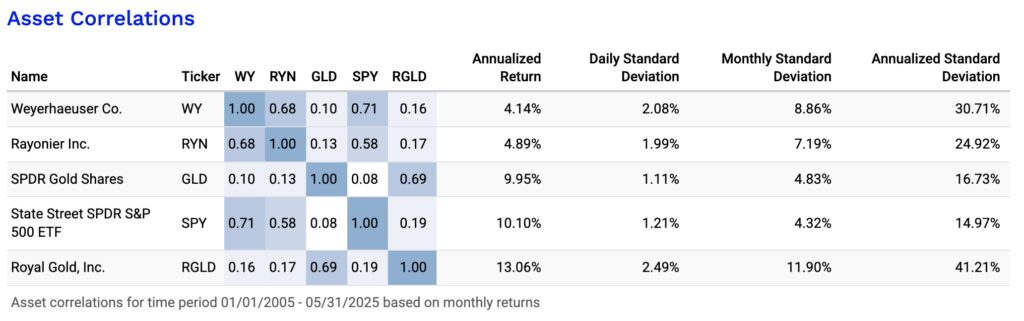
Seems sensible to own both. I think Rayonier is more attractively valued and has a higher yield, with some meaningful potential to improve efficiency a bit from the added scale of the still-fresh PotlatchDeltic acquisition, and with a slightly stronger focus on “HBU” land sales and housing development… but Weyerhaueser has more leverage to lumber, which is generally more valuable than pulp, with some extra capacity from Canada on long-term leases, and their timber land should be at least a little more valuable than Rayonier’s, due mostly to efficiency of scale and the bigger position on the West Coast. And it’s good that the two are not perfectly correlated with each other, which gives us an excuse to diversify a bit within the timber sector, among what are really effectively the only publicly-traded North American options (there are major timber companies throughout the world, including some with large holdings in Northern Europe and Asia, but I don’t understand them as well… and they’re also almost all really producers of paper, packaging, or lumber to more of a degree than they are stewards of timberland, and often have meaningful investments in other businesses, like the Japanese “timber” companies who are buying out US homebuilders of late).
So to some degree, Porter has convinced me to focus a little less on the performance of these two timber REITs as stocks over the past couple decades, and more on the embedded value of their timber assets, as a valuable diversifying tool whenever the next crisis happens to hit. That’s very unlikely to give my portfolio a better average return over the next year or two, but I think the valuations of the timber REITs are at least generally reasonable now, and I like the idea of monitoring them and managing those holdings based on their relative price/book value over time, as they get popular or unpopular — today, they are historically quite unpopular, and that seems like a reasonable signal to stop overthinking it, as I’ve been doing for the past few weeks, and just start to buy (I only burdened you with that overthinking once, last week, so you’re welcome for that :))
Deleted: Vanguard Dividend Growth (VDIGX) has really been suffering in recent years, after the departure of longtime manager Don Kilbride the fund has failed to participate in much of the market’s return while also, because of huge positions in Microsoft, Broadcom, Eli Lilly, Apple and other hugely successful and generall expensive megacap stocks, likely facing many of the same downside risks as the overall market. I’ve begun easing some of my accounts out of VDIGX, and into the (historically) more aggressive Vanguard Primecap Core (VPCCX), which has both stronger long-term performance and, I think, a better portfolio makeup for the current environment. I make that change partly because VPCCX is the fund I would have chosen when building those portfolios many years ago, but it wasn’t open at that time (it reopened in 2024, this is not brand new but I tend to move slowly within my fund portfolios). That’s an increase to portfolio risk, on the margins, so I’ll likely leaven that with some other relatively minor adjustments, including a little reduction in my holdings in Primecap Growth (POGRX), which is similar to VPCCX, in some of my tax-advantaged accounts.
Deleted: This challenge at some of the Wellington-managed funds at Vanguard is not brand new — Vanguard Dividend Growth and Vanguard Health Care have both underperformed in recent years, after doing very well for a very long time under different management teams. Vanguard Health Care still gives my portfolio some meaningful diversification, since I don’t have much health care exposure or sector expertise, so I’ll continue to be a bit more patient with that one, but it’s also a much smaller fund position for me, and it has more or less kept up with the (depressed) sector in the past couple years, if we give them a little credit for their global diversification.
I’ve also added some exposure to the Cambria Emerging Shareholder Yield ETF (EYLD), which is a shareholder yield-weighted fund of emerging markets stocks — in practice, that means it’s a way to buy into cash-generating and mostly smaller companies in emerging markets, without the huge weighting that most emerging markets ETFs have to the massive technology leaders of Taiwan and South Korea. I don’t have anything particularly against the wildly strong memory and chipmaking firms that dominate those indices, but I don’t think the world’s biggest makers of semiconductors and computer memory are “emerging market” positions that offer us diversification from the AI-focused tech boom, they’re just parts of that boom which happen to be domiciled in other countries.
I’ll also scooch a bit more of that surplus cash into LDRH and LDRI, which I like in part because they are very liquid while avoiding a lot of the maturity risks of ETFs, and they roll those five-year ladders automatically, which gives them an average maturity of a little over two years… but also because even though they don’t have high short ratios, they seem to attract short sellers to enough of a degree (especially LDRI), that my holdings have often been boosted by short lending fees, which increased my yield on these ETFs over the past year by close to 50%. You can also do bond ladders yourself of any duration, either using individual maturity ETFs (which is what these ETFs use) or individual bonds, but I find this short-term solution a LOT easier for my “a little better return than cash, a little more interest rate risk” investments in what are effectively short-term bond funds. I used to put some capital into building my own shorter-term T-Bill and Treasury Notes ladder, but these ETFs are a much easier way.
Where has that yield boost come from? I participate in the lending programs at both of my major brokers, Fidelity and Interactive Brokers — which means I authorize them to lend out my shares to any short seller who wants them, and I earn a share of the daily interest income received for those loans (Fidelity pays out 60% of the market lending rate for that security, IBKR 50%). That is usually not a huge amount of money, and it is often zero in any given month… but when those shares are lent, I reinvest the proceeds, and that’s why those positions show up with relatively high returns, in excess of their stated yield.
Today, the stated yield is in the range of 6.5% for LDRH and 3.5% for LDRI, but my annualized returns have been roughly 8.5% and 10.5%, respectively, since I started building positions in those ETFs 15 months ago, mostly because there has at times been solid demand for borrowing LDRI shares, and it doesn’t take much to provide a little boost, even having the shares borrowed for a few days a month is meaningful. That income is a bonus, some months there is very little borrowing against my portfolio, some months there’s quite a bit, but, while I permit all of my holdings to be lent out, most of that lending typically comes from my ETF positions. I heartily recommend participating in the lending program if your broker allows it. I believe that short selling is an essential part of a healthy market, so it doesn’t bother me that I’m “letting” the shorts access my shares, and I also believe that this exercise is essentially risk-free… and this is also a reason, in case you need one, to limit your use of margin leverage (ie, borrowing money from your broker to buy stock) — if you own stocks on margin, the broker can lend them out at their whim, you don’t get to decide because you don’t fully own them, and you won’t receive any of the proceeds.
(Regarding risk of lending: you still have full economic rights to the securities you lent out, including the receipt of cash in lieu of any dividends those shares receive, and you can sell at any time — but do note that although the economic income from lent shares is the same, the taxation can differ a little, including that the cash you receive in lieu of dividends is taxed as income, so it doesn’t benefit from any lower “qualified” dividend rate you might otherwise pay. Much of my “lent” securities are in tax-deferred accounts, and for the ones that aren’t the tax difference isn’t enough to offset the value of the extra income).