American healthcare faces a structural paradox: demand for skilled nursing care grows every year as the population ages toward a demographic milestone – by 2034, more Americans will be over 65 than under 18 – yet two out of every five patients prescribed acute home nursing care never actually receive it. The bottleneck is not a shortage of clinicians; it is the administrative cost of coordinating their work, which runs $0.60 to $0.90 for every dollar spent on clinical labor, a burden so heavy that traditional home health agencies reject an estimated $40B in referrals annually rather than absorb it. Adaptive Innovations bypasses this problem entirely by operating as a full-stack provider – not a software vendor – rebuilding the end-to-end operations of home health care with AI at the core, so that every function from intake and scheduling to charting, coding, billing, and compliance runs through a single AI-native platform rather than a patchwork of manual workflows. Since launching in 2025, the company has become one of the largest home health providers in Texas, delivering over 100,000 patient visits across a network of 500+ referring healthcare organizations including every major Texas hospital system while cutting clinician documentation time by approximately 80% with a rehospitalization rate of 4.9%, less than half the industry average. With an AI cost structure that makes it profitable to accept patients that legacy agencies turn away, Adaptive has built what it describes as a physical network flywheel: more patient density reduces clinician drive time, raises productivity and pay, deepens referral relationships with health systems, and compounds into a platform capable of owning the full post-acute coordination layer.
AlleyWatch sat down with Alex Wendland, Cofounder and Co-CEO of Adaptive Innovations, to learn more about the business, its future plans, recent funding round, and much, much more…
Who were your investors and how much did you raise?
We raised a $50M Series A led by Felicis, along with participation from Bain Capital Ventures, Optum Ventures, Sunflower Capital, BoxGroup, Dorm Room Fund, Constellation VC, SV Angel, and prominent angel investors across healthcare services and AI labs. We also raised a previously undisclosed $10M in seed funding led by Bain Capital Ventures, bringing our total funding to-date to $60M.
Tell us about the product or service that Adaptive Innovations offers.
Adaptive Innovations is an AI-native healthcare provider, starting in home health. We combine AI-native operations with clinicians-in-the-home to get every patient the care they need, including the 40% of patients legacy home health providers turn away.
What inspired the start of Adaptive Innovations?
There are many AI healthtech companies, but care can’t be delivered through a screen. Real care happens physically, between a clinician and a patient. And as a country, we don’t deliver enough of it. In post-acute care, the clinicians exist and patients exist, but 40% of patients are turned away due to the high admin burden and care coordination problem. Adaptive exists to solve this.
How is Adaptive Innovations different?
We’re not a software vendor. We’re the provider, and we’ve rebuilt the entire end-to-end operations that care runs on with AI at the core. This allows us to say yes to the patients that other providers turn away, and also get them better quality care – our rehospitalization rate is less than half the industry average.
What market does Adaptive Innovations target and how big is it?
We’re starting in home health, but targeting the entirety of post-acute care. Home health is a >$100B market and one of the fastest-growing outpatient sectors on pace to nearly double over the next 5-6 years.We’re not stopping at skilled nursing visits. Home health is the coordination layer through which the rest of post-acute care flows including home infusion, dialysis, durable medical equipment deployment, hospice, and specialty pharmaceuticals. Today, these verticals are fragmented and disconnected, but as we build density, we are building the only platform capable of solving the full post-acute coordination problem.
What’s your business model?
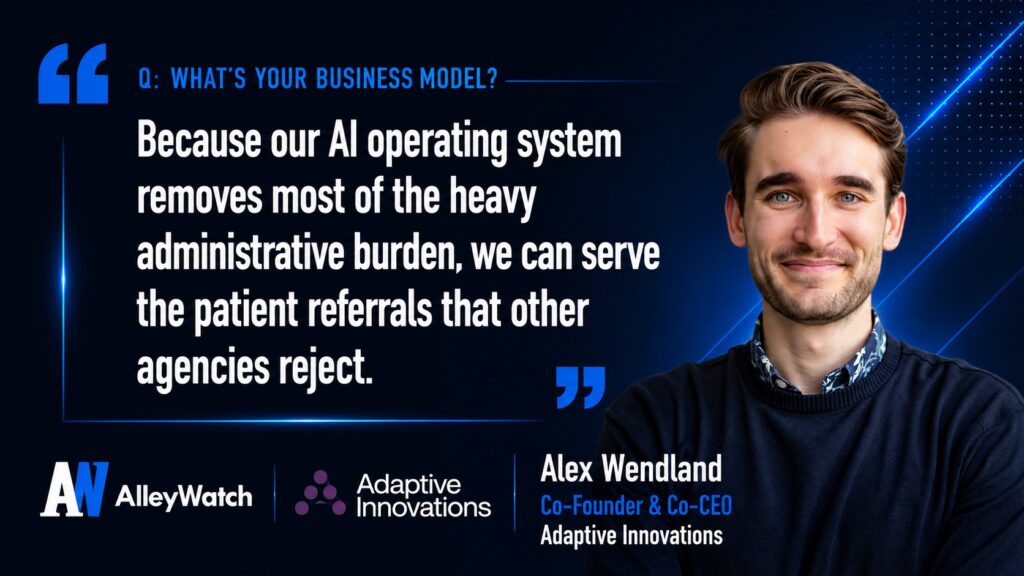
Because our AI operating system removes most of the heavy administrative burden, we can serve the patient referrals that other agencies reject. Being able to expand care to patients drives physical network effects which in turn fuels durable growth.More patients leads to more patient density, meaning clinicians drive less between visits, which raises their productivity and total take-home compensation. This also means that we build more trust with hospitals and referral sources, making them want to refer more patients to us. And finally, as we reach more patients, we’ll be able to thoughtfully partner with payers on innovative contracting models that align with our ability to shift outcomes at the population level.
How are you preparing for a potential economic slowdown?
People need care in any economy.But also, when budgets tighten, health systems and payers get more cost-sensitive. Because AI removes most of our admin cost, we earn a far wider margin on every visit than a traditional agency does. That margin is a buffer: we can keep delivering care at reimbursement levels that would put a legacy agency underwater.
What was the funding process like?
Investors are looking for a new class of startup that benefits from AI but isn’t consumed by it. The SaaS companies of the past are no longer interesting, because AI lets anyone vibecode software. Investors saw that we’re an early player in this new wave of real businesses that gets better as AI gets better.
What are the biggest challenges that you faced while raising capital?
Investors are still learning how to think about this new era of AI-not-SaaS businesses. We found that the sharpest investors understood this paradigm shift quickly, while others are still figuring it out.
What factors about your business led your investors to write the check?
Adaptive is solving an important problem (caring for patients), at a massive scale (>$100B market), with a rare team combining the best engineers in tech and the best operators from healthcare.
What are the milestones you plan to achieve in the next six months?
This new funding accelerates our expansion to new states.
What advice can you offer companies in New York that do not have a fresh injection of capital in the bank?
AI lets you do more with less. We’ve found that the best operators and engineers can do more than 2x what the next best can do simply because they know how to leverage AI more effectively.
Where do you see the company going now over the near term?
We plan to continue expanding within Texas as well as new states.
What’s your favorite spring destination in and around the city?
The High Line, hands down. I love greenery & architecture, so I’m a big fan of the defunct rail infrastructure reimagined into something green and walkable.
You are seconds away from signing up for the hottest list in NYC Tech!
Sign up today