No Result
View All Result
  • Login
Monday, May 11, 2026
FeeOnlyNews.com
  • Home
  • Business
  • Financial Planning
  • Personal Finance
  • Investing
  • Money
  • Economy
  • Markets
  • Stocks
  • Trading
  • Home
  • Business
  • Financial Planning
  • Personal Finance
  • Investing
  • Money
  • Economy
  • Markets
  • Stocks
  • Trading
No Result
View All Result
FeeOnlyNews.com
No Result
View All Result
Home Markets

Are We Running Out of Space in Space?

by FeeOnlyNews.com
2 months ago
in Markets
Reading Time: 5 mins read
A A
0
Are We Running Out of Space in Space?
Share on FacebookShare on TwitterShare on LInkedIn


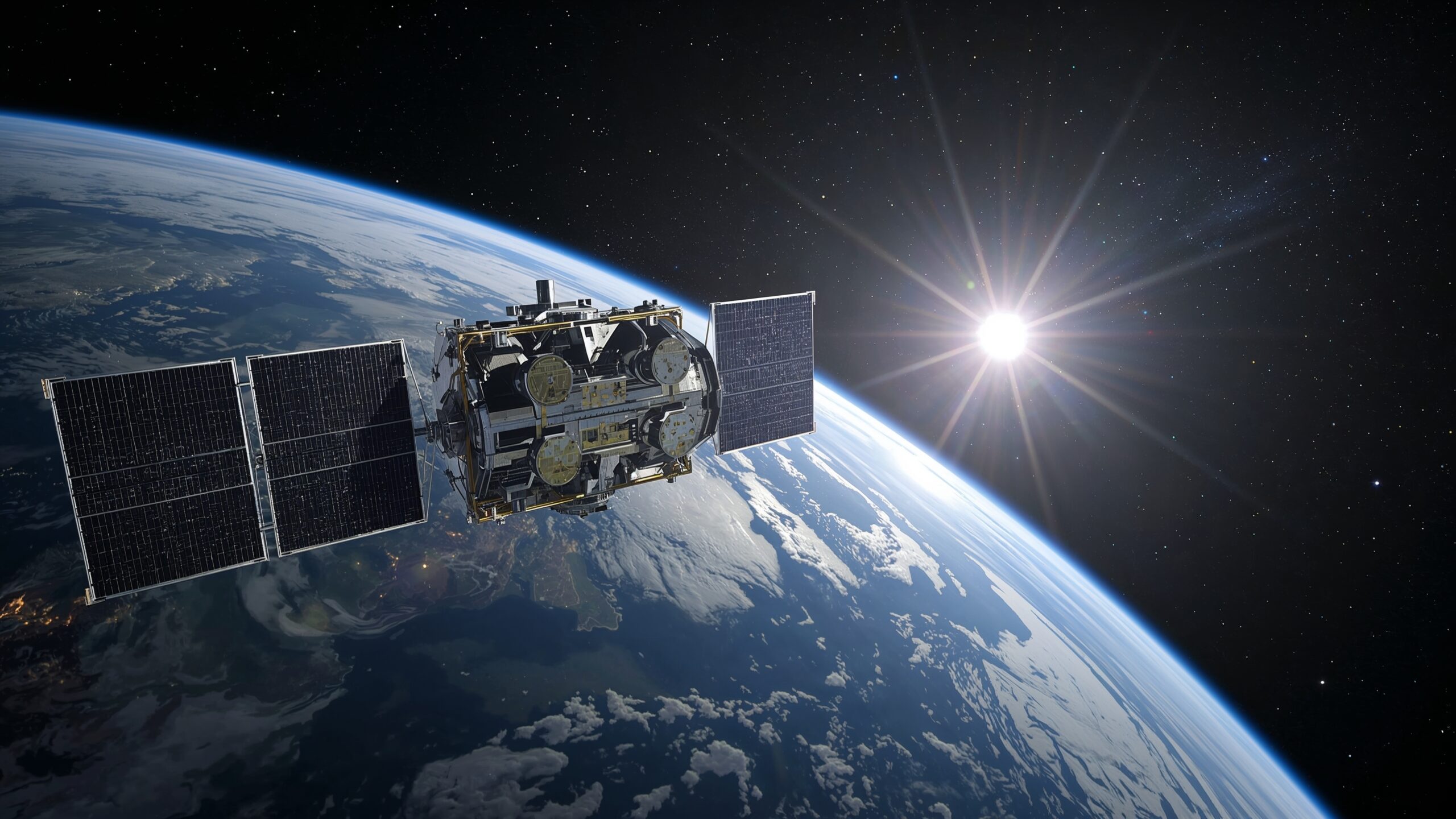
A startup just filed plans to launch 88,000 satellites into orbit.

If that number sounds outrageous, consider that today there are roughly 9,500 active satellites circling Earth. Starcloud’s proposal would multiply that number nearly 10X.

This plan might sound like the next big leap in the space economy. But it also hints at a growing challenge that few people are talking about.

Because the more satellites we launch, the more crowded Earth’s orbit is becoming.

And these days, that crowding is becoming a real problem.

The 88,000-Satellite Data Center in the Sky

The proposal comes from a company called Starcloud.

The company’s plan is different from most satellite constellations we’ve seen so far. Instead of providing internet service like SpaceX’s Starlink or Amazon’s Project Kuiper, Starcloud wants to deploy orbiting data centers.

That might sound crazy, but data centers on Earth consume enormous amounts of electricity and require expensive cooling systems. In space, sunlight is abundant and temperatures are easier to manage.

If the model works, companies could run artificial intelligence workloads or high-performance computing jobs in orbit and beam the results back to Earth.

It’s a bold plan.

It’s also part of a much larger trend.

Over the past decade, the number of satellites in orbit has exploded. In 2015, there were about 1,500 active satellites around Earth.

Today there are roughly 9,500.

More than 7,000 of those belong to Starlink alone, which has become the largest satellite network in history.

But this growth is just beginning.

Blue Origin’s TeraWave plan calls for more than 5,400 satellites. China is developing several competing constellations expected to reach tens of thousands of spacecraft.

And globally, regulators have already approved proposals for more than 50,000 additional satellites.

Add in projects like Starcloud’s proposed 88,000-satellite constellation, and the total number of spacecraft around Earth could climb into the hundreds of thousands within a generation.

If that happens, low Earth orbit could start to resemble deadly rush-hour traffic.

You see, satellites circle the planet at about 17,500 miles per hour. At those speeds, even a tiny fragment of debris can cause catastrophic damage.

And there’s already a lot of debris up there.

The U.S. Space Surveillance Network currently tracks more than 36,000 pieces of space debris larger than 10 centimeters. Scientists estimate there are about one million fragments larger than a centimeter that are too small to track but still capable of disabling a satellite.

Turn Your Images On

Image: Wikipedia Commons

As orbital traffic increases, operators are being forced to perform more avoidance maneuvers.

Starlink satellites alone reportedly conduct tens of thousands of collision-avoidance maneuvers each year.

That trend will only accelerate as more constellations come online.

But the real danger isn’t just a single collision.

Scientists have long warned about something called Kessler syndrome. If the density of debris in orbit becomes too high, one collision can trigger a chain reaction of additional collisions.

Each impact creates thousands of fragments, which then strike other satellites, producing still more debris.

In a worst case scenario, certain orbital regions could become so dangerous that they’re effectively unusable for decades.

But congestion is already a concern.

Because even paint-chip-sized debris traveling at orbital speeds can damage spacecraft or threaten crewed missions like the International Space Station, which has occasionally had to perform avoidance maneuvers to steer clear of debris.

Because many fragments are too small to track, operators often have little warning.

And orbital congestion doesn’t just create safety risks. It also increases costs.

Satellite operators have to invest in more advanced tracking systems and carry extra fuel for avoidance maneuvers. Every maneuver also shortens a satellite’s operational life.

That means spacecraft will probably need to be replaced more frequently than expected.

In other words, congestion in orbit could end up reshaping the economics of the entire space industry. And the ripple effects could extend far beyond the companies launching satellites.

Modern economies rely heavily on space-based infrastructure. Navigation systems, weather forecasting, global communications and financial networks all depend on satellites.

If orbital congestion makes those systems more fragile or expensive, the consequences could spread across many industries.

Astronomers are already seeing its effects today.

Bright satellites frequently streak through telescope images, interfering with both optical and radio observations. Some projections suggest that many of the moving lights in the night sky could soon be satellites instead of stars.

And there are also environmental concerns.

Every satellite eventually reenters Earth’s atmosphere and burns up.

Turn Your Images On

Image: Wikimedia Commons

As constellations of satellites grow larger, it could mean that thousands of them will reenter our atmosphere each year.

Researchers are beginning to study how the resulting metallic particles and soot could affect the upper atmosphere and potentially contribute to changes in ozone chemistry.

The good news is that policymakers are finally starting to talk about near-Earth space as a limited environment.

But right now, there’s no unified global system for managing all this space traffic.

The rules governing space were largely written decades ago, when only a few hundred satellites were in orbit. So they focus on basic safety and spectrum use, not what happens when tens of thousands of flying objects are forced to share the same space.

As satellite networks grow larger, that lack of coordination could become a serious challenge.

Because once debris accumulates in orbit, cleaning it up is extraordinarily difficult.

Here’s My Take

The space economy is entering a remarkable period of growth.

Reusable rockets, smaller satellites and lower launch costs have suddenly made it possible to deploy massive constellations that would have been unimaginable a decade ago.

But every technological boom eventually runs into a constraint.

For the space industry, that constraint might turn out to be self-inflicted.

Regards,

Ian King's SignatureIan KingChief Strategist, Banyan Hill Publishing

Editor’s Note: We’d love to hear from you!

If you want to share your thoughts or suggestions about the Daily Disruptor, or if there are any specific topics you’d like us to cover, just send an email to [email protected].

Don’t worry, we won’t reveal your full name in the event we publish a response. So feel free to comment away!


Source link

Tags: Runningspace
ShareTweetShare
Previous Post

20 Companies Hiring for Part-Time, Work-From-Home Jobs

Next Post

Eilat medical school to open this year

Related Posts

Economists’ Greatest Fear Is Almost Here

Economists’ Greatest Fear Is Almost Here

by FeeOnlyNews.com
May 10, 2026
0

By Brandon Smith For those who haven’t followed the shifting relationship between Washington and Europe closely, something important is happening...

Energy Secretary Says Trump ‘Open’ to Pausing Gas Tax Amid Climbing Prices

Energy Secretary Says Trump ‘Open’ to Pausing Gas Tax Amid Climbing Prices

by FeeOnlyNews.com
May 10, 2026
0

Energy Secretary Chris Wright said the Trump administration is open to suspending the federal gas tax to lower costs for...

Top Wall Street analysts recommend these stocks for stable income

Top Wall Street analysts recommend these stocks for stable income

by FeeOnlyNews.com
May 10, 2026
0

Investors appreciate having dividend stocks in their portfolios as they provide a steady stream of income, even during periods of...

What If the Government Just Gave Every Baby a ,000 ‘Trump Account’?

What If the Government Just Gave Every Baby a $1,000 ‘Trump Account’?

by FeeOnlyNews.com
May 10, 2026
0

A pair of academic researchers want the Trump administration to automate “Trump Accounts,” so that every baby born between 2025...

Greg Abel knows Berkshire cold, but some miss the Buffett magic

Greg Abel knows Berkshire cold, but some miss the Buffett magic

by FeeOnlyNews.com
May 9, 2026
0

BECKY QUICK:  We are sitting down right now with Warren Buffett, the chairman of Berkshire Hathaway, who, for the first...

Warm Weather Boosts EV Range: How Drivers Can Maximize Performance

Warm Weather Boosts EV Range: How Drivers Can Maximize Performance

by FeeOnlyNews.com
May 9, 2026
0

Warmer weather creeping across parts of the United States could have an immediate impact on electric‑vehicle drivers. Warmer temperatures make...

Next Post
Eilat medical school to open this year

Eilat medical school to open this year

The firm whose AI paper knocked the whole market is out with another big call

The firm whose AI paper knocked the whole market is out with another big call

  • Trending
  • Comments
  • Latest
The 27 Largest US Funding Rounds of March 2024 – AlleyWatch

The 27 Largest US Funding Rounds of March 2024 – AlleyWatch

April 17, 2026
Wells Fargo Transfer Partners: What to Know

Wells Fargo Transfer Partners: What to Know

April 16, 2026
Week 14: A Peek Into This Past Week + What I’m Reading, Listening to, and Watching!

Week 14: A Peek Into This Past Week + What I’m Reading, Listening to, and Watching!

April 6, 2026
The 16 Largest Global Startup Funding Rounds of March 2026 – AlleyWatch

The 16 Largest Global Startup Funding Rounds of March 2026 – AlleyWatch

April 21, 2026
The Justice Department Indicts the Ministry of Love

The Justice Department Indicts the Ministry of Love

May 2, 2026
LPL’s Mariner Advisor Network deal fuels already hot year for RIA M&A

LPL’s Mariner Advisor Network deal fuels already hot year for RIA M&A

April 16, 2026
Solana (SOL) Breakout Setup Strengthens As Bulls Regain Full Control

Solana (SOL) Breakout Setup Strengthens As Bulls Regain Full Control

0
Why More Seniors Are Choosing Multi-Generational Living Over Traditional Retirement Communities

Why More Seniors Are Choosing Multi-Generational Living Over Traditional Retirement Communities

0
Mah Sing sees natural ‘spillovers’ from Malaysia’s strong growth

Mah Sing sees natural ‘spillovers’ from Malaysia’s strong growth

0
Stove Selection Theory | Mises Institute

Stove Selection Theory | Mises Institute

0
Economists’ Greatest Fear Is Almost Here

Economists’ Greatest Fear Is Almost Here

0
Best money market account rates today, Sunday, May 10, 2026 (best account provides 4.01% APY)

Best money market account rates today, Sunday, May 10, 2026 (best account provides 4.01% APY)

0
Solana (SOL) Breakout Setup Strengthens As Bulls Regain Full Control

Solana (SOL) Breakout Setup Strengthens As Bulls Regain Full Control

May 11, 2026
Market outlook: Why the Nifty breakout failed and how to trade Vedanta & Bank Nifty this week

Market outlook: Why the Nifty breakout failed and how to trade Vedanta & Bank Nifty this week

May 10, 2026
Why Is Strategy Valuable? CEO Says MSTR Is More Than Its BTC Holdings

Why Is Strategy Valuable? CEO Says MSTR Is More Than Its BTC Holdings

May 10, 2026
Why global fund managers are giving D-St the cold shoulder

Why global fund managers are giving D-St the cold shoulder

May 10, 2026
Economists’ Greatest Fear Is Almost Here

Economists’ Greatest Fear Is Almost Here

May 10, 2026
Markets dip as US-Iran ceasefire goes nowhere, leaving Trump with a military option to reopen Hormuz

Markets dip as US-Iran ceasefire goes nowhere, leaving Trump with a military option to reopen Hormuz

May 10, 2026
FeeOnlyNews.com

Get the latest news and follow the coverage of Business & Financial News, Stock Market Updates, Analysis, and more from the trusted sources.

CATEGORIES

  • Business
  • Cryptocurrency
  • Economy
  • Financial Planning
  • Investing
  • Market Analysis
  • Markets
  • Money
  • Personal Finance
  • Startups
  • Stock Market
  • Trading

LATEST UPDATES

  • Solana (SOL) Breakout Setup Strengthens As Bulls Regain Full Control
  • Market outlook: Why the Nifty breakout failed and how to trade Vedanta & Bank Nifty this week
  • Why Is Strategy Valuable? CEO Says MSTR Is More Than Its BTC Holdings
  • Our Great Privacy Policy
  • Terms of Use, Legal Notices & Disclaimers
  • About Us
  • Contact Us

Copyright © 2022-2024 All Rights Reserved
See articles for original source and related links to external sites.

Welcome Back!

Sign In with Facebook
Sign In with Google
Sign In with Linked In
OR

Login to your account below

Forgotten Password?

Retrieve your password

Please enter your username or email address to reset your password.

Log In
No Result
View All Result
  • Home
  • Business
  • Financial Planning
  • Personal Finance
  • Investing
  • Money
  • Economy
  • Markets
  • Stocks
  • Trading

Copyright © 2022-2024 All Rights Reserved
See articles for original source and related links to external sites.