I used to think I had to time breakout trades perfectly.
But it’s easier than that.
The best breakouts I’ve ever traded were OBVIOUS (early). They left clues: clear levels, tight price action, big catalysts, steady volume.
You have to know what to look for while the pattern is still forming.
Once the stock is ripping past resistance, you’re probably too late.
First, I’ll walk through what a quality breakout setup looks like, how I plan the trade and why the early signs on the chart matter more than the breakout itself…
Then I’ll show you how to have a plan before the key resistance breaks (so you’re already in the stock when it starts going full supernova)…
What Makes a Breakout Worth Trading?
A breakout happens when a stock breaks above a key resistance level — a price the stock has recently (or historically) struggled to trade above.
These levels are like invisible walls on the chart. When they break, huge moves to the upside often follow.
These crazy breakout/squeeze plays are happening nearly every day in this ridiculous market…
And 99% of these plays don’t last more than one day…
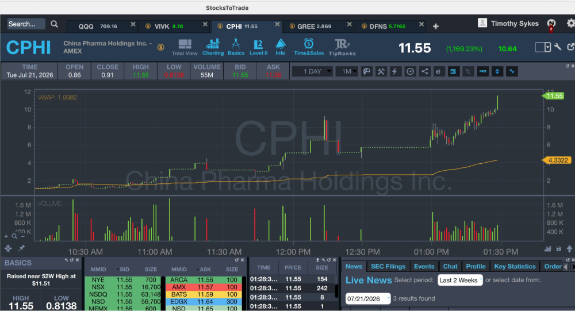
But China Pharma Holdings Inc. (CPHI) did it twice:
Source: Stocks To Trade
$CPHI 7/21/26 squeeze from the $1s to $19.
Then it did it again!
Source: Stocks To Trade
$CPHI squeezes shorts into the $11s, the 2nd $1 to $11+ spiker in 2 days!!
But every once in a while, when it happens on strong volume, the break can signal the start of a new trend (and maybe even a supernova move).
There’s nothing better than watching a chart break out on huge volume into blue-sky price discovery, prices the stock has never seen before.
But if you aren’t in the stock before the biggest piece of the breakout, you’ll probably end up chasing the top…
The 4 Steps to a Face-Ripping Breakout
Here’s what I look for in every breakout pattern:
1. Tight consolidation near a clear resistance level.
A strong breakout usually comes after price action gets quiet and compressed right under resistance. If the candles are getting smaller and overlapping, with clear support holding underneath, that’s a signal…
2. Volume gradually picking up into the setup.
You don’t need a massive volume spike right away. But when volume starts to increase slightly on up days, that shows buyers are getting active early. It’s a sign that demand is building.
3. Clean levels with repeat tests.
A strong breakout level gets tested multiple times. The more often a stock knocks on the same ceiling, the more likely it is to break through with strength when it finally clears it.
4. Orderly charts with consistent price action.
If the chart is wild or full of failed breakouts and fakeouts, I usually pass. The best setups look obvious in hindsight because they followed clean, predictable price behavior.
The Only Way To Catch Breakout Trades
Once I find a breakout setup…
• I mark my level, define my risk and set an alert.
• I don’t want to jump the gun and buy into resistance. I want the stock to prove it can break out and follow through.
• I wait for the breakout to happen with confirmation. Price should move through resistance with strength and increased volume.
• I’m looking for a clear shift in momentum.
The trick is to prepare ALL OF THIS before the breakout happens. That way, when the move triggers, you’re ready to act quickly and decisively.
You’re not scrambling to figure it out in real time because you’ve already set the terms of the trade beforehand.
The next time you see a chart keep trying to break resistance on higher and higher volume, take a closer look…
It just might lead to a massive breakout.
If you have any questions, email me at [email protected].
Cheers,
 Tim SykesEditor, Tim Sykes Daily