Tax-loss harvesting can be an effective way to reduce investment income in a taxable portfolio, by selling positions at a loss and reinvesting the proceeds in similar securities (but not identical ones, to avoid wash sale rules negating the loss) – which creates a loss for tax purposes that can offset gains from elsewhere in the portfolio, while keeping the portfolio funds still invested and able to participate in any further market upside. The caveat, however, is that unless new funds are constantly added to the portfolio to buy new positions, there becomes fewer and fewer losses available to harvest over time. Because on average, the market tends to rise, and so in a diversified portfolio most positions will eventually rise far enough above their cost basis that even subsequent downturns don’t result in taxable losses, while for positions that do continue to decline there’s only a finite amount of losses they can actually generate (because their market value – and cost basis – can only go down to zero).
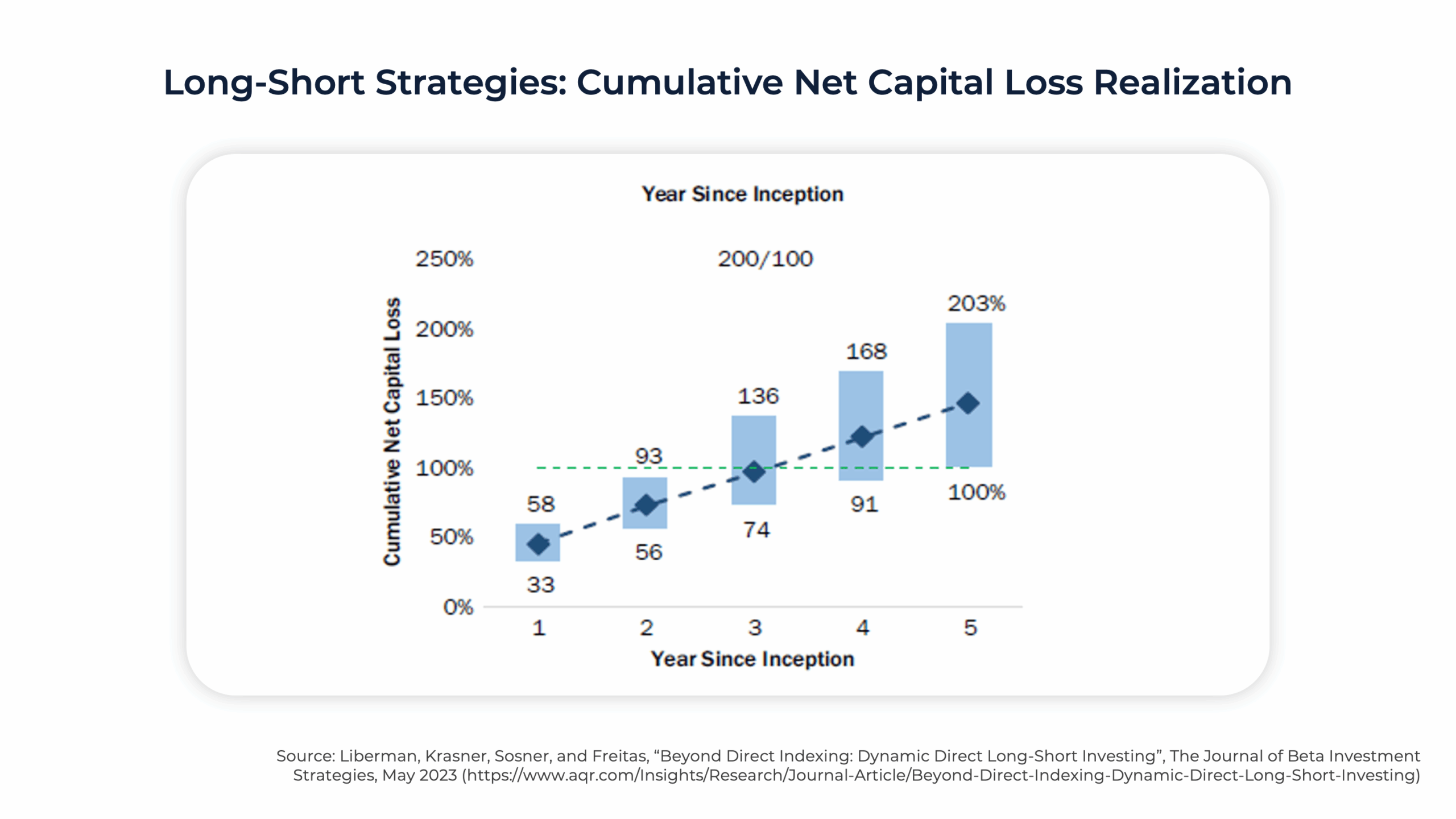
But recent years have seen the growth in popularity of a type of investment strategy that aims to generate more tax losses over time than standard portfolios, while still performing at or above the overall market return. At its core, “Tax-Aware Long-Short” (TALS) investing involves adding leverage (i.e., borrowing) to an existing portfolio to buy more positions and thus increase the number of potential losses to harvest. The leverage is used for both long (i.e., borrowing cash to buy equities in hopes that they’ll increase in value) and short (i.e., borrowing equities to sell and repurchase later in hopes that they’ll decline) positions – which means in theory, TALS portfolios can generate losses in both bear markets (where the long positions decline in value) and bull markets (when the short positions decline), while largely remaining economically neutral since a decline in the short positions will be mostly offset by an increase in the long positions and vice versa. And because short positions can theoretically generate an infinite amount of losses (since they decline when markets rise), TALS portfolios are less likely to run out of losses to harvest over time than standard long-only portfolios.
The higher tax-loss harvesting potential of TALS portfolios can make them useful in situations where an investor expects to incur a large amount of capital gains income, e.g., if they want to sell a highly-appreciated security and reinvest in a more diversified portfolio. However, for advisors who are considering TALS (e.g., managed by a subadvisor in a Separately Managed Account [SMA] portfolio), it’s also important to consider the underlying investment strategy beyond just the tax ramifications. Because tax rules prevent TALS from being entirely economically neutral, i.e., the long and short positions can’t exactly offset each other such that a loss on one side will be fully offset by a gain on the other side. Instead, they must have “economic substance”, meaning there needs to be a reasonable expectation of profitability before considering the tax benefits of the strategy. In other words, TALS managers can’t just aim to exactly replicate the performance of a market index while generating no additional pre-tax return from the added leverage – they need to actively try to outperform the market in order to substantiate the tax losses that they incur along the way.
Furthermore, the “carrying costs” of TALS investing – which include both fees to the TALS manager for managing the portfolio as well as fees to the custodian as compensation for their role in lending funds on margin (for the long side) and intermediating securities lending (for the short side) – create a significant baseline hurdle which TALS managers must overcome “just” to achieve market performance, let alone outperformance. And the higher the leverage in the portfolio (with higher potential losses to harvest), the greater the carrying costs – ranging from around 100bps (i.e., 1%) of the original portfolio value on the low end to 400bps (i.e., 4%) or more on the high end. And with that additional leverage comes more risk that any underperformance of the TALS portfolio will be more severe than in a more lightly-leveraged portfolio. Or put differently, increasing leverage in a TALS strategy increases the potential tax benefits it can generate, but also increases the risk that it may underperform enough that the investor would have been better off simply selling their concentrated security and paying tax on it!
The key point is that TALS portfolios’ potential for asymmetric tax losses also comes with a potential for asymmetric economic losses. And as the popularity of TALS investing continues to increase, it’s difficult to know what the repercussions of events like short squeezes will be in a world where TALS has ramped up the demand for short positions (as custodians like Schwab and Fidelity have begun to acknowledge by raising borrowing costs and imposing various restrictions on TALS accounts to manage their own counterparty risks as the primary lender in the strategy). And so advisors can provide value by analyzing not only the tax impact of a potential TALS strategy, but also how the costs and risk of the strategy aligns with the client’s goals and their own investment philosophy – because it’s one thing to generate ‘just’ losses for tax purposes, but it’s another thing when those paper losses translate into real economic losses instead!
Read More…