When Trump ordered the first wave of strikes in this ongoing war with Iran last month, he did so while his administration was engaged in active negotiations with the Iranian government. That echoed the situation last June when Israel launched a bombing campaign days after Trump scheduled new talks with Iran—a move Trump later claimed was a deliberate deception to help make the Israeli strikes more effective.
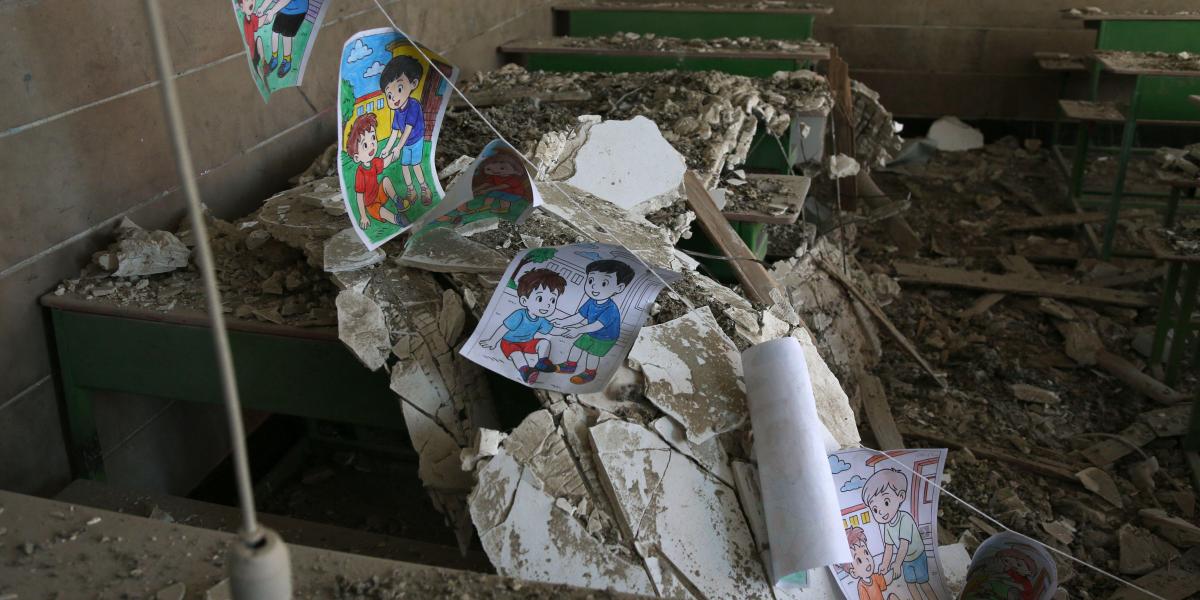
This time around, in that first wave of strikes on February 28, American cruise missiles targeted and destroyed a building that ended up being a girls’ school—killing more than 168 young children who had just started their day of classes.
In the weeks since, the specific toll of the war on the Iranian people has been obscured by a thick fog of war and a nationwide internet blackout. But the initial reports and anecdotes that have managed to slip through suggest that the civilian death toll from the intense bombing campaigns on and around dense residential areas has been extensive.
Then, last Saturday night, Trump announced that if Iran did not “fully open” the Strait of Hormuz within 48 hours, the US would begin targeting and destroying Iran’s power grid and energy infrastructure. Trump did announce Monday morning before markets opened that he’d extend his deadline until after markets close this weekend, which suggests it may have been a bluff.
But still, the fact that Trump is officially threatening this at all is a big deal. Because destroying Iran’s power grid would not just turn the lights off for a few days, it would irrevocably destroy Iran’s ability to sustain the current population that lives there. Food production, sanitation services, water purification, healthcare services, and more would be greatly diminished, if not stopped entirely. And the result would be mass civilian death—even more so if Iran carried out the retaliation they promised and hit similar infrastructure in nearby US allied countries.
As all of this has unfolded in the last three weeks—the surprise attack during negotiations, the violent deaths of Iranian civilians as a result of US and Israeli bombs, and the credible threats of escalations that would significantly intensify civilian deaths—anyone who has voiced any concern about the ethics of any of this has been either dismissed by the administration and its supporters as a naïve utopian pacifist or demonized as a serious internal impediment to an operation that will finally bring about the kind of lasting regional peace that virtually everyone claims to desire.
But ethics matter, especially in war. War is no trivial subject. It’s violence on the widest scale. At their best, wars can throw off the worst tyrannies and liberate the oppressed. But they can also bring about the worst atrocities.
That’s why it is so important to have a firm and precise understanding of when violence is justified. History shows that, without this, it is far too easy for our healthy human responses to real atrocities and tyrannies to be funneled into support for further crimes that only trap us in an escalating series of indiscriminate revenge cycles that create a more violent, tyrannical, and lawless world. Truly just wars are only possible when grounded in a precise understanding of what is and is not just.
And the best single articulation of that in the context of war is Murray Rothbard’s 1963 essay “War, Peace, and the State.” In it, Rothbard clarifies that the difference between war and all other questions of crime and punishment is simply a matter of scale. Basic moral truths do not magically change or disappear if more people are involved in either committing or responding to a crime.
In any context, everyone is justified in resisting or repelling any invasion of their person or property, extracting restitution or exacting punishment in response to an invasion, or helping someone else do the same. It doesn’t matter what governments say, that is a basic, universal right. However, as Rothbard lays out, one of the most important concepts that often gets lost or forgotten in the fog of war is that violence may only be used to resist or punish the aggressor. Any violence committed against an uninvolved third party in response to a crime is itself a new crime that can be justly repelled or punished.
Just about all of us seem to have a firm understanding of this nuanced but important ethical truth when we, our families, our communities, or our nations are on the receiving end of an unjustified violent attack. It’s when we are mobilized, or at least taxed, to help attack someone else that we’re propagandized into forgetting or disregarding it.
Virtually all Americans understand that the 9/11 attacks were wrong because, even if the Washington-enabled bombings of Middle Eastern civilians or propping up of brutal dictators in the region that convinced the men on those planes to do what they did were unjust, the civilians in those towers and on those planes were not responsible for it.
In recent weeks, the man who appears to have been so upset about this new war on Iran that he shot and killed people enjoying a night out in Austin, Texas, was wrong because, even if this war is unjustified, the people at that bar that night were not responsible for it.
And the man who drove an explosives-filled car into a Michigan synagogue last Thursday was wrong because, even though his brothers and young niece and nephew were killed in Israeli airstrikes two weeks before, the kids in that synagogue’s on-site school were not responsible for it.
But, by that same basic ethical standard—that is, again, uncontroversial when it’s applied to ourselves—the bombing of that girls’ school that killed all those children was a crime. Not the kind of bureaucratic “government crime” that, at most, results in a drawn-out internal investigation and some dry report about how similar mistakes could probably be avoided, but a real (at best) mass-manslaughter that the individuals responsible need to be held accountable for.
And, on that note, Trump’s plan to destroy the infrastructure that millions of Iranian civilians rely on to survive—because he’s frustrated their government has so far outmaneuvered him in the Straits of Hormuz—would be such an unbelievably egregious crime that every American should be absolutely outraged that the politician who ostensibly “represents us on the world stage” even dared to mutter it out loud.
I’ve already dealt, in recent weeks, with plenty of the talking points trotted out by proponents of this war to convince us—and themselves—that actions that are so clearly immoral are in fact warranted.
But, in short, this war was not launched preemptively to take out an “imminent” threat of Iran starting a nuclear war with Israel. It was an aggressive attack launched during negotiations as part of a broader joint US-Israeli effort to protect and expand Israel’s hegemony in the Middle East.
And then there’s the idea that, while war is always a messy business, collateral damage like this is a risk that is necessary to face in order to liberate the region, and really all future generations from the unique threat posed by the Iranian regime.
That is propaganda, not just pushed by the groups who agitated for this specific war but also sewn by the massive war machine in DC that’s spent decades inflating threats to justify its continued existence.
There’s nothing new about this dynamic. It’s a story the American population has been told dozens of times before. The German “Hun” were a unique obstacle to European peace that needed to be taken out. Then the Nazis and Japanese were the great threat standing between the world and peace. Then the USSR was. Then communists in Korea. And then communists in Vietnam.
Then it was Saddam Hussein. If he could just be removed from power, the Middle East would finally enjoy a level of peace and stability not seen in thousands of years. Then he was, and it turned out that Qaddafi and Assad were the real final obstacles. And now, after all that, it’s Iran.
In every one of these cases, war advocates acted like it was a certainty that, if the American people could just roll up their sleeves, contribute a bit more of their paycheck through taxes or inflation, and temporarily set aside any inconvenient moral considerations just long enough for the American war machine to do what was necessary to knock the current villain off the geopolitical chessboard, we would finally see a genuine lasting peace take hold. And it has never been the case. This time is no different.
But even if this were a different situation and this really was a just war that could not be avoided, it would still be imperative to demand that those running the war effort go to every possible length, not just to prevent the deaths of uninvolved civilians but, more importantly, to hold those who do kill civilians accountable.
Otherwise we risk becoming entirely defined by politicians who are gleeful about doing something as dishonorable as pretending to negotiate to set the stage for an unnecessary surprise attack, by a federal bureaucracy that protects the individuals responsible for actual crimes from accountability, and by citizens who shrug off or even embrace a policy that—if fully carried out—would constitute a moral atrocity on the level of some of the worst regimes of the twentieth century.
Said another way, we should not let our government turn us into the kind of unfeeling, evil-excusing, morally-deformed society that Americans have always, rightfully, despised.