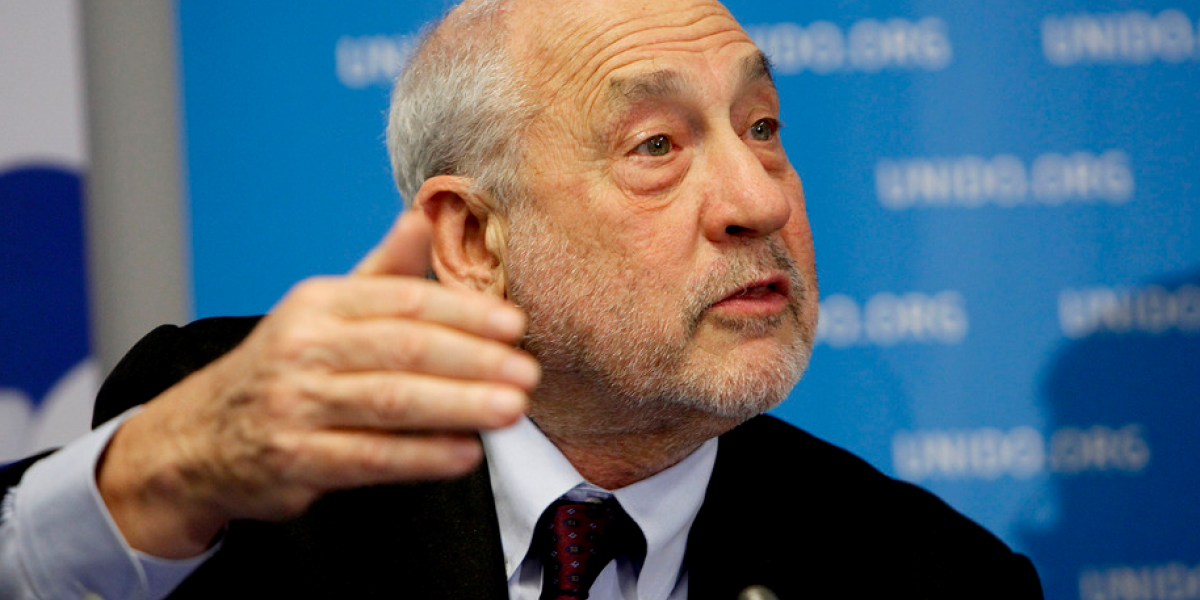
Although this year’s Nobel Memorial Prize in Economic Science winners are relatively favorable toward free markets, we should not forget that most of its winners have been technocrats that their wisdom alone can create the prosperous and “just” economy. Joseph Stiglitz is one of the most obnoxious examples.
Ever since winning the Nobel 2001, Stiglitz has been a one-man advocacy band for growth of the state. After 9/11, for example, he called for the formation of a federal agency to provide security for airline passengers, which he claimed would send a “signal” for quality. (Stiglitz won his prize for “proving” that free markets are “inefficient” and always result in less-than-optimal outcomes because of asymmetric information. Only government in the hands of Really Smart People like Stiglitz can direct production and exchange consistently to efficient and “just” results.)
More than a decade ago, Stiglitz lavished praise for the socialist government of the late Hugo Chavez in Venezuela, declaring:
Venezuelan President Hugo Chavez appears to have had success in bringing health and education to the people in the poor neighborhoods of Caracas, to those who previously saw few benefits of the country’s oil wealth.
He went on to claim that the Chavez policies of expropriating the capital structure of private oil companies in Venezuela would result in a more “equal” distribution of wealth in that country, something he believes is desirable everywhere. Interestingly, since Venezuela’s socialist “experiment” went south, complete with hyperinflation and one of the worst financial and economic crises ever seen in the Western Hemisphere, Stiglitz has been silent, at least when it comes to explaining why the so-called economic miracle in Venezuela was unsustainable.
Although Stigliz no longer is lavishing praise on Venezuelan socialism, he hardly is silent about his belief that only expanded state power can “save” the U.S. economy from self-destruction. In a recent article in Scientific American, he declares that “The American Economy is Rigged.” However, he adds in the title, “And what we can do about it.”
Those familiar with the public declarations of Stiglitz, Paul Krugman, and others in the “markets are internally destructive” camp, nothing Stiglitz writes in the article is surprising. For that matter, it is pure Stiglitz to have it in Scientific American, since he can claim he is engaged in scientific discourse, something he can prove with a lot of mathematical equations that “prove” free markets are bad:
From Stiglitz’s perspective, markets are rife with failure in processing and conveying information, and government must be ready to correct these failures. In his Nobel lecture, Stiglitz spoke of having “undermined” the free-market theories of Adam Smith, asserting that Smith’s “invisible hand” either didn’t exist or had grown “palsied.” He noted that major political debates over the past two decades have tended to focus on the “efficiency of the market economy” and the “appropriate relationship between the market and the government.” His approach favored government.
Furthermore, he declared in his Nobel lecture that “perfect competition is required if markets are to be efficient” (italics his). To Austrian economists, his statement raises the question as to why we are to assume that governments somehow possess the necessary information to produce “efficient” outcomes in economic exchanges, but Stiglitz never has tried to go there. He simply assumes governmental superiority regarding information and then runs with that assumption.
Stiglitz’s latest article lays out the theme that markets systematically produce inequality, and that over time we are faced with the situation in which only a privileged few people benefit from the capitalist system while the vast majority slip into the economic abyss. He writes:
In his celebrated 2013 treatise Capital in the Twenty-First Century, French economist Thomas Piketty shifts the gaze to capitalists. He suggests that the few who own much of a country’s capital save so much that, given the stable and high return to capital (relative to the growth rate of the economy), their share of the national income has been increasing. His theory has, however, been questioned on many grounds. For instance, the savings rate of even the rich in the U.S. is so low, compared with the rich in other countries, that the increase in inequality should be lower here, not greater.
An alternative theory is far more consonant with the facts. Since the mid-1970s the rules of the economic game have been rewritten, both globally and nationally, in ways that advantage the rich and disadvantage the rest. And they have been rewritten further in this perverse direction in the U.S. than in other developed countries—even though the rules in the U.S. were already less favorable to workers. From this perspective, increasing inequality is a matter of choice: a consequence of our policies, laws and regulations.
In the U.S., the market power of large corporations, which was greater than in most other advanced countries to begin with, has increased even more than elsewhere. On the other hand, the market power of workers, which started out less than in most other advanced countries, has fallen further than elsewhere. This is not only because of the shift to a service-sector economy—it is because of the rigged rules of the game, rules set in a political system that is itself rigged through gerrymandering, voter suppression and the influence of money. A vicious spiral has formed: economic inequality translates into political inequality, which leads to rules that favor the wealthy, which in turn reinforces economic inequality.
All of this results in what he calls a “feedback loop” that results in the downward spiral. We are to assume that the growth in income inequality will grow until we are at the Marxian state of “the reserve army of the unemployed,” or at least a reserve army of people that are unable to find work that will allow them to support themselves.
Like so many others who have claimed capitalism is destroying the middle class, Stiglitz turns to the policies created during the Great Depression and after World War II for salvation, seeing the time from the 1930s to the late 1950s as a supposed golden era of prosperity. He writes:
After the New Deal of the 1930s, American inequality went into decline. By the 1950s inequality had receded to such an extent that another Nobel laureate in economics, Simon Kuznets, formulated what came to be called Kuznets’s law. In the early stages of development, as some parts of a country seize new opportunities, inequalities grow, he postulated; in the later stages, they shrink. The theory long fit the data—but then, around the early 1980s, the trend abruptly reversed.
To reverse this trend of rising inequality – and rising poverty – Stiglitz calls for a return to the Depression-era policies of high marginal taxes and using the regulatory structure to recreate the financial and business cartels built by New Deal regulations that dominated American production, finance, and transportation at that time. Indeed, apart from the anti-discrimination laws that now are part of the modern legal landscape, Stiglitz believes that the only hope for our future is to return to the past:
…we need more progressive taxation and high-quality federally funded public education, including affordable access to universities for all, no ruinous loans required. We need modern competition laws to deal with the problems posed by 21st-century market power and stronger enforcement of the laws we do have. We need labor laws that protect workers and their rights to unionize. We need corporate governance laws that curb exorbitant salaries bestowed on chief executives, and we need stronger financial regulations that will prevent banks from engaging in the exploitative practices that have become their hallmark. We need better enforcement of antidiscrimination laws: it is unconscionable that women and minorities get paid a mere fraction of what their white male counterparts receive. We also need more sensible inheritance laws that will reduce the intergenerational transmission of advantage and disadvantage.
Challenging Stiglitz’s Logic
Stiglitz hardly is the only modern economist that wants the American economy to be restructured to resemble how it looked in 1939. Paul Krugman many times called for a “New New Deal” and actually claims that the US middle class didn’t even exist until President Franklin D. Roosevelt created it with his policies.
In reading the Stiglitz “we need” rant, it is clear that he sees the economy as both mechanistic and deterministic. Capital will have increasing returns because, well, capital has increasing returns, which means that over time, capital will increase the incomes of its owners and everyone else will become poorer. In fact, as one goes through the entire article, one can conclude that he believes, like Marx, that a market system is internally unstable and that it always will implode because a few people will see their incomes increase, but only at the expense of the masses, who will see their incomes decrease.
Indeed, if one follows Stiglitz to his logical conclusions, one would have to assume that the U.S. economy is a trap of exploitation and misery for American workers, as they toil longer hours and watch their standard of living slip away. He writes:
At the time of the Civil War, the market value of the slaves in the South was approximately half of the region’s total wealth, including the value of the land and the physical capital—the factories and equipment. The wealth of at least this part of this nation was not based on industry, innovation and commerce but rather on exploitation. Today we have replaced this open exploitation with more insidious forms, which have intensified since the Reagan-Thatcher revolution of the 1980s. This exploitation…is largely to blame for the escalating inequality in the U.S.
Like Krugman, Stiglitz uses an array of statistics and graphs to “prove” that before Ronald Reagan and Margaret Thatcher took power, the American and British economies were ensconced in “equality” and prosperity. For some unknown reason, however, free-market ideas suddenly emerged seemingly from nowhere to influence politicians to create a new economic system that undid the carefully-crafted structured post-New Deal economy which had created the American middle class and turned them into poverty-stricken serfs.
There is a problem with the Stiglitz analysis: It is wrong both theoretically and empirically. First, the 1970s were a decade both of inflation and economic decline in both the USA and Great Britain. In the USA, the economy wavered between inflationary booms (with inflation reaching well over 10 percent) and devastating busts, including the 1974-75 recession, and in Great Britain, the situation was even worse, as demonstrated in a 1977 “60 Minutes” broadcast, “Will There Always Be An England?”
The sad thing is that Stiglitz is trying to claim that Americans were better off economically in 1980 than they are now, which only can mean he believes Americans had a better standard of living 40 years ago than today. Yet, as pointed out by Philip Brewer, it is easy to confuse something like income equality to higher living standards. The so-called Golden Age of the 1950s was a time when a third of Americans lived in poverty. Writes Brewer:
In the 1950s and 1960s, a working man could support a family at a middle-class standard of living with just one income. It might surprise you to learn that one person working full-time, even at minimum wage, can still support a family of four at that standard of living. Nowadays we call that “living in poverty.”
Theoretically, Stiglitz holds that capital and resource owners over time receive increasing returns to capital which has the effect of raising the owners’ income over time, but only at the expense of everyone else. Thus, in his view, capital is the culprit, and as an economy accumulates increasing amounts of capital, income inequality — and poverty — logically follow. The only way to reverse this trend, he believes, is for the state to confiscate huge amounts of income from capital and resource owners and transfer it to lower-income people through welfare payments or availability of government services.
If Stiglitz is correct, it would be the first time in recorded history that capital accumulation gained through a profit-and-loss system would be responsible for decreasing the overall standard of living in an economy. Furthermore, Stiglitz seems to be oblivious to the economic role of capital: increase the supply of goods and services in an economy. By looking only at the income which capital owners gain and by failing to understand the real economic significance of capital accumulation, Stiglitz is left with applying a crabbed Marxist analysis in which the “rich” gain increasing shares of income, thus leaving everyone else with smaller income shares – with the result being an overall “glut” of goods that cannot be sold, leading to increasing numbers of layoffs, unemployment, and ultimate economic collapse. That economists from Jean Baptiste Say to Ludwig von Mises — and, may I add, the historical record — have debunked his arguments fails to keep Stiglitz from repeating them.
By publishing his article in Scientific American and couching his analysis in the language of science, Stiglitz wants us to believe that his viewpoints are systematic and have the aura of inevitability, as though he were describing the results of the Law of Gravity. In reality, Stiglitz simply repeats the fallacies of Thomas Malthus, Karl Marx, and John Maynard Keynes and presents a stiff, mechanistic, and utterly false view of how an economy works.
Throughout history, we have seen how socialism takes an economy backward, whether it is practices in the former U.S.S.R., Mao’s China, Cuba, and now Venezuela. He was unable to comprehend how Venezuela’s “socialist miracle” would fall apart, and now he intellectually is unable and unwilling to engage the truth as to why the deterioration of a socialist economy results in wealth for a few and real poverty for the masses. In other words, he cannot comprehend why the socialist economy is rigged.