For thirty years, American foreign policy has been guided by a ghost. It went by different names like primacy, unipolarity, the rules-based order, but its doctrinal core was always the same: Full Spectrum Dominance (FSD), the belief that the United States must remain militarily superior in every domain, in every region, against every competitor, indefinitely. It was never debated openly because it was seldom declared honestly. The Pentagon said it outright only once, in a 2000-era Joint Vision document, before the phrase was quietly retired. But the idea continued to shape budgets, basing, and grand strategy long after public rhetoric grew bashful about it.
The newly released 2025 National Security Strategy (NSS) finally closes the coffin on FSD. Beneath its triumphant tone and standard claims of American resurgence, the document performs the quiet interment of a doctrine that Washington has been reluctant to admit was dying. For the first time since the end of the Cold War, an official U.S. strategy rejects the premise that America can, should, or will dominate the globe across every domain of power. The text condemns past efforts to pursue “permanent American domination of the entire world” (NSS 2025, p. 1), admits that the United States lacks the resources to sustain such an ambition, and proposes a strategic architecture that only makes sense for a country preparing to shrink its sphere of responsibility, not expand it.
The mainstream coverage of the 2025 National Security Strategy has focused on its political messaging, its break with climate priorities, and its sharp language toward allies and rivals alike. But what the press has largely missed is the structural confession embedded in the text: the United States no longer possesses the military, industrial, or fiscal capacity to enforce the strategic worldview that governed the last three decades. The NSS is not simply a political signal; it is the first formal admission that the unipolar assumptions underwriting U.S. grand strategy have collapsed.
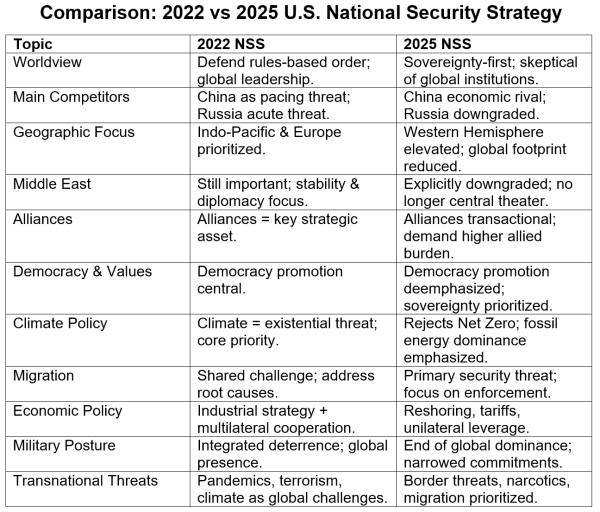
The key story in the NSS is not rhetorical surprises. It is the acknowledgment of constraint. The U.S. has performed poorly in sustaining two proxy conflicts, replenishing basic munitions, maintaining naval shipbuilding schedules, and raising enough recruits for a peacetime force. These failures, rarely mentioned in mainstream analysis of the NSS, are the arithmetic that killed Full Spectrum Dominance. The chart below shows the differences between the latest NSS and the previous 2022 NSS. The following discussion details the indications in the NSS of an historic shift in strategy.
The NSS explicitly condemns the pursuit of global domination
The heart of Full Spectrum Dominance was the belief that American primacy must be total — geographic, technological, and ideological. The 2025 NSS rejects this logic outright: “After the end of the Cold War, American foreign policy elites convinced themselves that permanent American domination of the entire world was in the best interests of our country.” (p. 1)
This is more than an ideological shift; it is a recognition that the United States could not perform global domination even if it wished to. The NSS language reflects a structural truth that has been visible for years in production lines, budgets, and battlefield attrition data — none of which appear in press coverage that treats this repudiation as merely political.
Prioritization replaces omnipresence
Full Spectrum Dominance rested on the idea of simultaneity: the United States must retain the ability to deter or defeat threats in multiple theaters at once. Prioritization was an admission of weakness. Yet the 2025 NSS states bluntly: “A strategy must evaluate, sort, and prioritize. Not every country, region, issue, or cause… can be the focus of American strategy.” (p. 1)
The effective abandonment of the longstanding doctrine that the U.S. must be able to fight and win two major wars at once is arguably the most important shift in the entire document. The NSS does not announce this explicitly, but its logic collapses without it. This acknowledgment of constrained military power has received surprisingly little attention from major outlets, despite the two-war standard being the cornerstone of the post–Cold War force-planning construct.
These statements contradict 30 years of strategic guidance built on the assumption that the U.S. could act everywhere at once. A strategy built on triage signals a military and political system running into constraints it can no longer ignore.
The “Atlas” passage ends the fantasy of global stewardship
No line in the NSS has attracted more attention — or deserves to: “The days of the United States propping up the entire world order like Atlas are over.” (p. 11)
Press coverage has fixated on the theatrical quality of the ‘Atlas’ line. But the deeper meaning lies in the institutional implications: a country that no longer intends to underwrite the global security system is a country that cannot sustain the industrial and logistical architecture that system requires — carrier strike groups, forward bases, constant deployments, and the munitions to support them.
This is not messaging; it is admission. A country that declares it will no longer hold up the world is a country that no longer intends to dominate it. Full Spectrum Dominance was the strength of Atlas: the global network of bases, alliances, carrier groups, intelligence platforms, sanctions regimes, and intervention forces. The NSS declares the end of that burdensome role.
Burden-shifting replaces burden-sharing
For decades, Washington urged allies to spend more while promising to remain the ultimate guarantor of their security. The 2025 NSS crosses a new threshold: it openly aims to export security obligations that the United States can no longer afford. As the strategy puts it, “The United States will organize a burden-sharing and burden-shifting network, with our government as convener and supporter.” (p. 11)
The meaning becomes clearer when paired with an impossible demand: “President Trump has set a new global standard with the Hague Commitment, which pledges NATO countries to spend 5 percent of GDP on defense.” (p. 11) No major NATO member can meet this target, and the NSS does not expect them to. The point is not burden-sharing. It is burden-shedding: using inevitable noncompliance as justification for reducing the U.S. financial commitment to European defense.
The press has treated the 5 percent figure as performative or punitive, but its strategic function is more fundamental: Washington is signaling that it will not fund the military-industrial base required to sustain hegemony. A hegemon builds alliances it can direct. A retrenching power builds alliances it can offload.
Hemispheric consolidation replaces global reach
Instead of treating Europe, the Middle East, and East Asia as co-equal theaters — the triad through which the U.S. enforced global primacy — the NSS elevates the Western Hemisphere as the center of gravity: “We will assert and enforce a Trump Corollary to the Monroe Doctrine.” (p. 15)
This is followed by: “The United States must reconsider our military presence in the Western Hemisphere.” (p. 16) This quiet hemispheric pivot is one of the clearest indicators of retrenchment. A hegemon builds an expeditionary force optimized for distant theaters. A state securing only its own hemisphere abandons the central mechanism of Full Spectrum Dominance: permanent forward presence.
Full Spectrum Dominance required forward presence in every region. A strategy whose focal point is the hemisphere is a strategy contracting into defensible geographic space. This is the opposite of imperial ambition; it is the map of a nation acknowledging limits.
The U.S. abandons regime change ambitions
If Full Spectrum Dominance had an ethos, it was the belief that the world could, and should, be reshaped by American political, economic, and military power. This worldview united liberal internationalists and neoconservatives alike, who treated global democratization as the moral aspect of American hegemony.
The 2025 NSS discards that logic: “A predisposition to non-interventionism… should set a high bar for what constitutes a justified intervention.” (p. 9)
And: “We seek good relations… without imposing on them democratic or other social change.” (p. 9)
This is not a pivot. It is a surrender of a core ideological pillar of U.S. foreign policy.
The NSS admits the U.S. no longer possesses the means of global supremacy
The fatal blow to Full Spectrum Dominance is found on page 1: American elites
“overestimated America’s ability to fund, simultaneously, a massive welfare-regulatory-administrative state alongside a massive military, diplomatic, intelligence, and foreign aid complex.”
These words, almost entirely overlooked in mainstream reporting, are the single most important doctrinal statement in the document. Strategy documents rarely confess resource insufficiency. When they do, it signals not a policy choice but a strategic constraint. This sentence ends the unipolar era, which assumed that the U.S. had the military, industrial, fiscal, and political capacity to sustain global supremacy indefinitely. The NSS says plainly, it does not.
Climate leadership reversed
Where the 2022 NSS called climate change an “existential threat,” the 2025 strategy rejects the entire framework: “We reject the disastrous ‘climate change’ and ‘Net Zero’ ideologies…” (p. 14) The abandonment of climate diplomacy is better understood not as ideological deviation but as a withdrawal from global-system stewardship more broadly.
Migration becomes the central national security threat
“The era of mass migration is over.” (p. 12)
In previous strategies, the central threats were terrorism, great-power competition, or the defense of the “rules-based order.” The 2025 NSS names none of these as the primary danger. Instead, it elevates migration to the center of national security — a framing that only makes sense for a state turning inward.
A global hegemon manages instability abroad. A nation in retrenchment manages its borders. The NSS treats migration not as a humanitarian or economic issue, but as a strategic threat that eclipses the external missions that once justified America’s global posture. This reframing signals a shift from expeditionary problem-solving to territorial defense, a move historically associated with declining empires, not confident superpowers.
Press analysis has treated the migration passages as Trumpist bargaining rhetoric or domestic political theater. But a deeper explanation is simpler: projecting power outward is expensive. Alliances are expensive. The infrastructure of hegemony — forward bases, foreign aid, stabilization missions, training programs — depends on the same budget resources now being redirected toward domestic enforcement. The NSS elevates migration as a primary security threat because it quietly abandons the idea that the United States can still shape international conditions in ways that once limited migration at its source.
Middle East downgraded in strategic priority
A region that depleted U.S. military power over two decades is reclassified as no longer a dominant concern.
“But the days in which the Middle East dominated American foreign policy in both long-term planning and day-to-day execution are thankfully over—not because the Middle East no longer matters, but because it is no longer the constant irritant, and potential source of imminent catastrophe, that it once was.” (p. 29)
Washington’s exhaustion in the region reflects material overstretch more than ideological shift. Lengthy Mideast wars diminished readiness and deferred modernization, costs the NSS now implicitly acknowledges.
Conclusion
The 2025 NSS announces itself as a revival of American strength, but the text tells a different story. Its rhetoric is muscular, but its structure is confessional. The United States is no longer planning to dominate every region, deter every adversary, stabilize every crisis, and redesign every political system. It is no longer willing or able to act as Atlas, shouldering the burden of all global problems with its enormous strength.
Full Spectrum Dominance was not just a military doctrine; it was the enforcement mechanism of American hegemony, the architecture of military power that made the post–Cold War unipolar order possible. And it was that order that made neoconservative foreign policy seem plausible, even inevitable. The death of Full Spectrum Dominance therefore portends the end of neoconservative foreign policy, because the military dominance that once enforced its worldview no longer exists. It is the end of the strategic model that the American elite supported for three decades. The NSS does not inaugurate a new era; it acknowledges that one has already arrived.













-1024x683.jpg "Strait Outta Hormuz: Getting the Iran Oil Story Straight")