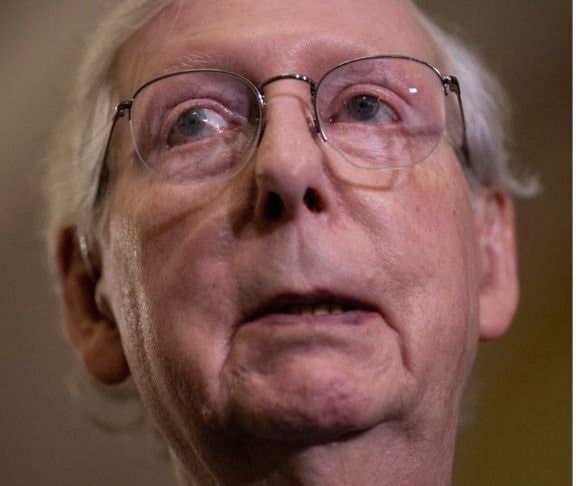
Senator Mitch McConnell (R-KY) finally speaks again. His office announced on June 14 that the Kentucky lawmaker had been hospitalized. While the statement came on the very day it happened, it was light on details. For the next 28 days, McConnell was not heard from directly, and while his office continued to assert he was “receiving excellent care,” it never revealed the reason he was in the hospital to begin with.
But then came the sudden and unexpected death of Sen. Lindsey Graham (R-SC) Saturday night. Now McConnell has broken his silence: He fell, then suffered a bout of pneumonia. He’s recovering, but still it highlights the danger of an aging Senate: Falls are the leading cause of injury and death in the elderly, and pneumonia – which frequently follows a serious fall – is high on the list as well.
The Missing McConnell Is Found
Sen. McConnell released a statement on his health on Sunday, July 12, including a photo of himself and his wife, Elaine Chao. He revealed that he fell and then caught pneumonia – even briefly being unconscious. He has been in the hospital since June 14, but now he has recovered enough to head to a separate recovery facility to regain his strength.
Perhaps it was Sen. Lindsey Graham’s sudden death that spurred this action. And it was sudden. As President Donald Trump explained Sunday on Meet the Press, he had just been on the phone with the man earlier that evening. Graham’s cause of death, according to preliminary reports, was also revealed on Sunday: aortic dissection caused by arteriosclerotic cardiovascular disease. Now, if that sounds like some foreign-language phrase to you, here’s what it means: He suffered a tear in the wall of the aorta, the body’s largest artery, caused by the hardening and narrowing of arteries, which is caused by long-term buildup of cholesterol, fats, and plaque along the inside of blood vessels.
Then again, maybe Senator McConnell simply felt it was finally time. On the one hand, he’s moving to a less critical recovery facility. On the other hand, there’s an understandable reluctance to reveal medical issues, as McConnell himself addressed in his statement on Sunday.
“My doctors have confirmed that I didn’t break any bones or suffer a concussion. I didn’t have a heart attack or a stroke. I don’t have any tumors or hemorrhages,” he explained. “But I was briefly unconscious and was taken to the hospital. While receiving excellent care over the past weeks, I’ve also had to deal with a mild case of pneumonia.”
The 84-year-old lawmaker added that his doctors haven’t cleared him to return to the Senate floor yet, though he assures his constituents that he has been working with his staff and fellow senators.
Perhaps just as importantly, he shared insight into why no one had heard from him for nearly a month: “You know how folks of my generation often hesitate to share the vulnerability that comes with growing older,” he said, addressing the many questions about both his well-being and his long silence. “Even in the public eye, I feel the same instinct – I can’t help it.”
America’s Aging Senate
This wasn’t McConnell’s first health scare recently – but then, he’s also a survivor of childhood polio, which left him with lifetime mobility challenges. And in his own words: “They haven’t exactly gotten easier to manage with age.”
The reticence to reveal age-related health problems is quite common, and McConnell’s blunt, simple explanation is probably the best example of how to understand it: vulnerability. Imagine your body simply giving out on you, betraying your mind and your will to get things done for no other reason than it’s simply worn out. A month of silence from an elected official in the hospital is a lot – but it’s also hard to blame him for staying quiet. Who would want their medical issues broadcast to the world, at any age?
McConnell is retiring at the end of this term – a decision he announced last year. But he’s not the oldest. Sen. Chuck Grassley (R-IA) has him beat by almost a decade. In fact, of the 100 senators in the 119th Congress (still counting Sen. Graham, as he was a big part of this session), 28 are 70 or older. The average overall life expectancy for US adults is 79 years, and nearly a third of the Senate – a high-stress job frequently requiring all-nighters and lots of travel – is already at or past it (nine) or within a decade of it (19).
The 119th Congress has been one of the oldest in America’s history – third oldest, in fact, and all of the oldest three have been since 2017. According to data from the Library of Congress, the average member age for the Senate specifically hovered between 56 and 58 from 1919 to 1971. It dropped briefly through the 70s, but in 1983 the average age began a steady climb that hasn’t stopped yet. The House’s line on the graph looks almost identical, if slightly lower.
Many have called over the years for a health disclosure rule. Members of Congress must disclose their personal finances, including their stocks and other investments, and any property owned. They have to reveal any gifts or travel-related reimbursements, as well as any positions held in businesses, educational institutions, and non-profits outside of Congress. But there has never been a rule made requiring regular health disclosures and qualifications. Perhaps that’s because the only people who can make that rule are the very ones subject to it.





-1024x683.jpg "Democrats’ Hopes for the House Rely on Moderates, Not Socialists")