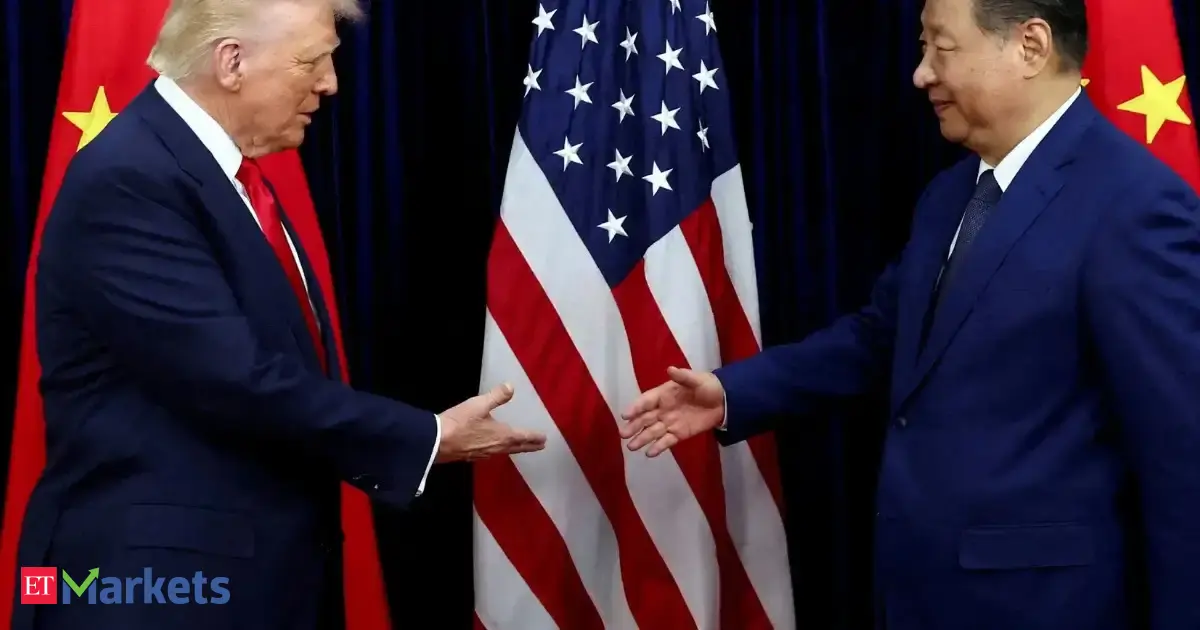
Speaking to ET Now, market strategist from China Market Research Group & Author Shaun Rein described the summit as one of the most consequential diplomatic engagements in recent years, particularly against the backdrop of trade disputes, AI rivalry and mounting tensions in West Asia.
“This is an important meeting. This is the first time that an American president has stepped foot in China nine years since Trump started the trade war back in 2017-2018 and the whole world, India, United States, Europe, Africa, we have all suffered from the geopolitical split and tension between the US and China,” Rein said.
He pointed out that export controls imposed by Washington on advanced technologies, including AI chips and semiconductors, had intensified the economic divide between the two nations. China, in response, has leveraged its dominance in refined rare earths, a critical input for global manufacturing and electronics.
“As America has forbidden and put export controls on all types of products from Nvidia chips to being exported to China, China has retaliated by holding the Sword of Damocles over the rest of the world, saying, will we send out Chinese refined rare earths or not,” he said.
West Asia Crisis Likely to Dominate DiscussionsWhile trade and AI remain major strategic concerns, Rein believes the worsening conflict in West Asia could overshadow economic discussions during the summit.“Well, trade, AI, and just competing visions of the global world order is very important. But unfortunately, because Trump has had a self-inflicted wound by invading Iran through bombs, that is what the large part of the discussion is going to be,” Rein said.According to him, Washington is increasingly dependent on Beijing’s diplomatic leverage to ease tensions involving Iran and the Strait of Hormuz, a critical global oil shipping route.
He argued that China’s interests align more closely with restoring stability in the Middle East rather than prolonging conflict.
“We have to remember they do $108 billion of trade with Saudi Arabia, $103 billion of trade with UAE, and only officially about 15 billion of trade with Iran,” Rein noted, adding that China’s broader economic priorities in the region outweigh its ties with Tehran.
Rein also said China would prefer an end to regional tensions as inflationary pressures begin to re-emerge domestically.
“So, China says, what, let us try to work with the United States and get a win to fix the problems in the Middle East because I do not think that China is as close to Iran as a lot of Americans believe they are,” he added.
Supply Chain Decoupling Still IntactDespite expectations surrounding the summit, Rein warned that the broader decoupling of US and Chinese supply chains is unlikely to reverse anytime soon.
He said Chinese companies and policymakers no longer trust long-term access to American technology after years of export restrictions and sanctions.
“So, the Chinese will never ever after a decade of being harassed and oppressed by the United States build their AI and their technology sector on the American tech stack anymore. They are going to focus on indigenous innovation,” he said.
Rein suggested investors should increasingly watch domestic Chinese technology players rather than American firms dependent on China exposure.
“So, investors should be looking at Chinese players like Cambricon, SMIC, Hua Hong. The Chinese players are going to do well because nobody in China can trust that they will be able to rely on the American tech stack,” he said.
He also argued that countries across the Global South have become wary of relying too heavily on US-controlled technologies and financial systems after Washington’s repeated use of sanctions and economic restrictions.
China Holds Stronger Position, Says ReinOn the balance of power between Washington and Beijing, Rein said China currently holds greater leverage in both trade and geopolitics.
“China clearly has won the trade war. China clearly has more leverage over the United States right now,” he said.
According to Rein, China’s influence extends far beyond rare earths and electronics, covering pharmaceuticals, antibiotics and key industrial supply chains that are deeply embedded in the global economy.
“It is the fact that China also controls along with India a combined 95% of antibiotic production. It also makes almost 100% of ibuprofen and paracetamol,” he said.
Rein argued that deteriorating ties between the United States and several traditional allies had further strengthened China’s global position.
“But the problem is Trump has ticked off his allies, Canada, France, Germany, and these leaders of these countries have all visited Xi Jinping and made the pilgrimage to China in the last two months,” he said.
India’s Strategic Position Under SpotlightRein also spoke extensively about India’s evolving role amid shifting global alliances, suggesting that India has the potential to emerge as one of the world’s leading superpowers over the long term.
“I believe India should and will become one of the three major global superpowers,” he said.
However, he questioned New Delhi’s current balancing strategy between Washington and Beijing and argued that India should adopt a more pragmatic relationship with China.
“I am happy to see that direct flights between the two countries have come back. I am glad to see that more visas are being issued both ways. Both countries should be working together to offset western imperialism,” Rein said.
He added that India should remain cautious about becoming overly dependent on the United States.
“You need to understand that the United States will do all that it can to prevent India from getting too strong,” he said.
As markets assess the possible outcomes of the Trump-Xi meeting, analysts believe even a temporary easing of rhetoric between the two nations could provide relief to global businesses grappling with geopolitical uncertainty, disrupted supply chains and shifting trade policies.