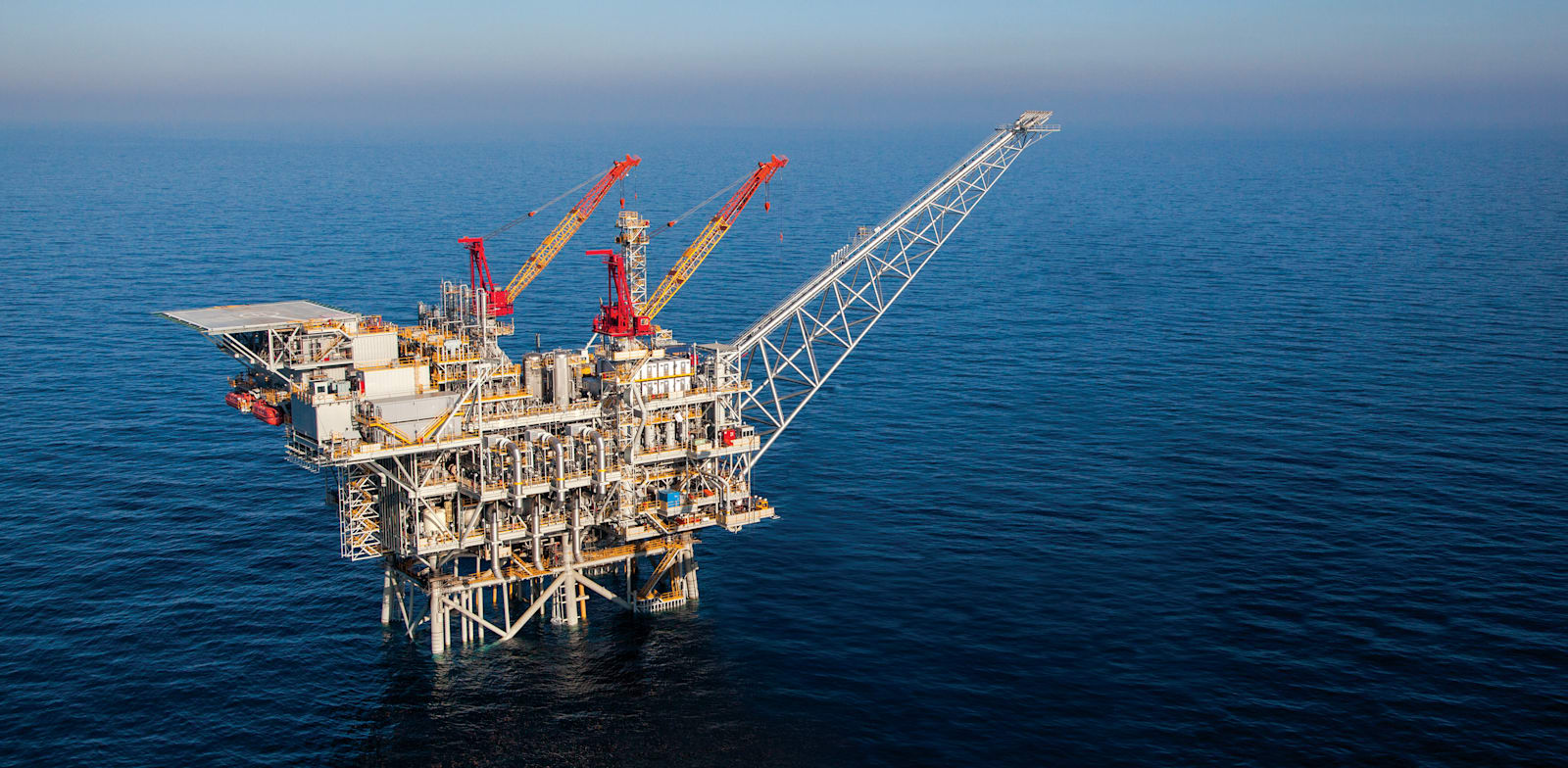
Israel’s Tamar offshore gas field has boosted production 45% to 16 billion cubic meters (BCM) of natural gas annually, which slightly exceeds the 15.8 BCM annual production from the Leviathan field. This is the first time that annual production at the Tamar gas field will have surpassed the far larger Leviathan offshore gas field. Tamar Partners Tamar Petroleum (TASE: TMRP) and Isramco (TASE: ISRA) saw their share prices rising sharply on the Tel Aviv Stock Exchange (TASE) today.
The expansion of production at the Tamar field was achieved at an investment of $664 million and included, laying a third 150 kilometer gas pipeline from the reservoir to the production platform in Ashdod, as well as upgrading compressors at the production facility itself. The project was carried out by Chevron, Tamar’s operator, which also operates the Leviathan field.
The work was carried out during the most recent war with Iran, while the international contractors of the Tamar reservoir continued to work even during the war, while the Tamar field was the only one producing gas, due to the Ministry of Energy’s order to stop gas production from the Leviathan and Karish fields for over a month.
The significance of increasing Tamar’s production capacity is that in the event of war, the Tamar reservoir will be able to supply a larger amount of gas to the domestic economy, thus relying less on coal and diesel as emergency fuels.
Competition for gas agreements with new power plants
The Tamar reservoir is Israel’s second largest in terms of gas reserves but is now the largest in terms of the rate of production for Israeli consumers, according to the Gas Authority’s 2025 report. 47% of gas for power plants and local factories comes from the Tamar field, followed by 41% from the smaller Karish field, and just 12% from Leviathan.
In terms of exports, Leviathan supplies the vast majority (74%) of the gas, mainly to Egypt and the rest to Jordan, while the Tamar reservoir supplies only 26% of exports.
A number of gas-fired power plants are expected to be built in Israel in the coming years, and not all of them have yet signed gas agreements. OPC Energy (TASE: OPCE) will build a power plant in Hadera and has not yet signed a gas agreement, and Dorad (Luzon, the State and others) and Reindeer (Generation Capital) are competing for the additional space in the electricity grid, which will also have to sign gas agreements soon.
RELATED ARTICLES
IEC signs huge gas supply MoU with Tamar partners
Leviathan production capacity exceeds expectations
Leviathan partners sign $35b Egyptian gas export deal
The Leviathan field has also expanded production to 15.8 BCM per year, which is significantly higher than the initially planned (14 BCM). Due to the agreement between the Leviathan reservoir and the state for export to Egypt, Leviathan is committed to selling at a relatively cheap price to the domestic economy, which means that both fields are competing to sign gas agreements with the new power plants.
In addition, the Tamar field also has an export contract with Egypt and will increase gas exports once the new gas pipeline between Israel and Egypt is built, in Nitzana. A few months ago, all of the gas fields in Israel signed their share of the investment for the development of the pipeline, and it is currently under construction.
Published by Globes, Israel business news – en.globes.co.il – on June 16, 2026.
© Copyright of Globes Publisher Itonut (1983) Ltd., 2026.