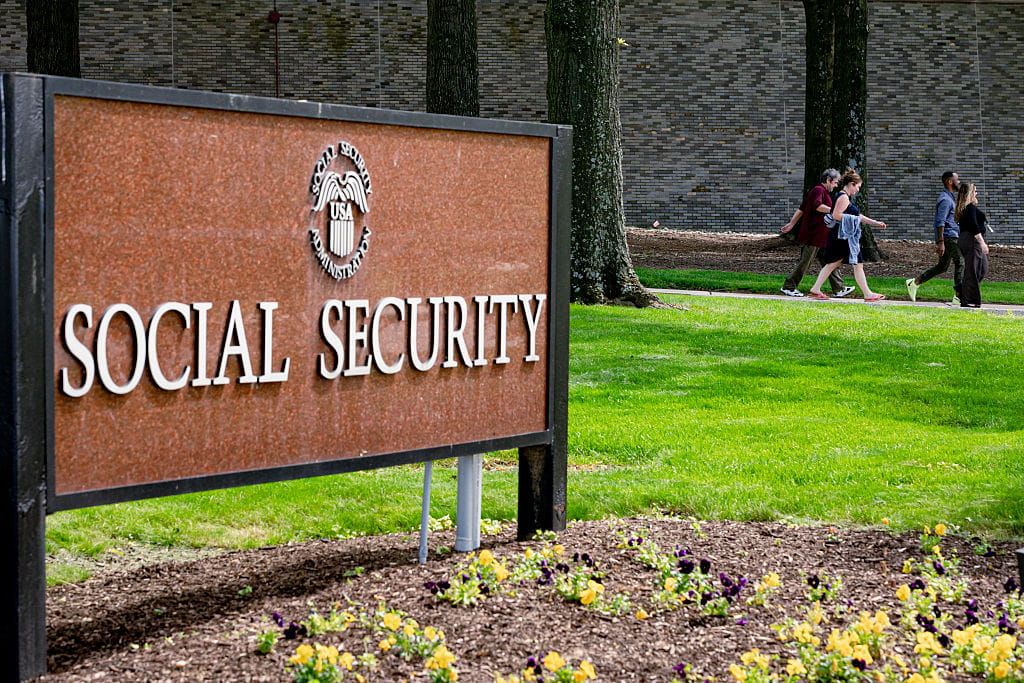
Social Security checks may be reduced in six years – months earlier than previously estimated. If Congress doesn’t allocate funds for the program, it is expected to run out of money by 2032, according to a new report released by Social Security’s trustees.
The Old-Age and Survivors Insurance Trust Fund (OASI) is an account in the United States Treasury that “provides automatic spending authority” to issue monthly payments to retired beneficiaries and the survivors of deceased insured workers. The spending authority is automatic, allowing the Social Security Administration to proceed with benefit payments without requesting funds from Congress.
That authority, however, may not mean much if the program’s funding runs dry. As the trustees’ report explained: “The OASI Trust Fund is projected to become depleted in the fourth quarter of 2032, one quarter earlier than projected in last year’s report. Upon reserve depletion in 2032, projected income is sufficient to pay 78 percent of scheduled benefits. This percentage declines gradually to 62 percent by 2100.”
The Future of Social Security
This year, over 70 million people have received Social Security benefits so far. If Congress fails to act, those beneficiaries could face automatic payment cuts of over 20%. According to the Committee for a Responsible Federal Budget, estimated monthly benefit cuts could exceed $500 in 29 states. Retirees in Delaware, Massachusetts, Connecticut, Maryland, Minnesota, Michigan, New Jersey, New Hampshire, Utah, and Washington would likely experience the largest reductions.
In all but three states, “[m]ore than 15% of the population would be directly impacted” by the expected cuts, “with the largest share of the population impacted in Delaware, Maine, Michigan, Montana, New Hampshire, Pennsylvania, South Carolina, Vermont, West Virginia, and Wisconsin.”
“The Trustees recommend that lawmakers address the projected trust fund shortfalls in a timely way to phase in necessary changes gradually and give workers and beneficiaries time to adjust,” the report stated. “Implementing changes sooner rather than later would allow more generations to share in the needed revenue increases or reductions in scheduled benefits.”
Experts and pro-Social Security activists alike have proposed a range of “solutions” to prevent the funding shortfall, including increasing the payroll tax rate and raising the age at which Americans become eligible for benefits. Of course, most of the recommended fixes could be political suicide. Shifting more of Social Security’s financial burden onto younger workers would undoubtedly anger Millennial and Gen Z voters, but cutting benefits would enrage Boomers – a massive voting bloc that many politicians have been afraid to cross for decades.
Social Security for Younger Generations
With Social Security’s long-term future uncertain, should younger generations assume they will never receive a dime from the program? Not according to Ronnie Thompson, owner of True North Advisors, a financial advising firm.
“For young people today, I do not fear that Social Security will not exist when they go to retire, rather it might just look different,” Thompson said. “The ages you can elect and benefit amounts you receive may vary and that could be positive or negative depending on how this may shift over time. In the end, I think the benefit will exist.”
Still, Thompson acknowledged the unstable system holding up the provocative program. “Social Security demands that for every one person taking it, three people are paying into it. Recently, there [have] been concerns that this is shifting towards two people paying in for every one person taking the benefit,” Thompson continued. “If we reach that point, the concern of the long-term stability of Social Security comes into question.”






-1024x683.jpg "Democrats Coy About Possible Trump Impeachment as Midterms Loom")