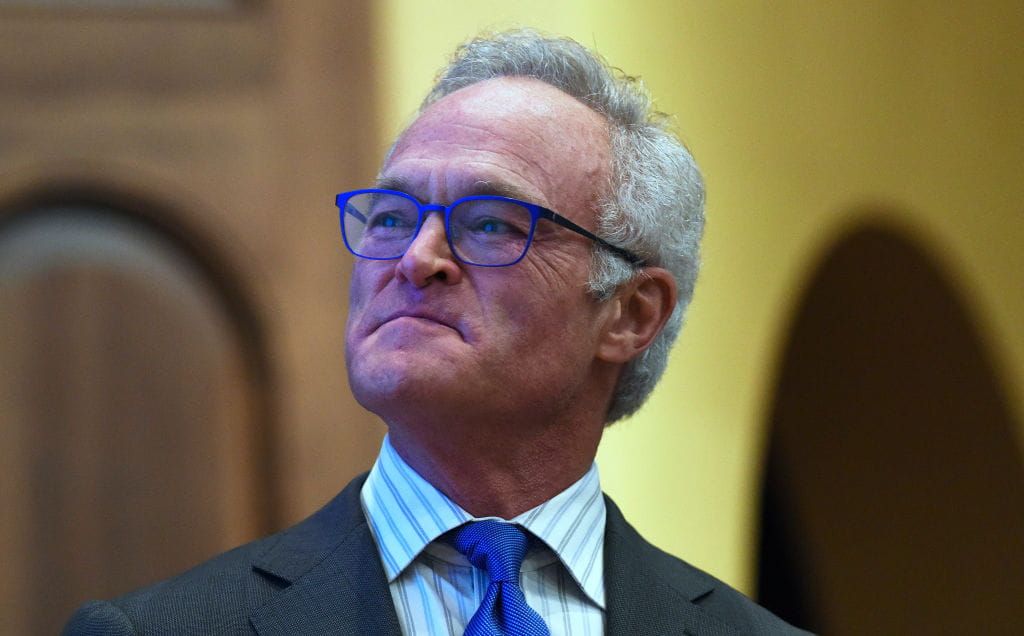
There are times in life when you don’t dare ask someone a simple “How are you?” for fear of them backing up their emotional 18-wheeler and dumping its contents all over you. That must have been at least part of the reaction of New York Times reporter Lulu Garcia-Navarro when she sat down with former CBS employee Scott Pelley last week. In what turned out to be a tearful encounter session, Pelley touched on a range of feelings and barely managed to hold back tears twice. All the whimpering had to do with a purge of several 60 Minutes personnel, including Pelley.
Backtracking a bit, it’s logical to conclude that this was always how it was going to end for the crew at 60 Minutes. However, what seems obvious to the outsider apparently did not dawn on someone inside the tent. That is, the hiring of Bari Weiss as the head honcho of CBS News was meant to bring some semblance of balance to the network and would likely result in the termination of many in the newsroom.
Weiss is not a political hardliner, but she was brought in to do a job and is apparently serious about accomplishing her goals. As National Review opined, “But despite claims that she aims to shift CBS to the political right, Weiss is a self-identified ‘left-leaning centrist’ whose stated goal is to serve the forgotten majority of Americans who are neither part of ‘an America-loathing far left’ nor a ‘history-erasing far right’ and have been ill-served.”
The reason Pelley took his firing so hard was probably the insulated cocoon that enveloped him. When you work, socialize, and hear only from those in your political echo chamber, it’s difficult to recognize that there is another point of view that exists. In other words, the longtime broadcaster could not see – could not conceive – that his programs had turned hard left. The partiality that had taken over the network of some of the most famed broadcast journalists had made it a biased left-wing operation, plain and simple.
Pelley seemed astonished that someone as well-heeled, well-read, and just, well, wonderful as himself could potentially be fired. Who were these nobodies coming after him? Griping and grumbling throughout the interview, the former CBS newsman summed up his new boss with more than a little bristling hubris:
“Look, she’s a lovely person. And her Free Press organization that she founded has been very successful. But television’s not her thing. This is like somebody walking up to me and saying, ‘There’s a 747, there are 400 people on it, we need you to fly it to Paris.’ I’m going to decline because I don’t have a clue. And it would have been so much better if Bari Weiss had been offered this job and said, ‘Oh, that’s not for me, I don’t know how to do that.’”
Lack of experience in broadcast news seemed to be Pelley’s overarching point. He issued similar complaints about the hiring of Nick Bilton as 60 Minutes’ new executive producer: “I’m sure he must be a wonderful man, but no one had ever heard of him. He has zero experience in television.”
More Than 60 Minutes of Fame and Fortune
All told, the 68-year-old Pelley has spent more than half his life at CBS News. For inquiring minds, creators of documentaries – which 60 Minutes is in the purest sense – hold plum positions in broadcast news. This is because TV journalists were historically considered lightweight newspeople. By its very nature, television news must deliver its content a mile wide and only an inch deep. But as more and more of the American public found the tube the easiest way to digest the news, broadcast reporters morphed into celebrities, with Pelley among them. It fits right in with the genre.
Thus, it’s understandable that Pelley feels a certain amount of ownership regarding 60 Minutes. The program debuted in the tumultuous year of 1968. It was a time when Dr. Martin Luther King Jr. and Robert F. Kennedy were shot and killed. College campuses were filled with anti-war protesters, but we were still two years from tragedies in places like Kent State, where four students were killed. These early years – with the war, the hippie and black power movements, and let’s not forget Watergate – were perfect for the 60 Minutes art form.
It could be said that those who worked on 60 Minutes had a certain, shall we say, gravitas that most broadcast journalists covet. Pelley was in his element near the top of the food chain. But it would seem his proprietary attitude toward the program was part of his downfall.
To put it succinctly, he began to believe his own press.
The January Disaster
The featured segment on the Jan. 18 episode of 60 Minutes concerned illegal immigrants to the United States who were sent to an uber prison in El Salvador. Weiss pulled the segment because she felt it was too one-sided. The program ultimately ran, but it was nothing short of a ratings disaster, with only 4.9 million viewers. This is only a small slice of ratings, but it makes the point that people were getting sick and tired of the bias in reporting that was evident to all. All, except perhaps Pelley and friends.
Then in February – in a moment of either abject cluelessness or a flash of “stick this one in your pipe and smoke it” – Pelley hammered President Donald Trump, saying:
“It’s too soon to tell how serious President Trump is in defiance of the Constitution. Presidents often push limits — FDR’s New Deal, for example — and voters in this last election wanted change. But the scope and speed of Trump’s reach for power may be unprecedented.”
By the time Nick Bilton was hired as executive producer of 60 Minutes, Pelley was loaded for bear. Now when you dress down your boss in front of a crowd, you can be sure to expect some blowback. And that’s precisely what happened.
In his termination letter to Pelley, Bilton came to the party with both barrels locked and loaded:
“I started this job excited to collaborate and to benefit from the wisdom and experience of the 60 Minutes veterans, with you among them. For that reason, one of the first things I did in my new role was call you to talk and invite you to dinner. It is a profound disappointment that you rejected that overture and chose ambush instead. Yesterday, you hijacked my first meeting with staff to disparage me, my qualifications, and my intentions with remarkable incivility and contempt. I welcome a diversity of viewpoints and respectful debate among the team, but this was nothing of the sort. Yesterday’s performative display of hostility – enacted in front of the staff instead of in a civil, private conversation – demonstrated that you have no interest in contributing to the future success of the show, or approaching my new tenure with a mind open to collaboration and progress. I am here to deliver first-in-class news programming, not to make headlines about newsroom drama.”
Anyone who has ever worked in a broadcast television newsroom knows the internecine conflicts that often envelop those who work there. Perhaps it’s brought about by the very nature of the beast. That big black hole must be filled each and every hour, day, or week. Unlike newspapers and digital news operations, which expand and contract depending on their content, TV news does not offer that luxury. If your program isn’t ready for its time slot, there’s nothing but a big black hole, and you’re “sucking swamp water,“ as they say in the business.
When the emotional component of Pelley’s argument is removed, his demise comes down to the simple fact that he wasn’t willing to change his tune and return to a less biased way of presenting 60 Minutes segments. For surely he knew that the jig was up when Weiss was hired to lead the CBS News division. It also helps to realize that if you are not at the top of the corporate food chain, your options are simple: either get with the program or get the hell out.