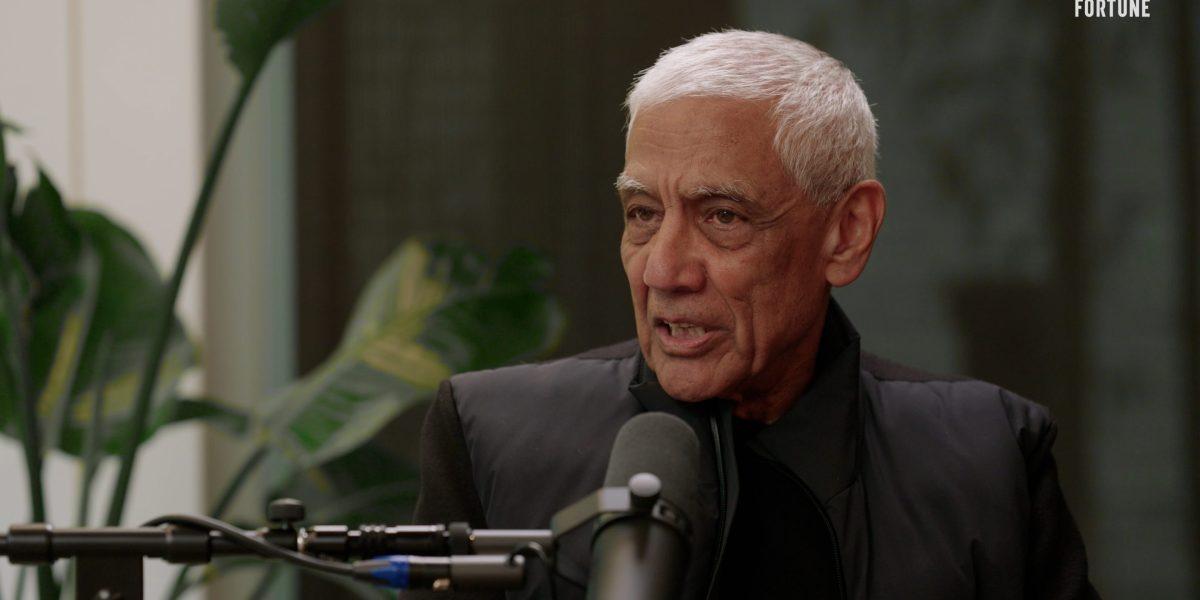
Vinod Khosla has been thinking about artificial intelligence longer than most, and betting on it longer than almost anyone. The legendary venture capitalist who scored a 2,500x return with Juniper Networks and became the first institutional investor in OpenAI—wiring in $50 million at a $1 billion valuation—has a message for anyone fretting about AI taking their job: That’s probably going to happen, but it ultimately can be a good thing.
In a new episode of Fortune’s Titans and Disruptors of Industry podcast, Khosla sat down with Fortune editor-in-chief Alyson Shontell to expand on his vision of an AI-transformed economy—for better and worse. The picture he painted was both exhilarating and deeply unsettling, a world of radical abundance built on the rubble of the labor market as we know it. And unlike recent doomsday essays that have shaken markets, Khosla’s is a vision of equality and prosperity, not collapse. He stressed, however, that policymakers have to get things right.
The 80% number
Khosla did not hedge. “Starting in about 2030,” he predicted, “80% of all jobs, so two-thirds of all jobs, will be capable of being done by an AI.” Physicians, radiologists, accountants, chip designers, and salespeople—all those roles, he said, could be done better by AI than humans.
The timing lands squarely in the crosshairs of warnings that have already rattled markets, some from unlikely places. Citrini Research, source of the top finance Substack, published a viral “thought exercise” in February framing the AI moment as a “global intelligence crisis”—a reckoning for every business model built on “friction,” or the human effort embedded in economic life that AI is now beginning to route around. Citrini’s hypothetical 2028 scenario envisions national unemployment printing at 10.2% and the S&P 500 suffering a 38% peak-to-trough crash. The essay was viewed over 85 million times on X, and the Dow fell more than 800 points the Monday after it circulated.
Khosla offered a calculation of the issue’s size and scope: “$15 trillion of U.S. GDP is labor,” he said, “$15 trillion that will mostly go away.” He framed this not as a catastrophe but as a structural transformation—a deflationary shock that conventional economists are not adequately modeling. “That’s a hugely deflationary economy,” Khosla said, adding that nobody is factoring that into their forecasts for the future. (Citrini called this “ghost GDP” and warned of a “deflationary spiral” with aftereffects far beyond the white-collar workforce, because “machines spend zero dollars on discretionary goods.”) But there is a good aspect of this kind of deflation, Khosla argued: abundance.
What becomes cheap or free
Khosla’s deflationary vision is built on a series of sectors collapsing in cost. Khosla believes AI and robotics will be able to produce most currently pricey goods very cheaply, creating a deflationary economy in which almost all labor and expertise will become free. Because the cost to produce goods will plummet, the amount of money everyone needs to thrive will decrease significantly. He predicts that by 2040, $10,000 could buy you more than a $100,000 income could today, including your house, education, food, and health care. That tab could be more easily picked up by governments in the form of universal basic income, an AI-productivity-driven wealth fund, or some other mechanism.
“Health care, except interventional procedures like heart surgery, will be near free,” he predicted. Farm labor, assembly line work, retail, accounting—all of it, in his telling, will be subsumed by robotics and AI agents available for “a few hundred dollars a month.” He said robots will function in the economy similarly to how car leases function now. “The way you pay a few hundred dollars a month for a car, you’d pay for a robot in the house.”
Khosla’s remarks recalled those from economic expert Kent Smetters, director of the Penn Wharton Budget Model, who told Fortune in January that so many goods have been deflated in price that people don’t fully appreciate the benefits. “The reality is that, in fact, we have a much higher standard of living than we had even 20 or 30 years ago,” he said. “I’m not saying there’s no problems,” but it’s a much different world from when, say, you had to budget for your car breaking down over and over again. Now imagine that level of improvement, Khosla argued to Shontell, projected across the entire economy.
The Citrini essay offered a more harrowing preview of the same deflationary transition. If and when AI agents begin operating 24/7 to optimize consumer decisions, businesses built on “habitual intermediation”—from food delivery apps to credit card interchange fees—will face a relentless race to the bottom. Travel booking platforms will fall first, Citrini predicted, with agents able to assemble a complete itinerary faster and cheaper than any platform by late 2026. “Their moats were made of friction,” the essay reads. “And friction is going to zero.”
Wall Street has pushed back on the doomsday framing. Citadel Securities published a blistering takedown of the Citrini essay, noting, for instance, that demand for software engineers is up 11% year over year, and more broadly arguing that productivity shocks have historically expanded output and raised real incomes. Morgan Stanley predicted a wave of entirely new roles—chief AI officers, computational geneticists, and “vibe coding” product managers. The Deutsche Bank Research Institute’s proprietary AI tool forecast that while 92 million jobs will be eliminated by 2030, 170 million new roles will be created.
Khosla put it differently, arguing that policy will have to play a bigger role than just praying that capitalism works out how to fix this brewing, self-created conundrum of AI abundance.
The policy fix
The most politically charged part of Khosla’s argument is also, he contended, the most urgent. “Capitalism is by permission of democracy,” he said, explaining that functioning markets require properly aligned incentives, and the democratic process plays a crucial role in governing those. In a world with incentives run wild, that can break down. “You can’t leave 80% of the population behind,” Khosla said. “They will revoke capitalism if that happens.”
His proposed solution is a tax overhaul: Eliminate income taxes entirely for everyone making under $100,000 a year, starting in 2030. The roughly 123 million Americans who earn below that threshold would see their federal income tax bill go to zero. The shortfall would be made up by taxing capital gains at the same rate as ordinary income, with Khosla noting that “40% of all capital gains is paid by people making more than $10 million a year,” making the math work. Beyond tax reform, he floated a national wealth fund modeled on Norway’s oil fund, as well as robot and AI taxes, universal basic income, and near-free government services.
Khosla’s optimism comes with a significant caveat. The 2030–40 period, he predicted, will be “really chaotic, and country by country, different,” echoing remarks in a previous Titans episode from Sir Demis Hassabis, Nobel laureate and cofounder of Google DeepMind. JPMorgan Chase CEO Jamie Dimon is also urging businesses and governments to proactively prepare for AI-driven job displacement before it becomes a crisis.
According to Khosla, nations that resist AI adoption—he cited Germany in particular, where robots are currently prohibited from working in retail on Sundays under labor protection laws—risk falling catastrophically behind.
The Trump administration offers reasons for both optimism and concern, he said, calling it “very good about less regulation and wanting to win, very poor about taking care of the people who need taking care of.” Without policies that cushion the disruption, he warned of “chaos in society and maybe the breakdown of social norms.”
Running through Khosla’s argument is a generational inflection point. The advice parents have given children for decades—study hard, get into college, get a good job—will become “bad advice” within 15 years, he said. “AI will free us to be more human,” he said, as AI largely eliminates unloved jobs that were necessary for a previous period in human development. They’re the ones that, in his words, amount to servitude—“an assembly line worker … mounting a tire for eight hours a day for 30 or 40 years” or “a farmworker … hunched over in 100-degree heat, picking lettuce.”
Whether or not Khosla’s imagined utopia materializes, he acknowledged, depends on whether governments get policy right. “I think we will have enough abundance,” he said. “The need to work will go away.” The question—politically, economically, and humanly—is what takes work’s place.