Israeli sanitaryware company Hamat decided last week to shut down the operations of MCP, its Turkish subsidiary in Izmir due to the difficulties in marketing its products on the local market and other markets outside Israel. The closure of the company, which produced ceramic sanitaryware, is another step in an ongoing process in which Israel is gradually disconnecting from Turkish industry.
The move was expected given Ankara’s strict anti-Israel trade policy, but from a business perspective it is a missed opportunity. Turkish industry is a major engine for the local economy, and after a slowdown in industrial output growth from 1.61% to 0.38%, last year there has been a new jump to 2.58%. This recovery has boosted Turkish production from $262 billion in 2024 to $273.4 billion in 2025.
Hamat’s decision leaves the presence of Israeli-owned business assets in Turkey even more limited, to the point of being negligible. Due to the current trend, it seems that just as the economy has already become accustomed to minimal trade relations with the Turks, a similar picture will now characterize direct economic activity in the country.
Dr. Galia Lindenstrauss, a senior research fellow at the Institute for National Security Studies (INSS), notes that in contrast to imports from Turkey to Israel, which are still taking place on a limited scale through third countries, Israeli exports to Turkey have completely stopped. She adds in this context that “Israeli companies that operated in Turkey are also having difficulty – as is evident from the closure of Hamat’s operations in Turkey.”
A complex business picture, in the shadow of political tensions
Israel ended 2025 with imports of goods from Turkey totaling $924.1 million, compared with about $2 billion in 2024, while exports fell from $598.6 million to only $10.9 million. The dramatic gap stems from the decision of Turkish President Recep Tayyip Erdogan in May 2024 to impose a complete trade embargo on Israel – an unprecedented step in relations between the countries, which was revealed at the time in Globes.
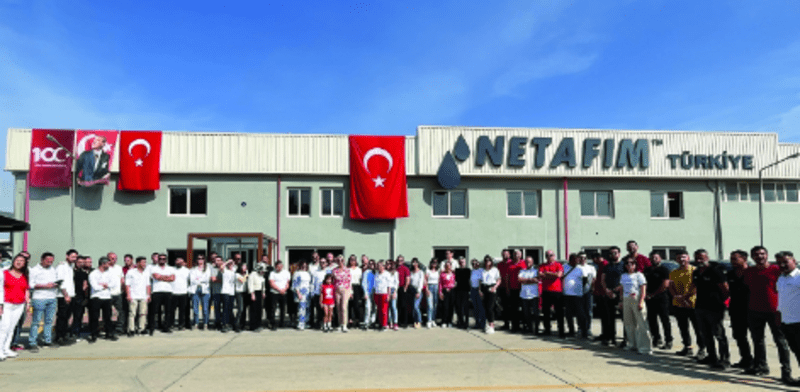
Despite the tensions, Israeli irrigation company Netafim continues to maintain operations in Turkey. Ownership in the company is divided between Mexico’s Orbia Corp., which owns 80%, and Kibbutz Hatzerim, which owns 20%. The company’s Turkish facility is responsible for the production and marketing of irrigation and agricultural support products for Turkey itself, and not for export. Another Israeli company that still operates in the country as part of its global deployment is ICL (formerly Israel Chemicals). The company operates 38 production sites in 13 countries, including the UK, Brazil, China, Australia and Turkey. The Rotem plant, located in the city of Bandirma, produces calcium phosphate and industrial cleaning materials, according to ICL.
RELATED ARTICLES
Turkey tightens trade embargo against Israel
Turkey prevents ZIM ship from docking at Istanbul Port
Teva Pharmaceuticals also includes the Turkish market as part of its international operations. The company’s Turkish headquarters are in Istanbul, which is the center for commercial drug marketing activities in the country, alongside collaborations with local organizations to improve access to medical care.
The Turkish market presents extensive business potential for companies in many fields, partly due to the size of the Turkish population of 87.9 million residents.
In contrast, the Central Bottling Company – Coca Cola – a large private company that was active in Turkey in the past – has not held any assets there for about two years.
Before the Marmara Gaza flotilla crisis in 2010, the company acquired Tuborg Turkey, the second-largest beer producer in the country at the time, which held a market share of 35%, for $80 million. However, during the war, the company completed divestment of its assets in Turkey.
Explorations to reduce tensions
A senior Israeli businessperson, who still works with Turkey on a large scale worldwide, tells “Globes” nothing will change until there is a different approach from the government in Ankara towards Israel. “From the Turks’ perspective, there are all kinds of explorations to reduce tensions and find a certain common ground with Israel,” he says, “However, until there are different results in the elections, there will be no change. At the root of the problem is a personal issue between Erdogan and Netanyahu. Will a new Israeli leadership be more cooperative diplomatically with Turkey? It is possible. The Turkish goal is to gain better access to activity in the Gaza Strip.”
Although Turkish-made products can still be found on Israeli shelves, such as Uluda? brand cheese or Alpedo ice cream, food imports from the country have never been considered a leading industry. On the other hand, in other sectors, a dramatic change has occurred, and Israel, which in the past relied significantly on Turkey’s status as an international textile powerhouse, has almost withdrawn from there. Today, the Israeli presence in this field is completely negligible and amounts to a single Delta Galilee sock factory.
Long-standing ties with traders
The bottom line is that Israeli companies that remain active in Turkey expose themselves to risks that become increasingly severe the larger and better known the company becomes. A striking illustration of this was seen last August, when Turkey decided to block ZIM ships – a step that was first reported in “Globes” and was influenced by prolonged protests and even sabotage attempts in the Turkish ports where the company operated.
These protests went beyond just ZIM alone, and even Israeli companies. Azerbaijan’s national oil company, SOCAR, also faced unusual protests due to its extensive activities in Turkey and its continued supply of oil to Israel during the war. The protesters refrained from pointing an accusing finger at Erdogan, even though the oil is pumped to Israel via Turkey via the Baku-Tbilisi-Ceyhan pipeline and from there loaded onto tankers at the Turkish port of Ceyhan.
“In terms of the willingness of Turkish traders to still trade with Israelis, it should be remembered that some of these ties are long-standing, with a lot of mutual benefit,” concludes Dr. Lindenstrauss. She adds, “The fact that Israel and Turkey are in many ways complementary economies and the short distance between the countries makes shipping costs negligible – and therefore this is an advantage that is difficult to give up. The concern is of a backlash from the Turkish public, but as long as it can be done quietly, especially if these are companies without a high media profile and through third countries, there is still motivation to continue economic ties.”
Published by Globes, Israel business news – en.globes.co.il – on June 25, 2026.
© Copyright of Globes Publisher Itonut (1983) Ltd., 2026.