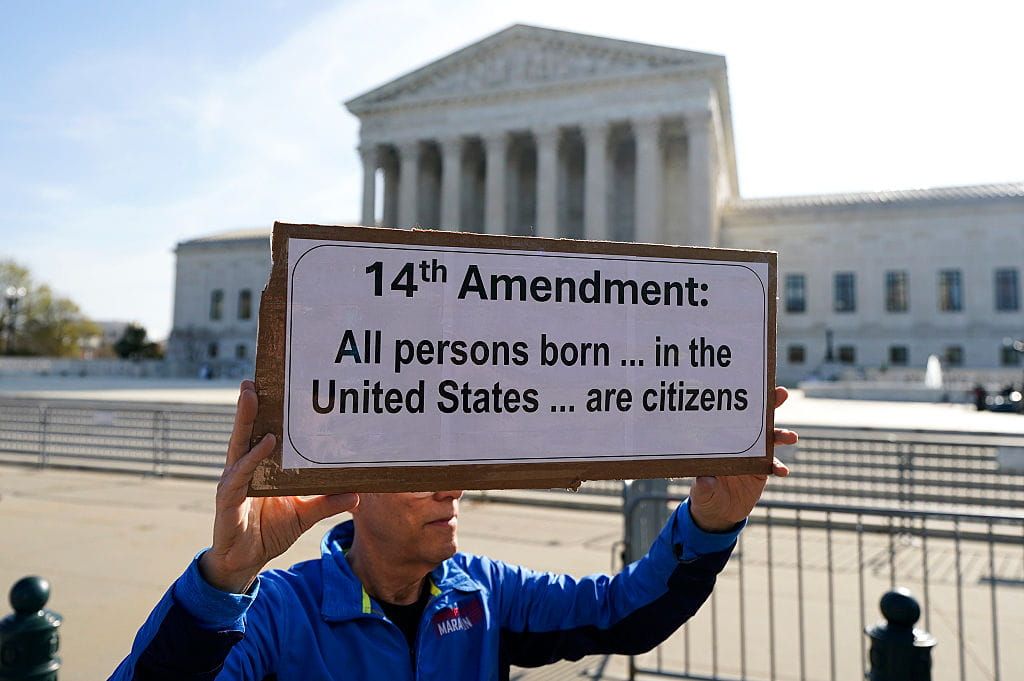
The Supreme Court issued its long-awaited, highly controversial decision regarding birthright citizenship on June 30. Trump v. Barbara challenged President Donald Trump’s executive order depriving children of illegal immigrants born on US soil of citizenship. The president’s position was struck down, in a decision rooted in just that — soil.
Soil or Blood?
The crux of this longstanding legal battle was deciding on the proper interpretation of the Citizenship Clause of the Fourteenth Amendment, which states: “All persons born or naturalized in the United States, and subject to the jurisdiction thereof, are citizens of the United States and of the State wherein they reside.” The Supremes decided 5-4 in Trump v. Barbara that the key phrase “subject to the jurisdiction thereof” refers to “the power of the United States to govern those within its territory,” affirming the British common law doctrine of jus soli, meaning “the right of the soil.”
In its lengthy majority decision, the Court recounted the history surrounding the passage of the Fourteenth Amendment and related legislation, concluding “congressional debates of the Civil Rights Act of 1866 and the Fourteenth Amendment confirm the common law rule.” The majority stated that the Fourteenth Amendment was proposed and ratified in direct response to the Court’s heinous Dred Scott decision of 1857, which held that citizenship was determined by blood, not soil.
The government’s attorneys argued on behalf of the Trump administration that the phrase “subject to the jurisdiction of” required something beyond mere physical birth based on domicile. The Trump v. Barbara ruling rejected this argument as requiring “some greater quantum of allegiance,” concluding, “There is scant evidence for this dramatically revisionist view.”
A Monumental Dissent
Justice Clarence Thomas disagreed in a lengthy (91-page!) dissent, recounting in great historical detail why the Fourteenth Amendment was specifically understood to exclude sojourners from citizenship. Joined by Justice Neil Gorsuch, Thomas declaimed the majority’s account as “not historically accurate,” observing, “The Court says that the Citizenship Clause incorporated the English feudal principle that subjects owed lifetime servitude to the King who owned the soil on which they were born, but Americans – unsurprisingly – rejected this feudal principle.”
In conclusion, Justice Thomas accused the majority of “repurpos[ing] the Fourteenth Amendment to protect its own set of preferred rights that the Reconstruction Congress never contemplated and that cannot find support in its text.” By basing citizenship solely upon the accident of birth, the Court’s decision “devalues that citizenship,” he wrote.
In his separate 39-page dissent, Justice Samuel Alito similarly decried the majority’s position as “a mistake that will seriously affect the country’s future,” warning, “The Court’s interpretation preserves a powerful incentive to enter or remain in this country illegally … Other than Canada, the United States will be the only affluent nation where birth alone is enough to establish citizenship.”
In a brief separate dissent, Justice Neil Gorsuch dismissed the majority’s invocation of jus soli to support its interpretation of the Fourteenth Amendment, writing, “That rule, developed in feudal times, had more to do with being a subject than a citizen.”
The Future of Birthright Citizenship
Whether this decision stands the test of time (Justice Thomas expressed skepticism) remains to be seen, but it is now the law of the land. The decision is already fueling partisan divisions in a midterm season, with immediate consequences. Children born to illegal immigrants will now have US citizenship, and Trump’s executive order is defunct.
The ruling is noteworthy in another way: Trump will abide by the Supreme Court’s decision, exhibiting not the qualities of a king but of a second-term elected representative of a republic. In contrast, President Joe Biden vowed to cancel student loan debt after the Supreme Court ruled his effort to do so unconstitutional, and New York City Mayor Zohran Mamdani recently proclaimed defiance of the Supreme Court’s ruling that the Trump administration can revoke the Temporary Protected Status of Haitians and Syrians.
If Americans wish to override the Supreme Court on the issue of birthright citizenship, they have a challenging pathway ahead. Since he is obviously no king, President Trump finds his hands are now tied in his response to what Justice Alito called “birth tourists” (people who travel to the United States to give birth). Even a majority-conservative Congress cannot sidestep the Fourteenth Amendment, and additional statutory hurdles remain (as Justice Kavanaugh explained in his concurrence). It’s been a long time since America ratified a new amendment to the Constitution, and it is particularly unlikely when the nation has rarely been so politically divided.
Dig Deeper: Enter the Liberty Vault!
Liberty Vault: The Constitution of the United States
Liberty Vault: The Supreme Court