For the past several years, Peltzman has been combing through the General Social Survey, a random-sample poll that has asked Americans the same simple question since 1972: Are you happy? What he found about the years since the pandemic stopped him cold.
“There was a huge hit,” he told me recently. “And then it’s only a little bit coming back. So when you’re all done, there’s an unprecedented decline into the whole of the 2020s.”
Americans are now at their least happy point in the survey’s 50-year history. Peltzman’s measure — the percentage saying “very happy” minus the percentage saying “not very happy” — ran at roughly +20 points on average from 1972 through the last pre-pandemic survey in 2018. That baseline held through wars, recessions, assassinations, stagflation, and 9/11. None of it broke the floor in any sustained way.
Then 2020 hit. The crash was 22.2 percentage points — by far the largest single move in the survey’s history. The number of people saying “not very happy” actually exceeded those saying “very happy” for the first time ever. The measure has come back somewhat since 2021 to around +6 as of 2024, resulting in a shift from +20 to single digits within just a few years, with no meaningful recovery.
Peltzman calls this a “regime change.” In macroeconomics, that phrase means something beyond a shift in numbers — it’s a shift in the underlying mechanism generating the numbers. “It’s not just a change,” he told me. “The whole mechanism that’s generating the numbers is different.” Unless the next wave of data shows a return to the norm, he said, “you have to proceed on the assumption that the world is different.”
The consequences are not abstract. Gallup estimates that low employee engagement costs the global economy $8.9 trillion in lost productivity annually, with unhappy workers generating higher absenteeism, turnover, and lower-quality output. The physical toll is equally severe: social isolation — the companion condition to chronic unhappiness — raises health risks as much as smoking 15 cigarettes a day and is twice as harmful as obesity, with the CDC linking it directly to heart disease, stroke, dementia, and earlier death.
The wrong chart
There is a debate that has defined this decade, and nobody is winning it. On one side: economists and analysts armed with charts showing wages up, unemployment low, household net worth at record highs. On the other: everyone else reports feeling squeezed, anxious, and quietly furious. The two sides are both right. They’re just reading different things.
The framework that best addresses the gap is called the aspiration gap. Economists Andrew Clark and Andrew Oswald showed that what drives satisfaction isn’t your paycheck — it’s where you sit relative to where you could reasonably have expected to sit, given your age and education. Financial Times data journalist John Burn-Murdoch recently put the finding starkly: there is a stronger statistical link between job satisfaction and income than expected, relative to absolute terms.
A raise doesn’t make you feel richer if everyone around you got a bigger one. And a college degree doesn’t make you feel successful if a college degree no longer marks you as exceptional.
This second point is where the story turns generational. The mass expansion of higher education — well-intentioned, broadly beneficial — has produced a society in which each successive graduating class is more credentialed and less elite than the last. One in three graduates now falls in the bottom bracket of earnings relative to their reasonable expectations, even though only about 10% are in the lowest absolute earnings quartile. In the U.K., the average thirty-something university graduate today sits at the same income rank as the average high school graduate did in 1995. The ladder shifted down, and barely anyone noticed — because the absolute numbers kept going up.
This is the scenario that retired UConn professor Peter Turchin calls “elite overpopulation”: a society so prosperous it makes education widely available, paradoxically producing a class of underemployed elites, with resentment — and sometimes revolution — ensuing. “The benefits that you get with wealth are now being diluted because there are just too many wealth holders,” Turchin told me last July. “There is overproduction of university degrees and the value of a university degree actually declines.”
Picture the 28-year-old with a master’s degree and $80,000 in student loans, sharing a two-bedroom apartment in a second-tier city because the down payment on the starter home her parents bought at 26 would now require a decade of saving. She is not poor by any historical measure. She is, by the aspiration gap’s definition, exactly the kind of person the data predicts will be most dissatisfied — educated enough to know what she was promised, positioned just close enough to the dream to feel its absence every day.
Wealth, meanwhile, has quietly redefined itself upward. According to Charles Schwab’s most recent Modern Wealth Survey, Americans now believe a net worth of $2.3 million is required to be considered wealthy — up 21% since 2021, far outpacing inflation. And the route that once led there has been foreclosed: median home prices have risen more than 400% since 1990, while median household income has risen less than 200%. The greatest returns now go to those who bought the assets decades ago.
Who was hit hardest?
When Peltzman looked at which Americans were hit hardest by the crash, he expected the usual suspects: the poor, the left behind, the least educated. That’s not what he found.
“The biggest decline over this period is among the most educated,” he told me. “The ones with the largest concentration of people who have reached the dream — biggest decline. Smallest decline, the least educated.”
Income told the same story. The wealthy fell furthest. The very poorest had the narrowest decline. The crash hit hardest precisely where expectations were highest — exactly what the aspiration gap would predict.
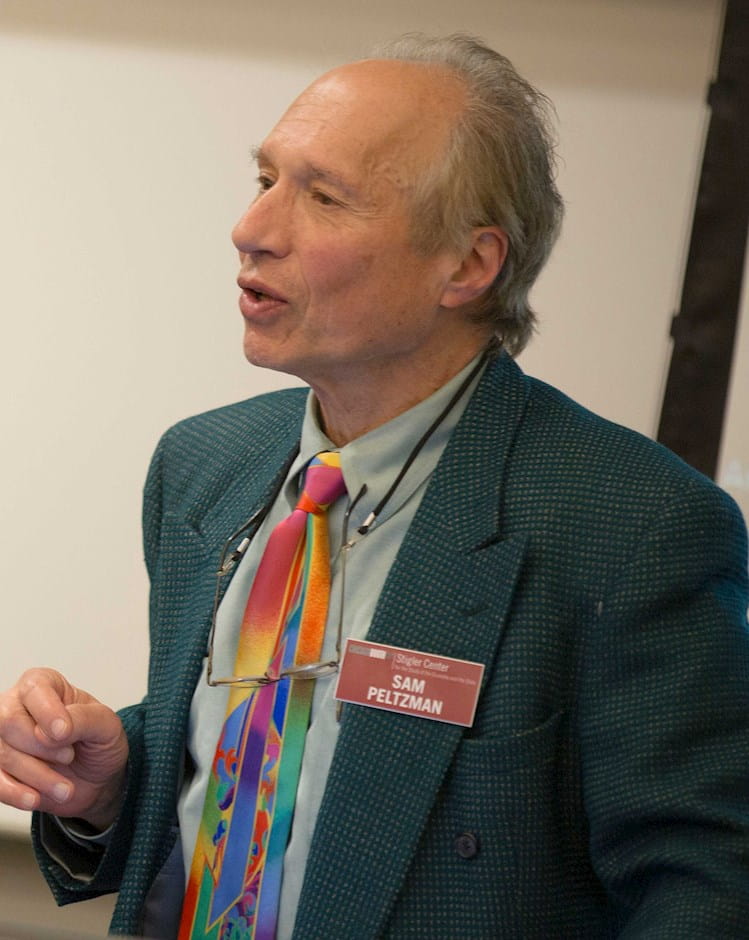
And then there is the fairness question, which Peltzman described with genuine unease. For 50 years, the GSS asked Americans whether they thought other people would treat them fairly. For 50 years, the answers were positive. Then: “They’ve behaved exactly like the happiness question — fell off the end of a table in 2020 and has not come back.”
Author Derek Thompson has a name for all of this: the Permademic. The argument that 2020 didn’t just cause a recession or a public health crisis — it caused a cultural rupture that released forces that have not been contained. Consumer prices surged 25% between 2020 and 2025, the same increase that had taken 13 years before. Confidence in every major institution — government, media, medicine, education — collapsed simultaneously. And counterintuitively, it was the richest third of households whose sentiment fell furthest, because full employment raised the cost of the services — childcare, restaurants, home care — that the affluent had come to treat as near-entitlements.
The aspiration gap, in other words, is not just a story about young adults falling behind their parents. It is a story about a society that raised everyone’s expectations and then, all at once, made them feel permanently out of reach.
Richard Edelman, whose eponymous firm has tracked global trust for more than two decades, didn’t push back when I shared the data. “A lot of people’s presumptions are shattered,” he said. “The presumption that I’m going to do better than my parents. The presumption that all facts from the CDC are true. The presumption that my doctor was infallible. These illusions have turned out to be illusions.”
His colleague David Bersoff, head of research at the Edelman Trust Institute, traced the consequences: “That starts leading to some of the erosion of the social fabric. You get polarization, polarization leads to paralysis, paralysis leads to grievance, grievance leads to insularity.” The endpoint, he said, is “a very negative, mean-spirited way of interacting with the world.”
Specifically, Bersoff added, as people’s concerns “fester unaddressed” — especially the ones that directly affect things they care deeply about, such as sense of personal safety, feelings of financial well-being and perceptions of being treated fairly — polarization sets in and with it comes paralysis. “This polarization/paralysis deepens people’s sense that the system is not working in general, and certainly not working for them.”
Over time, polarization metastasizes into grievance which, if left unaddressed, leads to an insular mindset, defined as an unwillingness or hesitancy to trust people who are different than we are. Once we lose the willingness to trust and thus constructively engage with others across our belief, values, and background differences; progress, and the potential for progress, comes to a halt.
As this sequence plays out, the social fabric further shreds and unravels; trust circles shrink and become ever more homogeneous; and hostility, mean spiritedness, and a general hardening take hold in society.
And this is what we are seeing in many countries today.
Harvard economist Raj Chetty’s research quantifies the damage to the dream’s foundation: more than 90% of children born in the 1940s grew up to earn more than their parents in absolute terms. For children born in 1980 — today’s 40-somethings — that figure has collapsed to roughly 50%. This aligns with the 2026 Trust Barometer finding that only 21% of U.S. respondents believe the next generation will be better off — down 9 points year-over-year.
A segregated happiness society
Peltzman’s most arresting finding — the one he described with the closest thing to alarm I heard in our conversation — is about marriage.
His research established what he calls the “marital premium”: married people score roughly 31 points higher on his happiness scale than unmarried people, a gap that held remarkably stable for 50 years across gender, race, age, income, and education. The crash changed the geometry. The marital premium stayed roughly the same, perhaps even widening. But the floor for the unmarried collapsed.
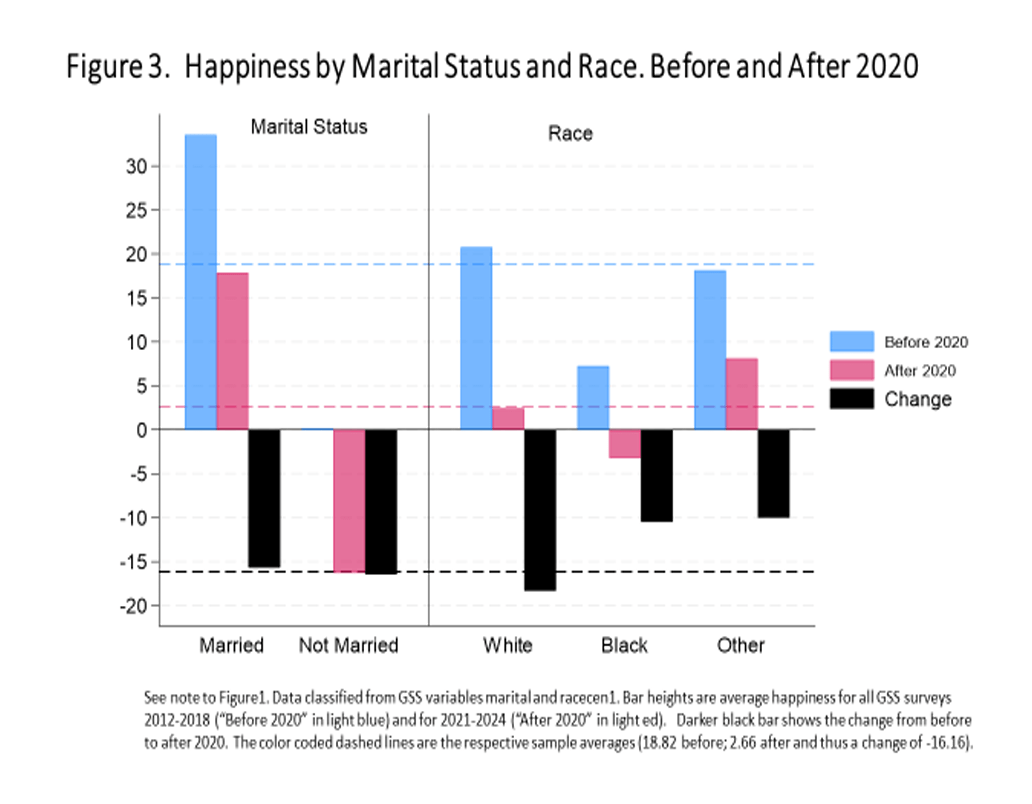
“We have a segregated happiness society,” Peltzman told me. “Here are the married people — they’re still reasonably okay, less than they used to be. Here are the unmarried, who used to be marginal. They’re way unhappy now.”
The numbers: 45% of American adults 25 and older are unmarried. Before the crash, they averaged near break-even on his scale. Now they average -15. The married have fallen from +30 to +50 — but still comfortably positive. “I can’t see that persisting without consequences,” Peltzman said. “Political, social, you name it. It’s a sense of foreboding.”
Marriage, in this reading, functions as the one social institution that still reliably closes the aspiration gap — a stable anchor for identity and status at a moment when career and credentials no longer deliver those things dependably. And it is, of course, in long-term decline. The institution that best buffers against the aspiration gap is the one Americans have been least likely to form — for reasons that are themselves rooted in economic anxiety: housing costs, childcare costs, the sense that you shouldn’t start a family until you’ve arrived somewhere. Somewhere that keeps receding.
Meanwhile, the experience economy has emerged as a coping mechanism. Delta CEO Ed Bastian has watched it play out in how Americans spend, talking to me about it in Las Vegas at the For All Summit, put on by Great Place to Work. “People aren’t as interested in investing in or buying things for themselves,” he told me. “They’re more interested in investing in themselves.” Delta’s premium revenue has surpassed main cabin revenue for the first time — not because Americans are uniformly flush, but because experiences have become, for a meaningful slice of the country, a substitute for the status markers that used to come from career and credentials.
What needs to change
Peltzman doesn’t offer a fix. “We’ve got to start thinking about how to fix it,” he told me. “That’s my only purpose. I’m too old to start another career.” But he offers the clearest statement of what needs to happen first: acknowledgment that something real has broken, and that the charts showing the line going up are not lying, but they are not telling the whole truth either.
The people who run the institutions Americans inhabit day-to-day have their own answers. Edelman’s is relational: listen, go local, build trust one conversation at a time. Bastian’s is financial dignity — his $100 million bet that giving a Delta employee a $1,000 emergency fund changes not just their financial security but their sense of self. Hoplamazian’s is emotional connectivity: “We don’t live in a transactional world.”
These are, at root, the same answer. The aspiration gap doesn’t close from the top down. It closes, if it closes at all, from the inside out — through institutions, relationships, and communities that make people feel like their position in the world is real, respected, and connected to something beyond a chart.
Gallup finds that Americans are now nearly evenly split on whether the American Dream is fundamentally about opportunity — the ability to improve your life through education and better work — or stability, merely being able to hold a family together with a job and a safe place to live. Lower-income Americans now predominantly define the dream as stability. Only the already-affluent still define it as an opportunity. That is the aspiration gap made visible in survey form: the goalposts have moved not because people became lazier or less ambitious, but because a generation has quietly recalibrated downward.
The GSS is in the field right now and Peltzman is watching for the next set of numbers. “Unless the next set of numbers comes in with a return to the norm,” he told me, “the world is different.”