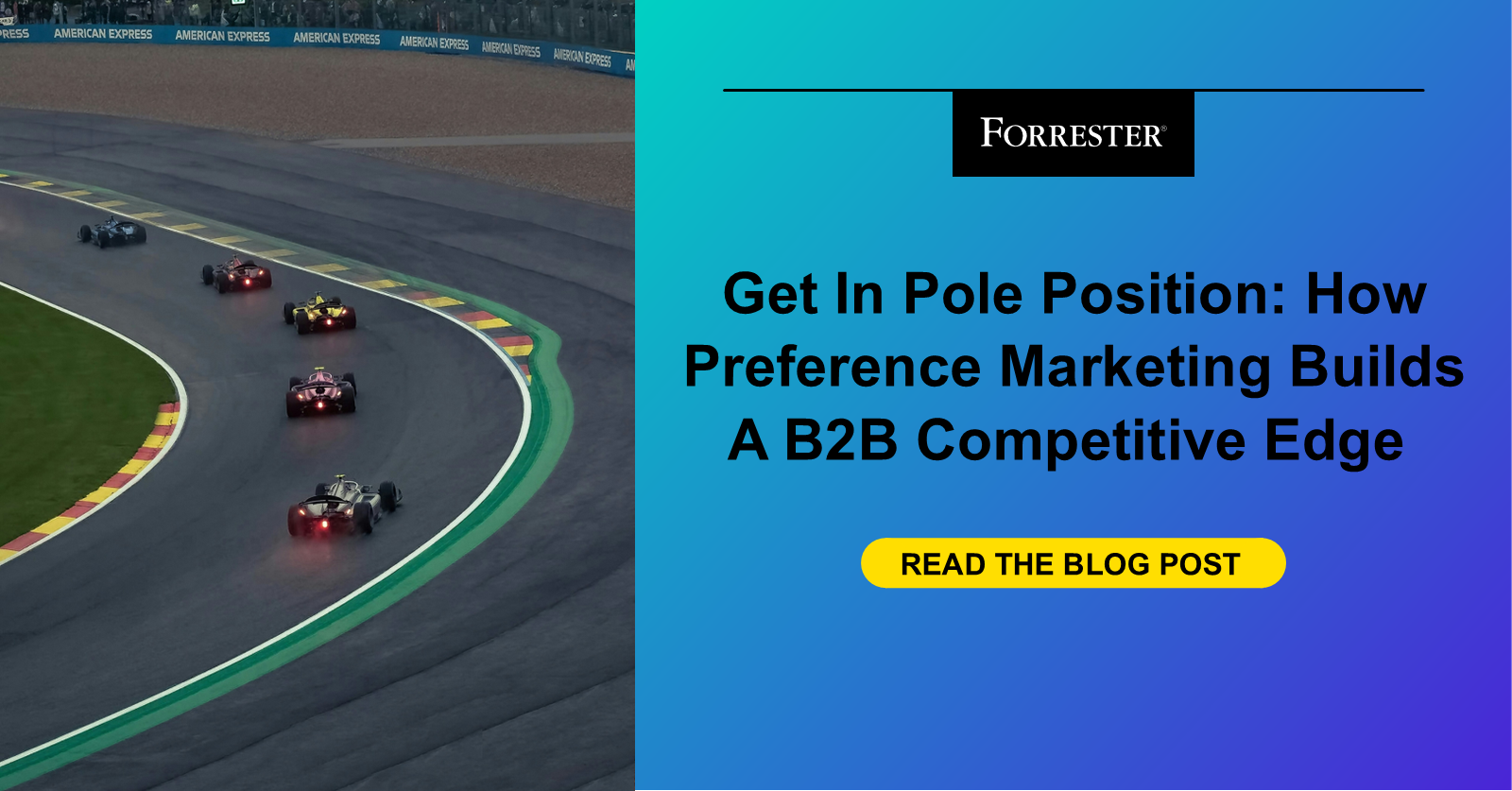
At B2B Summit North America this spring, Ian Bruce and Kelvin Gee opened their keynote session, “Make Brand + Demand Your Preference Multiplier,” with a lesson from Formula 1 racing: The real competition often happens before the race begins. In F1, securing pole position during qualifying dramatically improves a driver’s odds of winning on race day. The race may be decided before the Sunday green flag drops.
The same is increasingly true in B2B buying. Many marketers still focus most of their effort on capturing demand once buyers enter a formal purchasing process. But as Ian and Kelvin made clear, the race may already be over by then. The most important question isn’t how effectively you engage buyers when they’re evaluating vendors — it’s whether you’ve earned their preference before they start evaluating at all.
More Than Half Of B2B Deals Are Won Before The Buying Process Begins
Forrester’s most recent Buyers’ Journey Survey shows that 68% of B2B buyers enter a formal buying process with a preferred vendor already in mind. Of those buyers, 80% ultimately select that preferred vendor. The implications for marketers are sobering: Roughly 55% of B2B purchases are effectively won before vendors have an opportunity to compete.
Meeting this reality requires a fundamental shift in thinking. As Ian explained, the buyer’s journey has become “a process of confirmation, not selection.” Buyers increasingly use formal evaluations to validate decisions they have already begun making rather than to discover entirely new options. Yet many organizations invest heavily in pursuing opportunities that were lost before they ever appeared in the pipeline.
Why Traditional Brand And Demand Strategies Fall Short
If preference matters so much, why aren’t more organizations focused on it? As Ian and Kelvin explain, most B2B marketing organizations were not designed to build preference. Instead, they’re structured around an artificial division between brand and demand marketing — which typically operate as separate organizations with separate budgets, separate campaigns, and separate success metrics. The result is a fragmented approach that fails to align with how buyers actually buy.
Brand teams are frequently tasked with broad awareness-building initiatives but struggle to demonstrate direct business impact. Demand teams focus on capturing intent and generating pipeline but often engage buyers after preferences have already formed. While marketers have long debated whether brand or demand deserves greater investment, Ian and Kelvin argue that the real opportunity lies in connecting the two.
Preference Marketing Bridges The Gap
This is where preference marketing comes in. Preference marketing prioritizes building early affinity and long-term loyalty among increasingly decisive buyers, and it requires brand and demand marketing to work together toward a shared outcome.
Rather than optimizing for awareness alone or demand generation alone, preference marketing establishes buyer preference as a common business objective and KPI. Preference, Ian noted, can become the mechanism that reconnects brand and demand teams around shared programs, shared investments, and shared accountability for outcomes.
Going back to the Formula 1 analogy, preference marketing is how organizations earn pole position before buyers enter the race. The goal isn’t just to be included in vendor evaluations; it’s becoming the vendor most likely to win.
Understanding How Preference Is Built
Ian and Kelvin introduced the B2B Brand Measurement Framework (client access required), which outlines the progressive stages through which preference forms:
Awareness. Buyers recognize your brand.
Perception. Buyers understand what you do and how you differ.
Sentiment. Buyers form positive beliefs and attitudes about your organization.
Preference. Buyers place you at the top of their shortlist.
Loyalty and advocacy. Customers continue to support and recommend you.
Many organizations invest heavily in awareness while neglecting the stages that actually translate recognition into preference. As Ian noted, awareness is necessary, but by itself, it’s insufficient. Marketers must actively shape perceptions and sentiment if they hope to earn buyer preference.
The keynote highlighted ADP, the payroll and HR services provider, as an example. Through the ADP Research Institute, the company consistently delivers data-driven workforce and labor-market intelligence, helping it stay top of mind while building credibility and trust among its key audiences (e.g., CFOs, CEOs, and HR leaders). By consistently creating awareness, shaping perceptions, and building positive sentiment, ADP demonstrates how organizations can earn and sustain preference.
Putting Preference Marketing Into Practice
Later in the session, Ian and Kelvin outlined a three-step model for operationalizing preference marketing:
Build preference. Start by defining a clear narrative and differentiated point of view. Build proof points — including customer stories, analyst validation, research, and thought leadership — that reinforce your position in the market. Activate those assets consistently across the channels that matter most to your buyers.
Measure preference. Like Formula 1 teams that monitor performance data in real time, marketers need their own “preference telemetry.” Ian and Kelvin recommended tracking buying group interactions and comparing first-party and third-party signals to understand whether preference is being established before buyers formally engage.
Deploy playbooks. Finally, use preference insights to calibrate investments and engagement strategies. For example, organizations with strong preference and strong buyer engagement should focus on defending and expanding their position. Those with weaker preference may need to invest more aggressively in trust-building and credibility efforts.
The Future Belongs To Team Preference
As buyers become more informed and more decisive, organizations can no longer rely on late-stage demand capture alone. Winning increasingly depends on earning preference before buyers ever raise their hands.
The marketers who build awareness, shape perception, create positive sentiment, and establish preference early will enter the buying process in pole position. Everyone else may find themselves competing for deals that were already decided before the race began.
If you missed our B2B Summit North America event, you can catch this keynote session, “Make Brand + Demand Your Preference Multiplier,” and other great content at our upcoming B2B Forum EMEA in London.