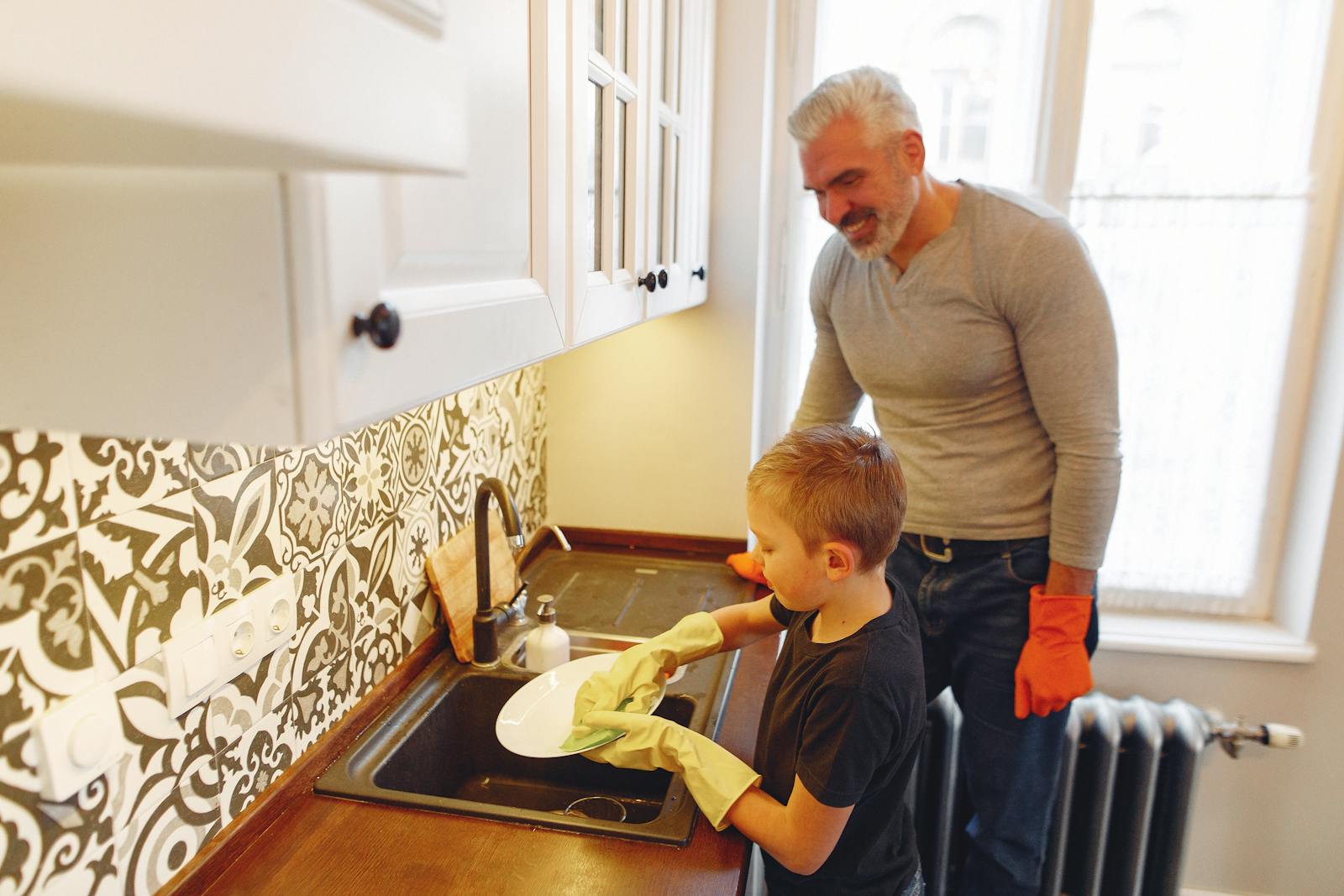
The compulsive helper at a dinner party is usually described as thoughtful, well-mannered, the kind of guest a host loves to have. The same person, in their own kitchen at 11pm, often cannot sit down until every surface is wiped, and does not know why a quiet room makes them anxious.
Both descriptions are true. Only one of them is the whole story.
I’ve been thinking about this pattern for a while, partly because I see it in friends I love, partly because I recognise pieces of it in myself. The reflexive offer to carry the platter. The half-step toward the dishwasher before anyone has even finished eating. The internal calculation of which guest needs a refill before they ask.
It looks like good upbringing. Often it is something stranger and sadder than that.
The difference between helping and earning
There is a kind of helpfulness that comes from a settled sense of self. You see something that needs doing, you do it, you sit back down. You do not feel a low hum of anxiety when you stop. You do not scan the room for the next task before the current one is finished.
Then there is the other kind. The kind where stopping feels physically uncomfortable. Where sitting still while someone else cleans up registers somewhere in your body as danger, even though no one in the room would describe it that way.
The first kind is generosity. The second is a debt being paid in real time, to creditors who are no longer in the building.
What conditional welcome teaches a child
Children do not arrive in the world with a theory of why they belong somewhere. They learn it. They learn it from how the adults around them respond when they are loud, when they are quiet, when they need something, when they offer something. They build, very early, an internal map of which behaviours produce warmth and which produce a chill.
If warmth reliably arrives in response to being, the child grows up assuming presence is enough. If warmth only reliably arrives in response to doing, the child grows up assuming presence is the part you have to compensate for.
This pattern is well-documented in developmental psychology, particularly in attachment theory. Childhood attachment patterns shape how adults relate to other people, including how they decide, often without conscious thought, what they need to do to be allowed to stay in the room.
The Berlin-based psychotherapist Ghazaleh Bailey put it bluntly in a viral clip viewed more than two million times: According to social media discussions about childhood trauma, some therapists suggest that children raised in emotionally secure environments develop different behavioral patterns than those who experienced survival-based parenting dynamics. Therapists note that children who experienced emotional neglect may later struggle to form healthy relationships and remain in survival-oriented patterns of behavior.
Helpfulness can be one of the cleanest disguises survival ever wears.
The price of being welcome
Some homes operate on an unspoken transactional logic. The child who notices the empty glass and refills it before being asked gets warmth. The child who is just sitting there, present but unproductive, gets a comment, a sigh, a glance that lands somewhere between disappointment and irritation.
Nobody says you have to earn your place here. Nobody needs to. The child works it out from pattern recognition, the way they work out which floorboards creak.
By the time that child is twenty-eight and standing in someone else’s kitchen, the calculation has been automated. They are not consciously thinking I need to be useful so they let me stay. They are simply unable to stop moving. The not-moving feels worse than the moving.
This is what makes the pattern so hard to spot from the outside. The behaviour looks polished. The internal weather looks nothing like polish.
Why “well-raised” is the wrong frame
The phrase well-raised implies the child was given something. A set of manners. A respect for the host. A spirit of contribution. And sometimes that is exactly what happened. Some compulsive helpers genuinely were taught, by warm and secure parents, that contributing to a shared space is what loving people do.
But there is a tell. Children raised on warmth can also stop. They can sit on the couch after dinner without their nervous system registering low-grade alarm. They can let the host clean up. They can say no when offered a second helping of work.
Children raised on conditional welcome usually cannot. The body does not let them. Sitting still while others move feels like a violation of an unwritten rule they signed in childhood and have never been allowed to renegotiate.
That is the diagnostic difference. Not whether you help. Whether you can stop.
The behaviours that travel with it
Compulsive usefulness rarely shows up alone. It tends to arrive in a small constellation of habits that all share the same underlying logic: stay ahead of the moment when you might become a problem.
Silicon Canals has explored several of these patterns in recent months — the reflexive apology that gets in front of blame before blame has even formed, and the inability to enjoy a calm afternoon without mentally scanning for what’s been forgotten. They share an architecture. They are all attempts to pre-empt a withdrawal of welcome that may never actually be coming.
The dishwasher offer fits the same shape. So does the over-tipping. So does laughing at a joke that wasn’t funny because the alternative was letting the room go quiet.
What the research actually says
Vague claims about “childhood” do a lot of work in pop psychology. The specific mechanism here is more precise. Children whose caregivers were inconsistent or conditional often develop strategies to manage proximity to those caregivers — strategies that calcify into adult relational defaults.
One of those strategies is hyper-attunement to other people’s needs. Another is the suppression of one’s own. A third is a low tolerance for the experience of being a recipient — being given something, being cared for, being allowed to sit while others work — because the recipient role was, in childhood, the role most likely to attract criticism or withdrawal.
These patterns live in the body, not just the mind. The compulsion to help is not really a thought. It is a physiological response to the felt sense of being a guest somewhere — any sense of being a guest, even decades later, even in homes where no one would dream of withdrawing welcome.
What makes this hard to unwind is that the strategy worked. It got the child through. The nervous system has no incentive to abandon a strategy that delivered safety, even if the strategy is now wildly disproportionate to the actual environment.
The sociology underneath the psychology
There is also a class layer to this that gets undersold. Some families operate on a belief that worth and welcome are demonstrated through visible contribution. This is not always pathological. It is sometimes a response to material precariousness, immigrant experience, or generational trauma where being seen as useful was, quite literally, protective.
The ethics scholar Davina Hurt has written about how conditional belonging operates across scales, from intimate spaces to institutional ones. Her piece is about immigration enforcement, but the underlying observation is portable: when a person learns that their belonging is provisional, that learning does not stay neatly in one domain of life. It generalises.
A child who grew up feeling that their welcome at home was contingent on being useful tends to feel contingent everywhere. Other people’s houses. Workplaces. Friendships. The dinner party is just the most photogenic version of the pattern.
What the helpful adult is actually feeling
From the outside: a gracious guest.
From the inside: a low-frequency hum that says you are not yet justified in being here. The justification has to be ongoing. It cannot lapse.
This is exhausting. It is also invisible to almost everyone in the room, including, often, to the helper themselves. They may describe themselves as someone who simply enjoys helping out. They may credit their parents with teaching them good manners. They will not mention that the few times they tried to sit still through a dinner party as adults, they spent the drive home replaying the evening and wondering if they had done enough.
The hardest part to undo
You cannot fix this by deciding to help less. The behaviour is downstream of a felt sense, and the felt sense does not respond to instructions. Telling a compulsive helper to stop helping is like telling someone with a stutter to just speak smoothly.
What seems to actually shift it, based on what therapists who work with this pattern describe, is something slower. Sitting through the discomfort of being a recipient. Letting someone else clean up while your nervous system runs its alarm cycle and gradually, over many evenings, learns that the alarm was a false positive. That nothing bad happens when you stop.
That the welcome was not, in fact, conditional. Not here. Not now. Not in this kitchen, with these people, in this stage of your life.
Some of the language people find useful for this work shows up in writing about habits that look mature but are actually emotional survival strategies, and in summaries of how childhood emotional neglect shows up in adult life. The recurring theme is that the behaviours look like virtues from the outside and feel like obligations from the inside, and the gap between those two readings is where the work happens.
What to do with this if you recognise yourself
Don’t perform a sudden refusal to help. That is just the same nervous system, running in reverse, trying to prove a new thing. You will exhaust yourself.
Instead, notice. Just notice. The next time you are at someone’s place and you feel the half-step toward the kitchen, pause for two seconds and ask whether you actually want to do the thing or whether your body is doing it for you. You don’t even have to act on the answer. The noticing itself starts to loosen the automation.
And the next time someone offers to do something for you — pour the drink, carry the plate, drop you home — try saying yes. Not graciously, not performatively. Just yes. Then sit with whatever comes up, which will probably be a small wave of guilt or unease that has been waiting decades for permission to be examined.
Being welcome was never supposed to be something you paid for. Some of us just had to learn that very late, from rooms full of people who would have liked us anyway, if we had ever let them try.
Feature image by Gustavo Fring on Pexels
About this article
This article is for general information and reflection. It is not medical, mental-health, or professional advice. The patterns described draw on published research and editorial observation, not clinical assessment. If you’re dealing with a serious situation, speak with a qualified professional or local support service. Editorial policy →