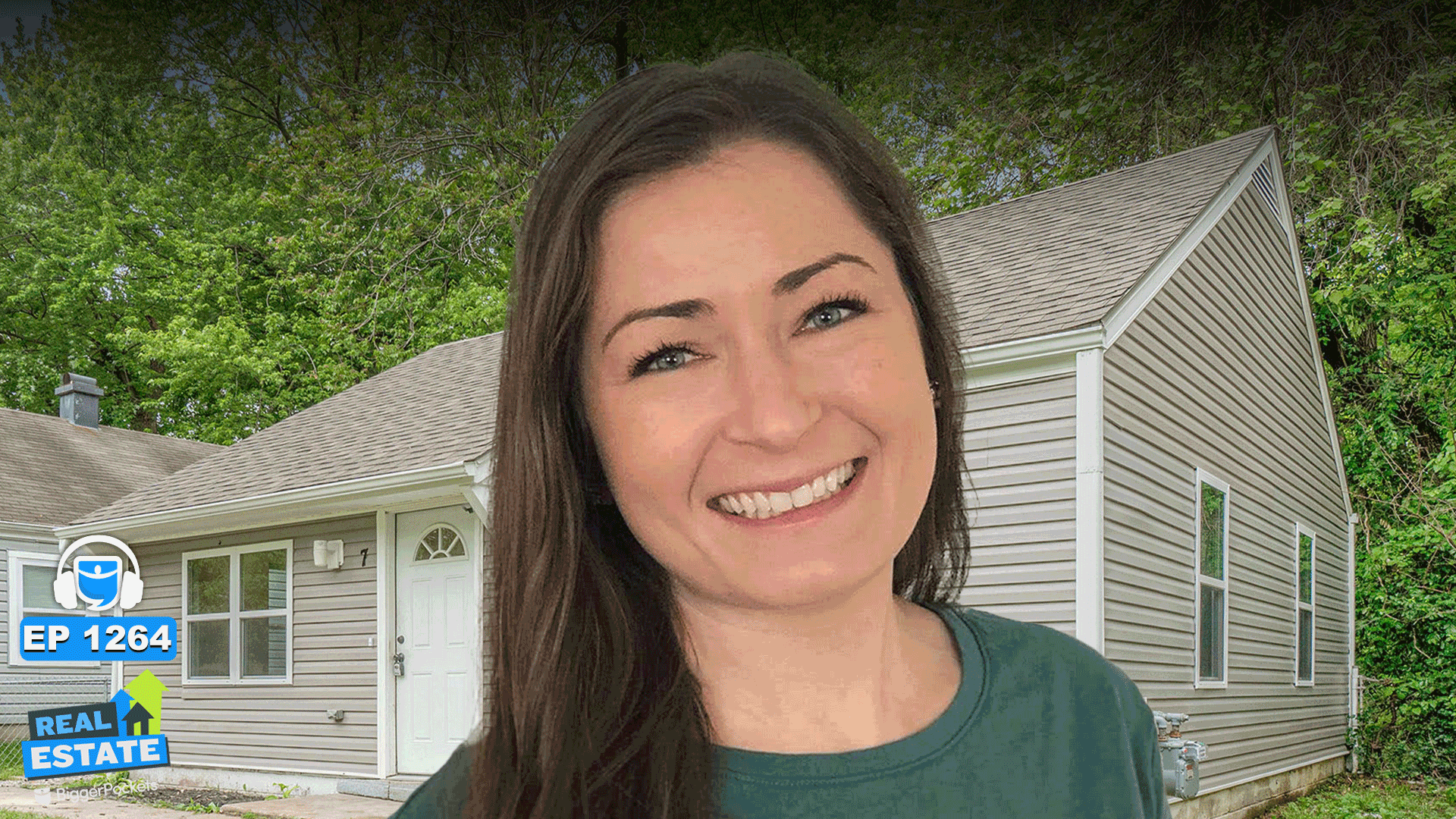
After having her second daughter, high school math teacher Christle Stezskal had a choice to make—keep working for little pay and give up the time she had with her young children, or find another way to help provide for them. Her husband had just finished the personal finance classic, Rich Dad Poor Dad, and knew rentals were the right move—but Christle was only working with a teacher’s salary.
She couldn’t buy $400,000 houses, let alone $300,000 or $200,000 houses. But $50K – $100K rental properties—that she could do. The duo set off, finding an out-of-state investing market where the numbers would work. They purchased their first deal, and then…lockdowns, and a tenant moving out—terrible timing.
That wouldn’t stop Christle.
Now, just six years later, she has a real estate portfolio of 19 cash-flowing rentals. She’s gotten creative, buying off-market properties, sending direct mail, and even bidding at courthouse auctions to get rentals at the right price. Because of her hustle, she’s quit her job, now gets to spend time with her girls, and provides her family the financial future they’ve always dreamed of—and she didn’t need deep pockets to do it.
Henry:After having her second daughter, high school math teacher, Christle Stezskal had a choice to make. She could keep working for Little Pay and give up the time she had with her young children, or she could find another way to help provide. Her answer, rental properties. But not $400,000 homes. She couldn’t afford that, but what she could afford were small rentals. We’re talking 800 square feet that cost less than $100,000. That’s something she could do. She bought her first rentals out of state right when the lockdowns began, and she had a tenant moving out. Not a great start, but she didn’t give up. By rental number three, she quit her job and went all in. Now, Christle has 19 rental units using all her cashflow to keep investing while her husband’s W2 is paying their bills. That’s a dream team combination. She’s able to spend time with the two girls and provide the best experience to her tenants across her portfolio, and she should know because she self-manages these units.Christle is still buying properties for around $100,000 and they’re still cash flowing. She shares the exact market she’s buying in, the renovations she’s doing to get her higher rents, and how she juggles it all while raising two kids. These small properties can make you financially free too. So let’s learn how.What’s going on everybody? I am Henry Washington. I am here with an investor story from Christle Stezskal out of Illinois. She is building a portfolio to help her achieve financial freedom, so let’s jump in and learn how. Christle, welcome to the show.
Christle:Thank you. Happy to be here.
Henry:Why don’t you start off by telling us a little bit about your background and how you first jumped into all this crazy real estate stuff.
Christle:So I was a high school math teacher. I taught for seven years. I really enjoyed it, but in that time, my husband and I started a family and we had two daughters, Lily and Cora. And after having Cora, it didn’t make sense for me to continue teaching. The pay was not offsetting daycare costs, that kind of thing. So we started looking for other options for me. My degree’s in math, so I went back and got my master’s and then made the shift into IT. Did that for a couple of years. But at the same time I made that shift, Alex, my husband, was doing a book club and they read Rich Dad Poor Dad. Gotcha. And it’s classic. So he came home and he was like, “Hey, we should really look into real estate investing.” He’s like, “I started listening to a couple podcasts. We should listen to more and we should read some stuff.” So we did.We listened to, I feel like all the BiggerPockets episodes. It was all the time. We read all the books, all the audiobooks. And it quickly became like, let’s do this. Let’s put some effort in and see what we can make happen.
Henry:We have a lot of similarities. My father and my stepmother were both high school teachers. My stepmother was a high school math teacher.
Christle:Nice.
Henry:I did IT for a while before I got into real estate. And I too read Rich Dead Poor Dad and my head exploded. So I get it. I get how this all pointed you in that direction. But reading the books and getting excited and translating that to actually doing something are very different things. So what’s kind of the first deal you did? How did you stumble into that?
Christle:In our area, in the northwest suburbs of Chicago, things are more expensive than what we were able to do at the time. We had a little bit of money that we were willing to earmark for real estate investing, kind of try it out, but we couldn’t do that here. So we knew we had to find another market. So we landed on Kansas City, Missouri. We said, “Okay, let’s look for some boots on the ground.” We started networking through BiggerPockets and we found a realtor, decided to take a trip out there, meet him, see what he does, look at some places. We did that. It was great. He was fantastic. Came back. And then from there, what he did is he would send us things. We’d let him know if we’re interested. He’d go and he would walk it. He would do a video call with us and show us everything.We ended up finding a place that we wanted to go under contract on. It was brought to us by a wholesaler, but then we had this realtor represent us in it. It still went through all the processes. We did an inspection because it was our first one, right? Yeah. We don’t do those anymore, honestly. But our first one, we did the inspection. There were some things that had to be addressed. We had a couple things addressed. We bought it at a low price knowing that there was going to be more work to put into it, but it did have a tenant and it was going to cash flow for us.
Henry:Okay. So you picked Kansas City. And one of the things I want to highlight about this story, sounds like you knew what you wanted in terms of financial return and you figured, “I can’t get that in my backyard, so let’s start looking for places you settled on Kansas City.” You networked on BiggerPockets and found an agent. BiggerPockets has an agent finder now. That is a great tool for people when you’re looking to invest out of state, you can connect with an agent. And then after a couple video interviews, you said the one thing that people really never say when they’re trying to pick a market. You got your butt on a plane and you went to the market or you got in the car and you went to the market. And not with intent to buy anything, but to get a feel for the market.And that is such an important part of investing out of state because there are just things you need to see, touch and feel in order to understand and evaluate deals as they come into your inbox. It’s not just that you want to go and buy something, but you want to go and figure out, okay, what are the neighborhoods that make sense? Where do I not want to buy? You ended up finding a deal. That deal came from a wholesaler, you said, but you had your agent represent you and you did an inspection. Everybody, if you’ve never bought a property before, do inspections. Absolutely. I don’t do them anymore either, but I am very experienced. If you’re not experienced, you should try to get inspections whenever you can. So about this deal, talk to me a little bit. What was the purchase price of that property?
Christle:So we bought it for 52,000.
Henry:52,000. And how much work did it need?
Christle:We negotiated for them to do radon mitigation. And then as soon as we closed, I had somebody do the roof for us, but that’s all we did because we had that tenant in there. As soon as she left, we did a little bit of work. We ended up replacing the floor in the kitchen.
Henry:So not a ton of work, which is good. So 50 some odd thousand is a ridiculously good price. And then to not have to do a ton of work and it be in decent livable condition enough to rent it out, that’s a pretty solid deal. What was it renting for?
Christle:If I recall correctly, when we bought it, it was at 800.
Henry:Oh, wow. That’s really good. Okay. And how did you fund this deal? Did you pay cash and refinance it? Did you just get a bank loan right away? Because some banks won’t fund a loan that low.
Christle:This one, we did delayed financing on it. So we purchased cash, but we don’t have to wait to season it for a cash out refi. You can delay finance it and you can do 75% of ARV.
Henry:Yep. Do you remember what it appraised for when you did that?
Christle:I want to say like 75.
Henry:Oh, nice. So
Christle:You
Henry:Were able to … Did you pull cash out or did you leave it all in there?
Christle:We ended up leaving $13,000 in it, I want to say, and it cashflowed.
Henry:Do you still own that one?
Christle:We do. We still own it. Yep. Awesome.
Henry:Okay. So first deal, sounds like it was a decent deal. You still own it. Cashflow, paid 52, did a light renovation, new roof, some infrastructure things. How did you transition from that into your next deal? Was it also an out- of-state deal?
Christle:Yeah. So our second deal was also out of state. October 2019 was when we bought that first one. And then our second one, we actually bought at foreclosure auction February 2020.Wow. It was pretty cool. So that was Kansas City as well. We were working with this guy. His whole business was, “I’m going to find people who want to purchase at auction. I’m going to identify auction properties. I will send out a list to all of my buyers. If anyone’s interested, I will go look at the house morning of auction. I will see if I can get pictures. I will see if I can identify any structural concerns, whatever. I will send that information to you. You tell me your max bid. I will go to auction. I will bid for you. If we win it, I will put the money down. You wire me the money. I will renovate for you. ” And for most of his buyers, he was also an agent and he would then sell it as a flip for them. For us, we told him, “We want to keep it, so you renovate it, but then we’re going to go ahead and take over and we’ll lease it up.”
Henry:Huh. Did you find this person through BiggerPockets? I
Christle:Don’t remember if we found him on BiggerPockets or not. Okay. But I don’t know how we found him either.
Henry:Okay. Okay. Random stranger seems like a
Christle:Decent
Henry:Business model. All right.
Christle:Yeah, right. No, so he was another person that we went out and we met and we actually, with him, we said, “Hey, we’re very curious how this process works. Can we ride along with you one day?”And heWas like, “Yeah, meet me at seven o’clock at the McDonald’s and we will go together. You can follow me to a couple properties. I’ll show you which ones I’m looking at.” And then we went to an auction with him and it was really cool. Well,
Henry:That’s cool. I think that’s another great piece of advice for people. If you are at all interested in buying auction properties, just go to a couple of auctions. Oh, for sure. See how it works. You’re going to learn so much, but also auctions are a great place to meet people who have money and might be willing to be a private lender for you. So if you continue to go and start to build a brand for yourself or start to build a reputation for yourself, I mean, in most auctions, you got to pay cash for properties, if not right away, then within like 10 to 15 days. SoThese are great people who have cash on hand who like investing in real estate, who could be lender contacts, but they also have all the other contacts you need to invest in real estate. Auctions are just a great place to hang out if you want to build your network, because those are doers at the auction. They’re not playing games if they’re bidding on auction properties. So you vetted this person by going and seeing how they were doing what they were doing. You looked at some of the properties that they were bidding on. So that gave you a level of comfort, I assume. Yeah. And then he would go to the auctions and bid for you. Did it take a while before you wanted … Because auctions aren’t easy to win. People bid those properties
Christle:Up.
Henry:Yeah.
Christle:It took a while. We probably worked with him for probably two, three months, honestly. We were looking at properties every night. Every night after the kids went to bed, we were looking at the properties and flagging anything we’re interested in. What’s tricky is you can’t actually make your final bid. You can’t set that number until you know the condition of the property, which you don’t know until morning of, if at all. There were so many times he’s like, “I can’t really see much. Don’t know what’s going to happen.” And that’s actually how this property was. He went to it and he’s like, “It’s tiny. It’s 850 square feet.” He’s like, “It looks like it started maybe getting some work because there was new siding on, but it wasn’t fully completed.” So he’s like, “This is a little bit of a wild card.” So we’re like, “Okay, well, what could it possibly cost to renovate this thing?” It’s 800 square feet.And we set our price, but those mornings were so tense. And my husband and I were both working. So I can remember sitting at our desks being like, “Okay, we have 10 minutes, figures out quick, chat back and forth and then send him the info.” And we finally won that one. He told us, he’s like, “You’ll get one.” He’s like, “It takes time, but we’ll get it. ” And so this day, I remember I was sitting in a meeting, a one-on-one meeting with my managerAnd I get a text message that says, “You won. I need the LLC name now.” I was like, “Oh my God.” I’m like, “What do I do? ” So I told my manager, I’m like, “I’m so sorry, but I just got a text message and I need five minutes.” I went hustled and did whatever I needed to do, but it was like, whoa, just wild. It was very cool.
Henry:Okay. How much did you win the auction for?
Christle:Yeah, so that house we bought for $21,000.
Henry:21,800 square foot house.
Christle:Okay.
Henry:Was it a complete gut job? What’s the catch here?
Christle:So it was, but not for us. The people who owned it before, it must have been an investor that ran out of money. I don’t know how you do on an 800, but I mean, stuff happens, but they had gone and they had completely gutted it and started drywall, flooring. So it was set up perfectly for us to just go in and finish it.SoWe did finish the renovation completely. They had started some tile floor in one of the rooms, but it was ugly and we’re like, “Just rip it up and let’s just do LVP through the whole thing.” So standard, we do the same finishes on all of our stuff to keep it easy. So dark wood LVP, white cabinets, black knobs, all white bathroom, just went in and did that. We did have to add AC. We had to redo the electrical because somebody had gone and pulled out all the wiring, but I think the renovation ended up being all in 40,000 maybe.
Henry:Oh, wow.
Christle:It’s
Henry:Not bad at all.
Christle:No, no. With all new AC, HVAC.
Henry:So you’re all in 60, 65 grand. What’s that thing rent for? Well, what did it rent for then versus what’s it rent for now?
Christle:When it rented at first, I think it was like 800.
Henry:That’s
Christle:Such a
Henry:Deal.
Christle:I know. Well, and we bought it cash. We funded the renovation ourself and then it appraised right away for 88. Oh, wow. So we pulled almost everything out of it. We’ve got $13,000 in that one too. Oh my
Henry:Goodness, man.
Christle:Most of our money back, cash flows and it’s up to 925
Henry:Now. Oh my goodness. What a deal. Yeah. That’s awesome. It’s got to be scary to walk into a partnership like that though when you’re doing a deal like this. I know you said you vetted him by going and kind of seeing what he was doing.DoYou have any other tips or advice you would give to people who are considering a partnership or a similar model for making sure that who they’re working with, they can trust? Is there any conversations you had upfront before you did anything?
Christle:Yeah, so we also asked him for references. So I talked to three other investors that he’d worked with. And then the other thing that was nice is they, he had a team that he worked with. His team was very communicative. They used iCloud to record videos and send them to us. We had weekly updates on how the renovations were going. You got to just be in communication as long as that’s happening and you get videos. Pictures are one thing because picture can be taken anywhere. But if you see a video, it starts with your front door and you’re walking into the house, there’s a little bit more there to it.
Henry:Awesome. I definitely want to dive into seeing how you continued scaling, but first we got to take a quick break.
Dave:Most investors focus on returns, but the real lever is what you keep after taxes and how flexible your capital is along the way. That’s where Frech takes a different approach. With direct indexing, you’re not just tracking the market, you’re actively harvesting losses across your portfolio to help offset gains and reduce your tax burden over time. But here’s where it gets interesting. Instead of selling assets when you need capital, Frech also offers a PLOC, which is a portfolio line of credit, so you can borrow against your investments without triggering taxes or disrupting your strategy with no credit check and no strict monthly payment schedule. So you stay invested, you stay tax aware, and still have access to liquidity when opportunities show up. If you want a more efficient way to manage both taxes and access to capital, check out FREC and schedule a free portfolio analysis.
Henry:All right. We are back on the BiggerPockets podcast with investor Christle Stezskal, and we are talking about how she built her real estate business. She did her first deal in Kansas City, Missouri. And I would say that was a solid double in terms of profitability. And then did a second deal in a semi-partnership. I’d call that one a double, maybe going on a triple.That’s a pretty good deal.
Christle:Yeah, that’s a great one. Proud of that one.
Henry:All right. So how did you determine what was going to be next? Did you continue this business model with this person? Did you continue in Kansas City? Where does the story pivot from here?
Christle:Yeah. So to be honest, I think we would’ve continued with that process, but COVID happened and foreclosures were done. Yeah, they dried
Henry:Up. They
Christle:Dried up.
Henry:Yep.
Christle:So unfortunately for that gentleman we worked with, his business kind of shut down for a little while. At the same time though, we were reflecting and honestly people are like, “Why did you start out of state? You’re crazy.” It was great because it forced us to figure out how to do it with other people and systems. But at the same time, it is kind of nice to have things a little bit closer.
Henry:There’s a price for convenience though.
Christle:Absolutely. I
Henry:Just think that out- of-state investors have a leg up because you have to build your business to run pretty much without you. That way when you want out, it’s a whole lot easier than where people like me, I don’t have to do that. I’m here, but I end up spending time doing things I absolutely should not be doing out of pure convenience.
Dave:So
Henry:Is there a benefit to investing in your backyard? Yeah, I love investing in my backyard, but you have to force yourself to build in processes even though you can do the things yourself. And when you’re type A like you, that can be sometimes hard to do.
Christle:Yeah. So we decided let’s try to stay a little bit closer to home. So again, through networking, we found a realtor in Rock County, Wisconsin. So that’s just over the Illinois border, just north of Rockford, Illinois. For us, it’s about an hour. And we started working with him in Beloit specifically, and we started building a portfolio there. We got our first property in fall of 2020, single family, purchased it for 57,000, two bedroom.
Henry:Was this on market?
Christle:Yeah, it was on market. He brought it to us. I feel like he knew it was coming to market, so pocket listing. But yeah, it was just MLS. It was an investor that had it. He had a couple of buildings and he was trying to 1031 into some other stuff.
Henry:And
Christle:So we told him, “Yeah, we’re flexible to your timeline. So go ahead and get your other stuff figured out so you can 1031 it all together and we’ll just close when you’re ready.”
Henry:Did this one need work? Was it already rented out? What’s the store?
Christle:No, it was totally renovated. It was not …
Henry:For 50 what?
Christle:Yeah, 57. Yeah, it’s tiny. It’s tiny. It’s like 600 square feet.
Henry:Okay.
Christle:And renovated rental grade
Henry:In Wisconsin.
Christle:Yeah, I mean, but still. Still. I mean, LVP floors, white kitchen appliances.
Henry:What was the rent that tenant was paying?
Christle:It was not rented at the time. We rented it, I want to say our first rent was 725 on it.
Henry:Oh, that’s solid.
Christle:Yeah. That’s
Henry:Solid. Awesome.
Christle:It was
Henry:Good.
Christle:Okay.
Henry:Did you pay cash and refi this one or how did you purchase it?
Christle:We just financed it straight up on that one.
Henry:So you did a conventional mortgage 25% down, 30 year fixed?
Christle:Yep.
Henry:So you found this amazing deal. You have now said, “All right, investing closer to home seems like a better fit now that we have some experience, plus we feel like the market’s affordable, things are growing in the right direction.” At what point in all these deals were you able to leave your job? How did you make that decision?
Christle:Yeah, so it was kind of happening right around this time. It’s like one, two, three, we’ve gotten, they’re working. This is a thing. I had only been in IT a couple of years. I wasn’t super into it. I wasn’t super invested in that role and it just made sense for us. It was going to give me the flexibility to stay home with my kids and spend more time with them. And so we just decided to go for it.
Henry:And when you say you went full-time, you mean just you, your husband continued working at W-2?
Christle:Yep. Yep. So my husband’s still working his W-2. He’s an engineer. I’m very thankful that we found real estate and that we were both comfortable enough for me to leave. We didn’t necessarily need my income. His is the household income that supports us. We don’t use our real estate income at this point. Just put it right back in.
Henry:That’s a lesson people learn I think once you start doing a few deals because yeah, the allure is buy properties, get cashflow, cashflow equals income, income replaces, job, then I do full-time real estate. But several things happen when you do that. A, you become less bankable. Banks love a W2. Even if your real estate business makes so much more than your W2, they will still love a W2. So you limit yourself from a bankability perspective when you leave your job too soon. Also, there’s something to be said about real estate being more enjoyable when you don’t have to feed your kids with the money your deals produce. But once it becomes, “I’ve got to pay my mortgage and feed my kids with my real estate business,” it can hurt you because you start looking at deals with different goggles on, right? Absolutely. And so knowing that no one’s going to starve and our bills are going to be paid regardless of if I do this real estate deal or not, A, makes it more fun.B helps you make more solid investing decisions. I’m saying all this because everybody wants to quit their job. And I think there are some people that absolutely should quit their job. Sure. If you can generate enough cashflow and you have a terrible job and it’s limiting your life with your family, sure, you should try to figure out a way out. But if you at all like what you’re doing, you make a decent income, keep that job as long as possible because it’s just you can grow and scale faster. It will make your investing life easier. You will enjoy investing more. And then you can build up wealth faster. If you have a job versus not having a job, it will make real estate harder if you don’t have a job. So just don’t just do it because you can, do it because you have to or you need to.I didn’t quit my job until it literally cost me money to have a job. But other than that, I was going to keep working. All right. I’m off my soapbox. Great. You were able to quit your job. Your husband still works. Can you give me a little bit of a breakdown? What does your portfolio look like now? Where are the properties? Did you sell anything that you’ve bought? Where are you standing?
Christle:Our thing is we find houses that are in need of renovation, significant or light, usually more significant. We renovate them, we cash out and we hold them. We are at a total of 19 doors right now.
Henry:Wow, congrats.
Christle:Thank you. We’ve got 18 long terms and we just got our first Airbnb in summer 2024.
Henry:In your backyard or did you go get one somewhere cool?
Christle:So it’s in Wisconsin, but it’s just over the Illinois border.
Henry:Okay. So it’s somewhere cold, but not somewhere
Christle:Cool. Well, yeah. I mean, cold during the winter. So yes. But that’s where we’re at. But we love it. It’s a little lake house. It’s on a very quiet little lake. It is the perfect little retreat and we are so obsessed.
Henry:Do you guys use it?
Christle:We use it when we can, but it’s booked very often. We were supposed to go up there this week for spring break and it got booked and we were like, all right, let other people enjoy it. We’ll hang here. But yeah, our long terms, 18 doors long term, we have a four unit, we have a two unit. Both of those are in Wisconsin. We did just start working into Illinois a little bit more into Machesney Park, which is just north of Rockford. I did a direct mail marketing.
Henry:That was going to be my next question is how are you snagging these local deals?
Christle:Yeah, so this is kind of crazy to be honest. After I left, I was like, “Let’s try all the things. Let’s try banded signs. Let’s try direct mail, networking in investor groups.” Bandit signs, I got nothing off of. It was people calling me with … Dude, it was the most ridiculous numbers and-
Henry:There was a time they worked. It doesn’t work anymore.
Christle:Yeah, I have the same experience as you. I hated it. The direct mail, the first set of postcards I sent out, I specifically remember I did 83 test cards and one of those was to myself. So 82 cards went out to these targeted properties that I found. I used PropStream for a list and I wanted to see what they looked like. That was really the motivation. Let me get this. Let me see how it works. Let me make sure my phone number works.
Henry:All right.
Christle:I got two different deals off of that from two different investors from those 82 cards. Whoa.
Henry:I couldn’t even believe it. That is unheard of. I was just about to fuss at you too because 80 cards is a waste of money. But if you’re doing it as a test, that makes sense. That’s actually a pretty smart thing to do. Send out a small batch, see what they look like. So your test case landed you two deals on 80 postcards?
Christle:Yeah, it was ridiculous.
Henry:Okay. I’m going to make a caveat here and then
Christle:I’ll
Henry:Ask That doesn’t happen. Yes. People who are listening do not do that. You are throwing money down the drain. This is a very rare occasion where you’ll get a deal from anything less than at least a thousand postcards. To send less than a hundred and get two deals is literally like a miracle. So congratulations. But I think here’s what I think worked in your favor, just based on all my years of sending mail. Mail has a much higher return in smaller, less popular markets because people there are not used to getting direct mail. They’re not used to hearing from real estate investors about buying their house. If you’re going to send 80 postcards in Houston, Texas, you wouldn’t have heard of Pete. But when you’re sending it in much smaller markets, people are sometimes getting direct mail about buying their home for the very first time.They’ve never seen anything like it. So people respond. They’re not always positive responses, but people respond. Okay. So caveat out the way, congratulations. That’s amazing. So you got two deals from this direct mail campaign where a direct to seller, assuming they were decent deals.
Christle:Yeah. Yeah, no, they were great. And at this time I was working with a small local bank too.That’s
Henry:The formula. That’s my
Christle:Formula. It was great. They basically set us up with a line of credit and then we could do our renovations using that line of credit or using our own cash, and then they would finance it for us at the end. We still work with them. They’re great. Such a good relationship.
Henry:That’s the play. That’s the real estate investor, single family, small, multifamily playbook. If you can find a way to get direct to seller leads and you can get in with a local community bank or two that like those types of assets in those specific markets, they can get super creative with you about how they get to finance. You can really grow your real estate business if you nestle into that niche. That’s super awesome. All right, this is great information and I want to dive into some more, but we’re going to do that right after the break. All right. We’re back with investor Christle Stezskal talking about growing her real estate portfolio. Let’s jump back in. All right, so you sourcing some off market deals, but it sounds like your price points are still that sub $100,000 price point. You put some money into it if it needs it, and then you’re renting it out for somewhere between, sounds like between 800 and 1,000 to 1,200 bucks.Is that the typical deal structure that you buy and are you continuing to buy at that price point?
Christle:Yeah. So generally speaking, yes, we’re still in that same kind of price point. Obviously, COVID has changed things. It’s much harder to find those property values. Everything has increased significantly. Additionally, though, rents have increased significantly. So we are still purchasing usually around a hundred at this point. And then renting, those initial properties are still 900, et cetera. But we do have the last property that we did, we purchased for 110. Our renovation was right around 40. It appraised at 187.
Henry:Wow.
Christle:And then with that small bank, we did a cash out refi. So we were able to pull everything out except for 11,000. They had us keep 11,000 in it. It’s renting for 1,825. Wow.
Henry:Yeah, that one’s pretty
Christle:Good. That’s
Henry:Really good. And when you’re buying sub-100,000 properties, what are the ages of these homes? Are they really old homes?
Christle:Absolutely. So they’re definitely older. We started limiting ourselves. We don’t purchase anything older than the 60s at this point.
Henry:Oh, that’s not
Christle:That bad. It’s not. No. We were purchasing older stuff and we do have … Our duplex was built in the 1880s, old building. We don’t want those anymore. But yeah, they’ve been worn down and a lot of them I’m buying from investors. So it hasn’t been owned occupied. It’s been rented, tenanted, beat up. So we go in and this last one, we threw some new subfloor down in some of the rooms. We all new flooring, all paint, updated electrical in a couple places, a couple new windows, that kind of thing.
Henry:People hear sub 100,000 and they just think these are the worst properties they’ve ever seen in life. And that’s not always the case. Every market is different. I still buy properties sub 100,000 sometimes, and they’re perfectly fine houses. Do they need work? Yeah, absolutely. But they’re not some home built in 1882. It’s a very reasonable home. I’m buying one that was built in 72 for $85,000. This can be done. It depends on your market. One last thing I wanted to cover with you is you’d mentioned earlier in the podcast that you self-manage, but it sounds like a lot of your portfolio is about an hour drive away, maybe a little more, plus you’ve got the stuff in Kansas City. Are you managing the entire portfolio and how does that impact or not impact your life?
Christle:Yeah, so I manage everything. Any of the maintenance requests come through me. Anytime leases need to be renewed, it’s me finding new tenants. I do that. Honestly, I feel like when a rain is, it pours. Oh, of course. I’ll hear nothing, and then it’s like everything.
Henry:Everybody’s HVACs out at the same time.
Christle:Almost. Yeah. And it’s on a Saturday and it’s freezing.
Henry:And the roof’s leaking. Yeah.
Christle:Right. Yeah. So yeah, I mean, there’s been things that it’s like, “Wow, I need to address this immediately.” Not convenient. My husband and I were out of the country for a wedding and I got a text from one of my tenants that the refrigerator started on fire. They opened it up and it was smoking and stuff. I was like, “Well, get it out the house … House.And I send them a new fridge. And the Lowe’s delivery, they also take away the old appliance and done in 24 hours. So I mean, yeah, stuff’s going to happen and it’s not the most convenient time, but you just have to have, again, systems. I know that I can go to Lowe’s and I can get appliances delivered to any property and the old one removed quickly. I know that I can call this HVAC company and they’ll go to this set of properties and they’ll be out there today. I have plumbers that I can reach out to in each of the markets in Kansas City specifically. So we also inspect our units. I recommend that to anybody who’s starting out. And we’ve all admit, we’ve gotten a little bit lax with it. We started with quarterly inspections. Every single quarter we got- Do you do them
Henry:Or do you send someone to do them?
Christle:In Kansas City, I have somebody boots on the ground that he’s my guy. He goes and he uses my form, so it’s all consistent. And he schedules with the tenants. He has their numbers. He schedules, he goes out there, he takes pictures. The units here, I do them just so I can get in and see everything and say hi to my tenants. We have good relationships with our tenants. Our tenants stay with us for a really long time. We have very low turnover, but it’s all about relationships. We pride ourselves on being mom and pop and caring about our properties and not being run by a property management company where you’re just a number. But yeah, I mean, there’s trade-offs. It is a lot of work and you do have to be available. The whole tenants, toilets, and termites, right? Everybody says that. It’s not that bad usually.There are times where it all hits, but it’s really manageable.
Henry:All right. Well, this has been amazing. You have a fantastic story. What advice would you say or give to someone who’s listening to this, who’s maybe a teacher or maybe working a job where they know they need to bring in some additional income, but they’re very scared to jump in. What advice would you give to that person?
Christle:Yeah, I mean, it can be scary. And the way that I combat scary things is by data gathering.Get your hands on anything you possibly can. Listen to BiggerPockets Podcasts, talk to other investors, read the books and network and see what are other people doing? Are there opportunities in your area? Do you need to start looking out of state? And I mean, that’s scary too, but it does force you to figure stuff out so you can be confident to make that decision. So you can do it. You’re capable of doing it. You just have to set your mind to it and combat any fears by just gathering data. Now be careful not to get stuck in analysis paralysis. At some point you have to make a move, but there’s definitely a fine line. You need to make sure that you’re informed enough and confident enough in what you can do.
Henry:I love that. Christle, you’ve got an amazing story. Thank you so much for coming on the BiggerPockets Podcast and sharing it with everybody.
Christle:Thank you.
Henry:All right, everybody. If you learn something from Christle’s story, then check out BiggerPockets Podcast, episode 1252. It was back on March 16th and it was with investor Joanna Caldera. Joanna’s another scrappy investor who proved almost anyone can improve their financial picture, starting with just one property. Thank you everybody for watching this episode of the BiggerPockets Podcast. We’ll see you next time.
Help us reach new listeners on iTunes by leaving us a rating and review! It takes just 30 seconds and instructions can be found here. Thanks! We really appreciate it!
Interested in learning more about today’s sponsors or becoming a BiggerPockets partner yourself? Email [email protected].