Yves here. For those minimally on top of AI power usage, the headline is a “Gee, ya think?” item. But this post documents a key point: not only is AI greatly increasing electricity demand, but that need is also being met enough by fossil fuels so as to reverse the decarbonization of electricity production.
By Alessandra Bonfiglioli, Rosario Crinò, Mattia Filomena and Gino Gancia. Originally published at VoxEU
AI and other data-intensive technologies may help optimise energy use, but the technologies themselves are power hungry. This column explores how the diffusion of AI affected emissions in the US between 2002 and 2022 and finds that local AI growth raises emissions by boosting economic activity and energy use. It also leads to power generation becoming more carbon-intensive as plants shift from renewable to non-renewable sources. The ‘green’ promise of AI will remain elusive as long as the electricity sector itself does not rapidly decarbonise.
Quantifying the carbon footprint of AI is an increasingly urgent task. Policymakers are debating whether the surge in electricity demand linked to AI will jeopardise decarbonisation goals. Data centres – the core infrastructure supporting AI models – are projected to account for 8% of US electricity demand by 2030, up from 3% in 2022 (Davenport et al. 2024). Concerns have been voiced that this power surge may delay the retirement of coal-fired plants. On the other hand, AI and digital industries are often promoted as a ‘green’ technology that may increase efficiency and lower emissions.
Studies of past waves of digitalisation (e.g. Lange et al. 2020) showed that while ICT can reduce some forms of waste, the overall effect was often an increase in energy use. More recently, cryptomining has been linked to an increase in local electricity prices (Benetton 2023), and there is an ongoing debate whether data-centre expansion will force grids to rely longer on fossil fuels (Electric Power Research Institute 2024, Knittel et al. 2025).
In a recent study (Bonfiglioli et al. 2025), we contribute to this debate by providing systematic evidence on how the diffusion of AI has affected emissions in the US over the last two decades. Our findings suggest that the ‘green’ promise of AI will remain elusive as long as the electricity sector itself is not rapidly decarbonised.
A Novel Dataset Linking AI, Data Centres, and Power Plants
To carry out the analysis, we assemble a novel dataset linking AI, emissions, and the location of data centres and power plants in 722 US commuting zones between 2002 and 2022. This period coincides with the rise of the digital economy, cloud computing, and early AI applications. To capture the carbon footprint of these phenomena, we define AI as algorithms applied to big data, and we measure its penetration using changes in employment in data-intensive occupations – software developers, data scientists, systems analysts, and related computer-science jobs – identified from the O*NET database (see Bonfiglioli, Crinò, Gancia, and Papadakis 2024, 2025).
We then map the geographical location of more than 2,000 data centres and link them to nearby power plants and their fuel mix. Finally, we measure emissions from the high-resolution Vulcan dataset (Gurney et al. 2009, 2025), which tracks CO2 from fossil-fuel combustion by sector and location, complemented by satellite-based data on other pollutants.
Figure 1 presents colour maps showing how employment in data-intensive occupations (panel a) and CO2 emissions (panel b) vary across US commuting zones, with darker colours representing higher levels of adoption or emissions over the sample period. Red triangles also indicate the location of data centres. The figure shows that areas with more workers in data-intensive occupations tend to have higher emissions and are more likely to host at least one data centre. Yet, this correlation cannot be interpreted as causal evidence, as both AI and emissions might be simultaneously driven by other shocks.
Figure 1 Data-intensive occupations, data centres, and CO2 emissions
Notes: Panel (a) displays the employment share of data-intensive occupations in each commuting zone in 2022. Panel (b) shows the total CO2 emissions in each commuting zone for the same year. Darker colours represent higher levels of adoption of data-intensive occupations or emissions over the sample period. Red triangles indicate the presence of a data centre site.
To address the fact that AI adoption could itself be influenced by local demand or productivity trends, we use a shift–share (Bartik) instrument. Specifically, we identify commuting zones exogenously more exposed to the arrival of AI as those zones historically specialised in industries that experienced faster growth in data-intensive occupations than the nation as a whole.
The Effect of AI on Emissions
Our analysis yields four key findings. First, AI slows down the green transition at the local level. Localities specialised in industries with faster growth of data-intensive employment saw a significantly slower fall in CO2 emissions (Figure 2). On average, emissions fell by 16% over the period 2002–2022. In contrast, in a hypothetical commuting zone that had experienced no AI penetration at all, CO2 emissions would have fallen 37% more than the average. While these figures should not be interpreted as counterfactual exercises, since nationwide effects are differenced out in our empirical strategy, they nonetheless suggest that local AI penetration increases emissions relative to less exposed areas.
Figure 2 AI penetration, CO2 emissions, and electricity generation
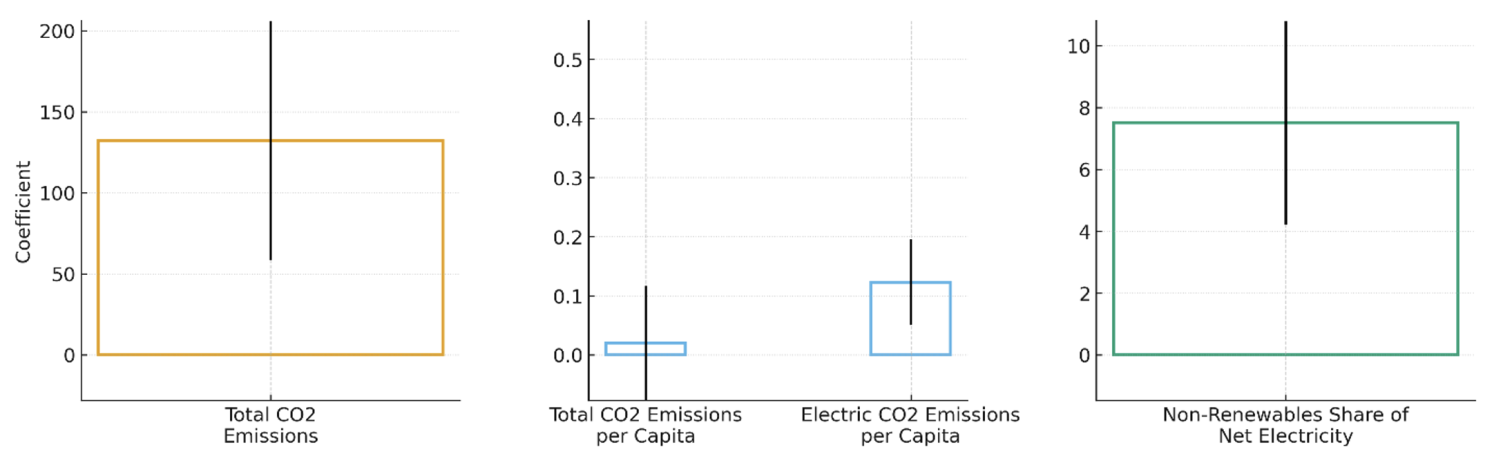
Notes: The figure presents estimated coefficients and 90% confidence intervals for the effects of AI penetration on various types of emissions and on the non-renewables share of net electricity generation. The estimation sample includes 722 commuting zones observed across four 5-year periods from 2002 to 2022.
Second, the growth in emissions is mostly due to a scale effect. Decomposing the drivers of emissions into scale, composition, and technique (à la Levinson 2009), we find that expansion of local economic activity is the main channel through which AI affects emissions. Areas specialised in industries with faster growth of data-intensive employment attracted more workers and firms, increasing total output and hence energy use (Figure 2). Shifts in industrial composition modestly reduced, rather than increased, emissions.
Third, electricity generation becomes more carbon intensive. Even after controlling for scale, per-capita emissions from power generation rose in areas with higher AI penetration (Figure 2). This happens because power plants located in more exposed areas switch electricity generation from renewable sources to non-renewable sources (Figure 2). It confirms concerns that the energy demand driven by AI applications and data centres is met primarily by fossil-fuel plants, which can guarantee the stable and continuous supply that high-performance computing requires.
Our fourth and final result is that the location of data centres matters. Since electricity cannot be stored at scale easily, the grid must balance supply and demand in real time. Given the high transmission-loss costs, power plants are influenced by nearby sources of demand, especially from data centres which require a stable, high-capacity electricity supply. Consistently, we find that proximity to data centres is associated with power plants generating higher CO2 emissions and relying more heavily on non-renewable energy sources (Figure 3).
Figure 3 Distance to data centres and power plant activities
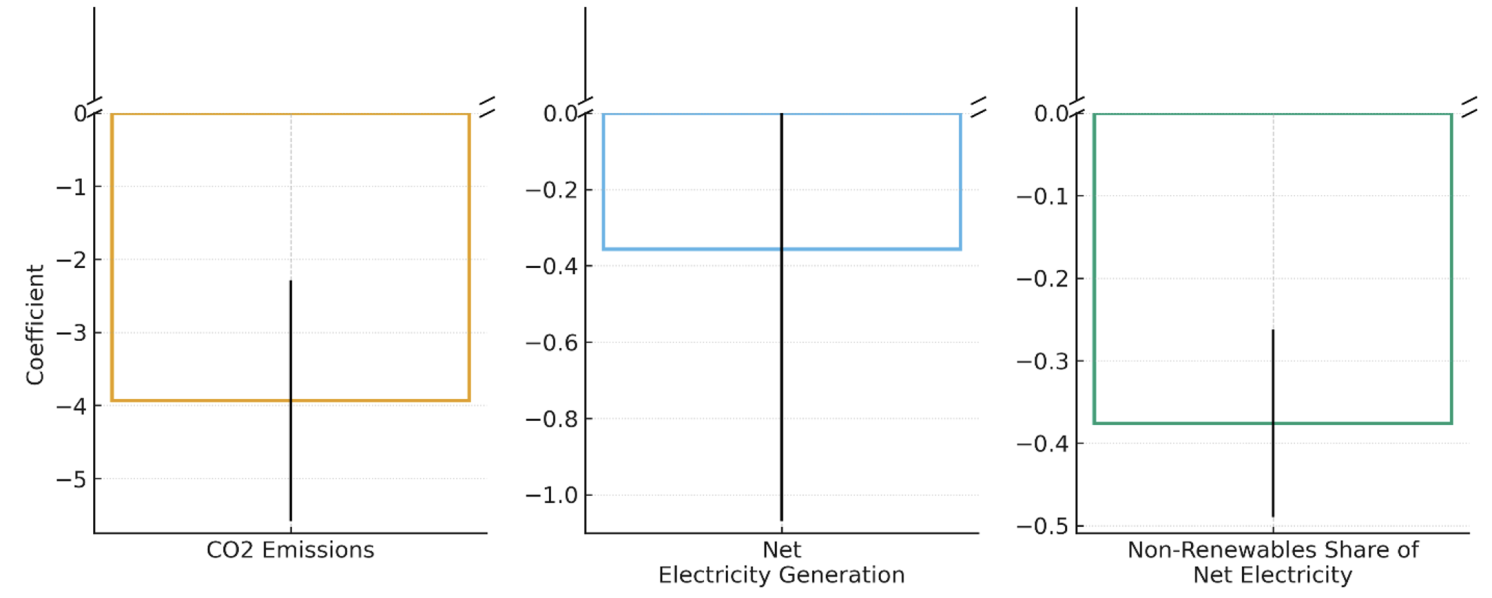
Notes: The figure presents estimated coefficients and 90% confidence intervals for the effects of power plants’ average distance to data centres on different power plant activities. The estimation sample consists of 11,500 power plants observed four 5-year periods from 2002 to 2022.
Conclusions
These results put numbers on a concern often voiced by climate analysts: absent a faster transition of the power sector to low-carbon sources, the diffusion of AI can slow or even reverse recent gains in emissions reduction.
Notably, our study covers 2002–2022, a period that predates the explosion of generative AI. While the promised efficiency gains from these new technologies may eventually help decarbonise the economy, training and running today’s large language models is far more energy-intensive than the earlier AI applications captured in our data. Unless accompanied by massive investment in clean power, the next wave of AI may therefore have even larger short-run impacts on emissions.
Our research points to an uncomfortable truth: digital transformation and decarbonisation cannot be treated as separate agendas. The diffusion of AI epitomises a classic challenge of technological progress: innovations that promise long-term efficiency gains can, in the short run, raise environmental externalities by expanding demand for energy. The solution is not to slow AI, but to accelerate the clean-energy transition. This may require incentives for more energy-efficient hardware, locating data centres in regions with abundant clean-energy capacity, and strengthening transmission infrastructure. Without that alignment, the race for ever-more-powerful algorithms may inadvertently lock economies into a higher-emission path.
See original post for references