When it comes to learning about a client, some topics can be easier for financial advisors to raise than others. For instance, while a client might be willing to open up about how they plan to spend their time in retirement, they might be more reluctant to answer questions about their health or legacy. Which can create a challenge for advisors, who may need to understand these issues to build a plan that truly reflects the client’s values and circumstances.
In this guest post, Meghaan Lurtz, a leading expert on the psychology of financial planning and Professor of Practice at Kansas State University, explains why sensitive conversations matter in financial planning, how trauma-informed interviewing techniques can help advisors approach these discussions, and how advisors can use three practical tools to navigate these ‘hard questions’.
When a client tenses up or talks around a sensitive question – such as, “Do you have any health concerns I should know about?” – an advisor might assume the topic is out of bounds and avoid it in the future. However, research suggests that when someone is reluctant to discuss a particular topic, it’s often because they expect the conversation to be more uncomfortable than it is likely to be in reality.
With this in mind, advisors can draw on trauma-informed interviewing techniques –even when a client hasn’t experienced trauma themselves – to facilitate these discussions more effectively. Key practices include being mindful of the order and pacing of questions asked (e.g., not going directly to the hardest questions), preparing for the conversation beforehand, and asking open-ended questions where possible.
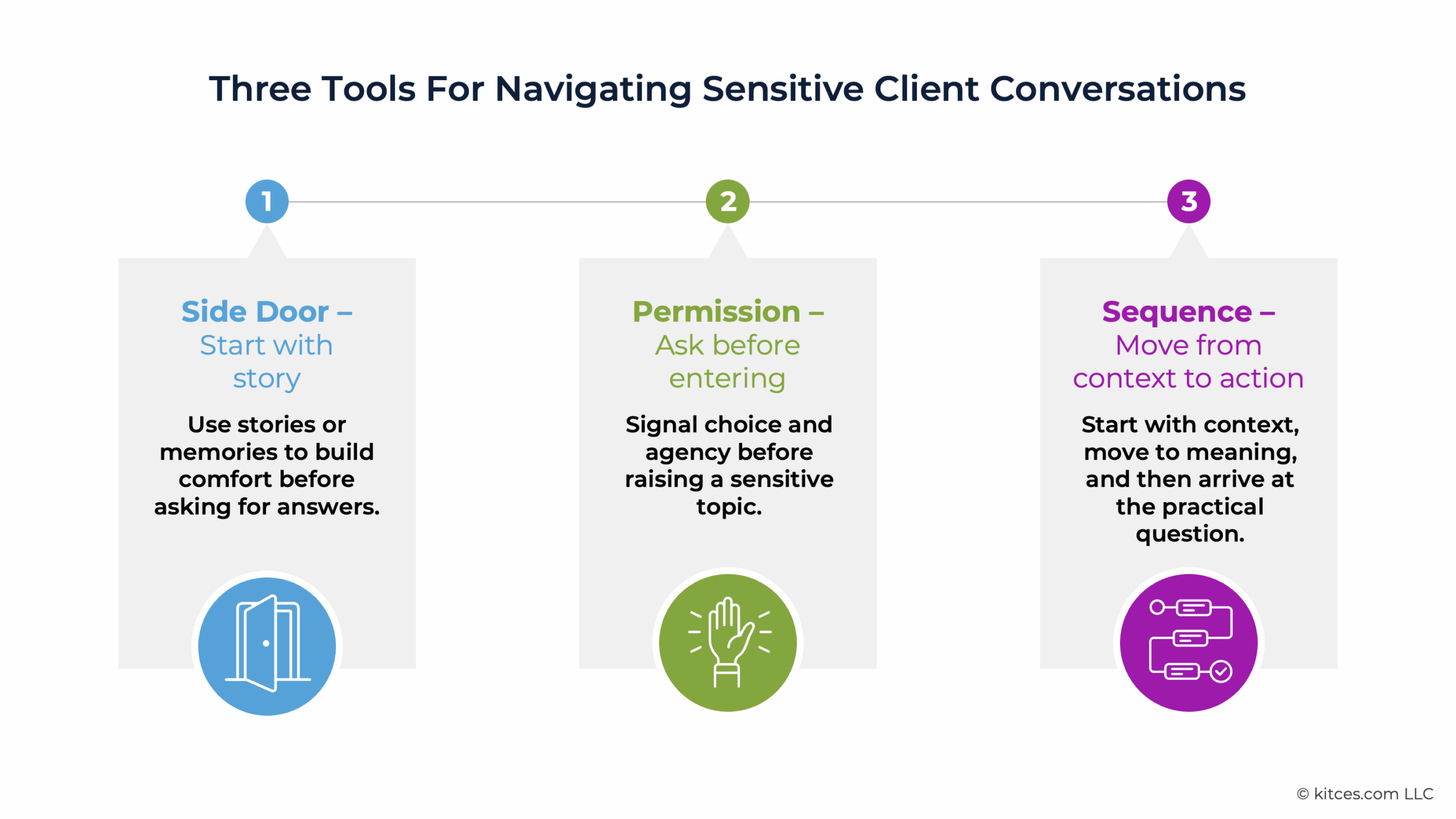
One related tool for navigating hard questions is to use a “side door” approach. By starting more gently with a potentially thorny topic, advisors can ease clients into the conversation. For example, instead of asking, “How much do you want to save for your children’s college education?” an advisor might ask, “When you imagine your child getting their acceptance letter, what do you picture happening next?” This can help get the client talking while surfacing unspoken assumptions about the topic. Advisors can also ask clients for permission before broaching a potentially sensitive subject, which can give clients a greater sense of control over how the conversation unfolds. (And, paradoxically, clients who are given permission to say no are far more likely to say yes!) A third approach is to sequence questions, starting with low-pressure context to understand the client’s story, moving to the emotions or deeper meaning behind the topic, and only then arriving at practical decisions.
Ultimately, the key point is that advisors don’t need to avoid sensitive questions in financial planning. Rather, by preparing clients, pacing conversations, asking permission, and sequencing questions from story to meaning to action, advisors can reduce defensiveness and uncover insights that lead to better plans!
Read More…