The migration of creative and post-production workflows to the cloud has delivered flexibility but also fragmentation, leaving the average production team managing five or more disconnected platforms for storage, streaming, review, and delivery. Teams lose more than 30 hours per project shuttling files between those systems – uploading to storage, downloading to edit locally, exporting for review, and repeating the cycle – while locating a specific clip in a multi-terabyte archive often requires manually scrubbing through hours of footage. Shade addresses this directly with a unified cloud-native platform that consolidates storage, real-time file streaming, AI-powered search, review and approval, and archiving into a single system of record for media teams. Its block-level streaming engine makes large files editable the moment they upload without local downloads, while AI processes footage on ingest so editors can find a specific soundbite or visual moment through a natural language query rather than manual hunting. In under a year since launching publicly, the company has ingested more than 60 million assets for some of the largest brands, agencies, and sports organizations in the world – a pace that signals a genuine gap in how the industry has managed media infrastructure.
AlleyWatch sat down with Shade CEO and Co-Founder Brandon Fan to learn more about the business, its future plans, recent funding round, and much, much more…
Who were your investors and how much did you raise?
We raised $14M led by Khosla Ventures and Construct Capital, with participation from Bling Capital. This brings our total funding to $20M. We’re also grateful to our seed investors, General Catalyst, SignalFire, and Contrary, for believing in us early.
Tell us about the product or service that Shade offers.
Shade is the intelligent file system for creative teams. We replace the typical post-production stack with a single unified platform where teams can access, search, review, and archive everything (combines cloud storage like Dropbox, streamable file systems like LucidLink, MAMs like Iconik, review platforms like Frame.io, file transfer services like Signiant, and proxy generation tools).
Post teams get one source of truth for all their media assets, feedback, and approvals, accessible from anywhere.
What inspired the start of Shade?
Emerson Dove (Cofounder and CTO) and I were creatives ourselves and we lived this problem firsthand. We’d spent countless hours shuttling files between five different platforms instead of doing the work we loved. Upload to storage, download to edit locally, export for review, download revisions, repeat.
We started having hundreds of conversations with editors and heads of post and kept hearing the same frustration. This wasn’t unique to us. Teams everywhere were spending more time managing files than creating. That’s why we started Shade in 2024: to build a single source of truth for media teams.
How is Shade different?
The rest of the industry forces teams to choose between cloud collaboration and real-time performance. Legacy tools either make you download entire files before you can work with them, or they solve one slice of the workflow and leave the other four to a different vendor.
Shade is the only platform that unifies storage, streaming, AI-powered search, review, and archive in one place. Our block-level streaming engine makes a 100GB file editable the second it uploads, as if it were stored locally. Our AI processes footage on ingest, so teams can search by what’s actually in the video, not just what someone remembered to tag.
Everyone’s building the AI brain. We’re building the memory system that makes it work.
What market does Shade target and how big is it?
Shade targets creative and post-production teams across film, TV, advertising, sports, gaming, and enterprise video. But there are no real industry limits here. Any team working with large media files runs into the same infrastructure problem, which makes this a multi-billion dollar opportunity across storage, collaboration, asset management, and review.
Today, the average production team juggles five or more disconnected platforms and loses 30+ hours per project moving files between storage, editing tools, and review. Feedback scatters across Frame.io, email, and Slack. Finding a specific clip in a multi-terabyte library means scrubbing through hours of footage because traditional storage can’t search what’s inside the files.
Shade consolidates the entire workflow into one platform. Editors mount Shade as a cloud-native drive and stream files directly into their NLE without downloads. AI automatically tags and transcribes on ingest, so teams can search by what’s actually in the video. Review happens in-platform with comments syncing directly to NLE timelines.
What’s your business model?
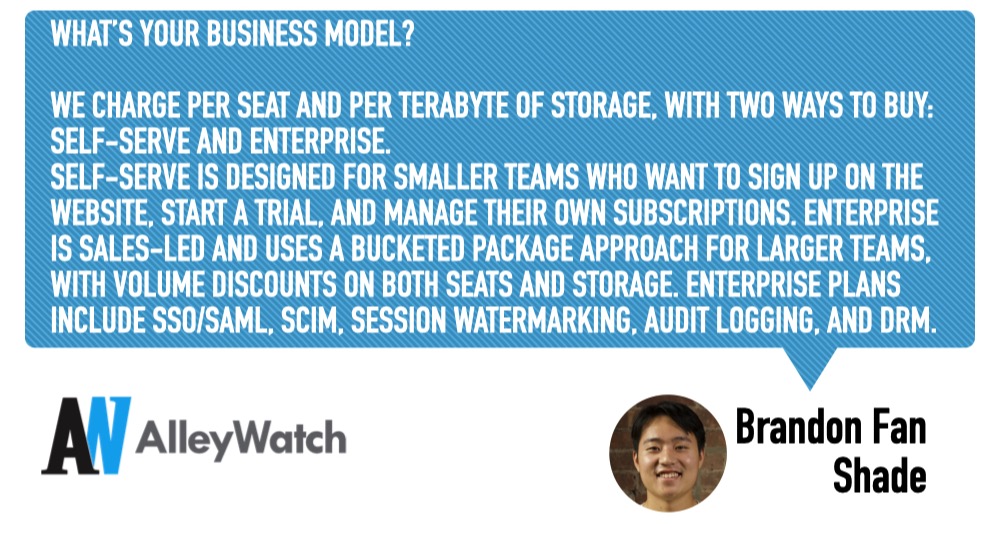
We charge per seat and per terabyte of storage, with two ways to buy: self-serve and enterprise.
Self-serve is designed for smaller teams who want to sign up on the website, start a trial, and manage their own subscriptions. Enterprise is sales-led and uses a bucketed package approach for larger teams, with volume discounts on both seats and storage. Enterprise plans include SSO/SAML, SCIM, session watermarking, audit logging, and DRM.
How are you preparing for a potential economic slowdown?
The best defense in any market is solving a real, painful problem that customers can quantify. Every Shade customer can point to hours saved per project and headcount freed up. When budgets tighten, tools that consolidate four or five line items into one become even more valuable, not less. We’ve built the business around that.
What was the funding process like?
We spent time meeting a lot of investors and looking for partners who understood both the creative industry and where AI infrastructure is headed. Khosla and Construct saw it quickly, and the process moved fast from there.
What are the biggest challenges that you faced while raising capital?
The hardest part was helping investors outside of post-production understand just how broken the current workflow is. Most people don’t realize that creative teams are losing 30+ hours per project to file management, or that the average team is paying for five separate tools to do what should be one. Once we walked them through the day-to-day reality, the conversation changed.
What factors about your business led your investors to write the check?
The size and urgency of the market need. Post-production is shifting from hard drives to the cloud right now, and the fragmentation that shift has created is measurable in hours and dollars per project. Investors saw a real, unmet problem, a product already used by teams at the scale we’re targeting, and a clear path to becoming the file system of record for creative work.
What are the milestones you plan to achieve in the next six months?
Four things we’re focused on:
Building a file system people love to use. If Shade is the tool all data flows through, it needs to be a place teams love to work in every day. We’re pouring resources into a unified design system, better interactions, and a beautiful user experience.
Building the smartest search engine for any modality. We’re going beyond semantic search with custom metadata and doubling down on search across images, video, and text, with direct moment detection and time-specific metadata. We’re also investing in how AI can sort, organize, and label automatically.
A file system that represents your business. Most file systems just store files, or just do review, or just act as a MAM. We want Shade to represent your actual business (events, sports teams, clients, projects) and let you build no-code workflows that automate the busywork. We’re not just building a system of record. We’re building a system of action.
The most extensible file system. For workflows to be truly connected, Shade needs to be extensible. We’re doubling down on developer experience, and our Shade App Store is coming
What advice can you offer companies in New York that do not have a fresh injection of capital in the bank?
Be product-led. Capital amplifies what’s working, but it doesn’t create it. The companies that end up raising from a position of strength are the ones whose customers are already telling their friends. Focus every ounce of energy on making something a specific group of people genuinely can’t live without. Revenue and word of mouth will follow, and so will investors.
Where do you see the company going now over the near term?
Over the next six to twelve months, we’re focused on making Shade the operating layer for creative work, not just a place files live. That means shipping Custom Objects and Automations so teams can model their actual business (events, sports teams, clients, projects) inside Shade and automate the busywork around ingest, review, and delivery. It also means deepening our integrations across the tools post teams already use, so Shade becomes the connective tissue between creative, production, and delivery.
What’s your favorite spring destination in and around the city?
The East Village. Our office is there, and that’s where the energy is in New York!

You are seconds away from signing up for the hottest list in NYC Tech!
Sign up today