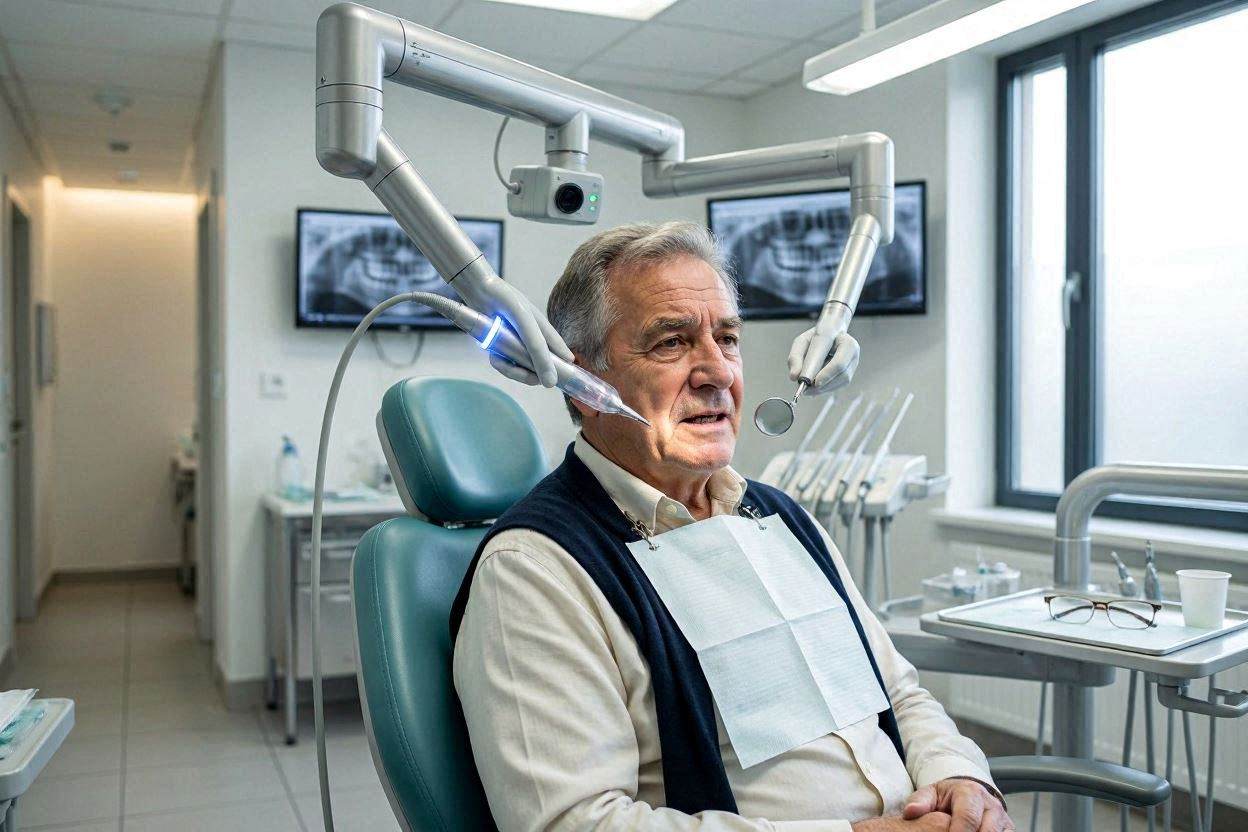
You’re sitting in the dentist’s chair about to receive a routine crown.
But instead of hearing the familiar buzz of a drill in your dentist’s hand, a robot about the size of a wine cork glides into position.
A few minutes earlier, it scanned your tooth. Now, while your permanent crown is being manufactured, the robot precisely prepares the damaged tooth so everything is ready in a single visit.
Image: University of Basel / Catherine Weyer
That might sound futuristic, but researchers in Switzerland have already built the prototype.
And it’s just the latest example of a trend that’s gaining momentum.
Robots are about to become an ordinary part of our daily lives.
Leaving the Factory
Robots have been working for us for decades.

Image: YouTube
But until recently they’ve remained mostly behind the scenes.
They’ve assembled automobiles, welded steel, packaged electronics and moved products through warehouses. In fact, they’ve become so commonplace in manufacturing that it’s easy to forget just how many are already out there.
According to the International Federation of Robotics, factories around the world now operate more than 4.6 million industrial robots. Last year alone, manufacturers installed more than 540,000 new ones as companies looked to improve productivity and offset rising labor costs.
Most of us never think about those machines because we’ve never really had to interact with them.
But I believe robots are about to become a much more visible part of our everyday lives.
It’s why we have multiple robotics related stocks in the Strategic Fortunes model portfolio.
You see, advances in artificial intelligence have given robots the ability to see, understand instructions and perform increasingly complex tasks. At the same time, labor shortages and aging populations are giving businesses reasons to deploy them.
The little dental robot developed at the University of Basel is a perfect example.

Image: University of Basel / Catherine Weyer
Measuring just 43 millimeters long, it’s designed to fit inside a patient’s mouth after first creating a detailed digital scan. Researchers say it’s accurate to within less than two-tenths of a millimeter, making it precise enough to handle one of the most delicate parts of preparing a tooth for a permanent crown.
But it wasn’t built to replace dentists.
It’s meant to eliminate repetitive work and improve consistency from one patient to the next. By reducing the number of appointments needed, it should also improve the patient experience.
And dentistry is only the beginning.
If you’ve ever had a nurse struggle to find a vein while drawing blood, you’ll appreciate what companies like Vitestro are working on.

Image: vitestro.com
Their robotic blood-draw system uses ultrasound and AI to find a patient’s vein before inserting the needle. In testing, it was successful on the first try 94.5% of the time, making one of medicine’s most common procedures faster and more reliable.
Hospitals are also finding new jobs for robots that have nothing to do with surgery.
Diligent Robotics’ Moxi robot now delivers medications, lab samples, meals and supplies through hospital corridors, allowing nurses to spend more time caring for patients instead of pushing carts from one department to another.

Image: Diligent Robotics
The company says its robots have already completed well over one million deliveries.
Robots are infiltrating the hospitality industry too.
Relay Robotics has deployed thousands of autonomous service robots across hotels and hospitals.

Image: Relay Robotics
They bring towels to guest rooms, deliver toothbrushes in the middle of the night and carry meals through hallways without ever getting tired. The company says its robots now complete tens of thousands of deliveries every month.
And robots have been working in restaurants for a while now.
Fast-food chains are increasingly relying on robotic fry stations, automated drink systems and AI-powered kitchen assistants to improve consistency. What started as a response to labor shortages is quickly becoming part of the normal restaurant experience.
And that’s just here in the States.
Travel through parts of Asia, and robots are much more common.
In South Korea, more than 9,000 unmanned stores now operate with little or no staff. Some use robotic baristas to prepare coffee. Others sell flowers, pet supplies or clothing without a single employee standing behind the counter.
Business owners say robots help offset rising labor costs while serving a country with one of the world’s fastest-aging populations.
Hotels in Asia are preparing for the same future.
Researchers are already teaching humanoid robots how to set banquet tables, fold linens and greet guests by recording the movements of experienced hotel employees.
And in China, developers are building what they hope will become the world’s first hotel run almost entirely by robots, from check-in and room service to housekeeping.
That might sound crazy, but in a few decades it could become the norm in many parts of the globe.
Here’s My Take
Most of us probably wouldn’t think twice about letting a robot cook our hamburger or deliver extra towels to our hotel room.
But what about drawing your blood? Or preparing your tooth for a crown?
You and I might answer those questions differently, but one thing seems increasingly clear.
The future of robotics won’t just be decided by what machines are capable of doing.
It’ll also be shaped by what we’re willing to let them do.
Regards,
 Ian KingChief Strategist, Banyan Hill Publishing
Editor’s Note: We’d love to hear from you!
If you want to share your thoughts or suggestions about the Daily Disruptor, or if there are any specific topics you’d like us to cover, just send an email to [email protected].
Don’t worry, we won’t reveal your full name in the event we publish a response. So feel free to comment away!