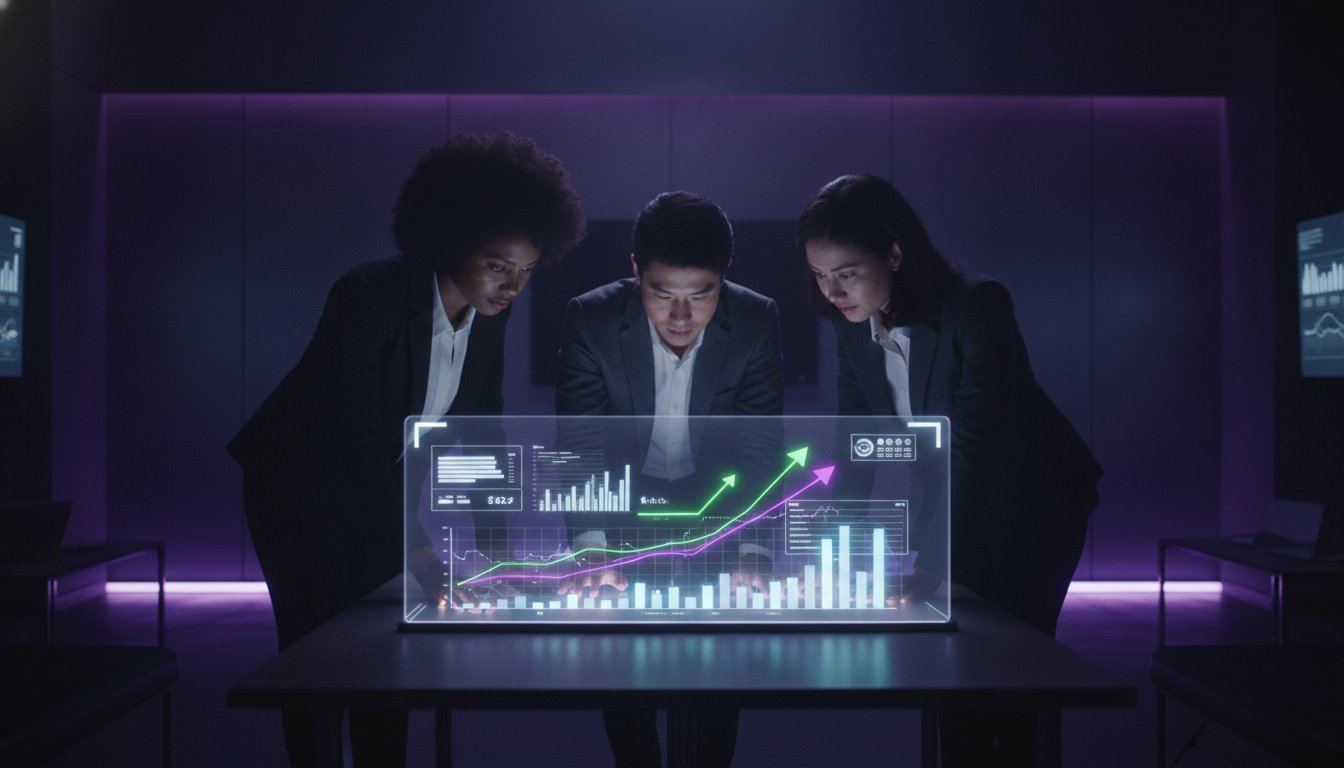
The Quantum Intelligence Race
Why Quantum Computing May Shape the Next Global Economic Order
The Next Technological Revolution Is Already Beginning
Throughout history, every major technological revolution has reshaped the global balance of economic power.
Steam engines powered the Industrial Revolution.
Electricity transformed manufacturing.
The internet created the digital economy.
Artificial intelligence is now redefining productivity across nearly every industry.
Yet another technological wave is emerging—one that could prove even more transformative over the coming decades.
Quantum computing.
Unlike classical computers, quantum computers are not simply faster processors. They represent an entirely different computational paradigm capable of solving classes of problems that remain impractical for conventional systems.
For investors, policymakers, and business leaders, the important question is no longer whether quantum technologies will matter.
The question is how they may reshape global competitiveness.
Beyond Hardware
The quantum race is frequently portrayed as a competition to build the largest quantum computer.
That view is incomplete.
Long-term leadership will likely depend on an ecosystem that combines:
Quantum processors
Quantum algorithms
Error correction technologies
Photonics
Cryogenic engineering
Semiconductor manufacturing
Artificial intelligence
Quantum-safe cybersecurity
Quantum communications
Highly skilled research talent
Countries capable of integrating these capabilities may gain significant strategic advantages.
The Next Layer of Global Competition
During the twentieth century, economic influence was largely built upon:
Industrial production
Energy resources
Financial capital
Military capabilities
Global trade
The twenty-first century increasingly adds another strategic layer:
Intelligence Infrastructure.
This includes:
AI compute capacity
Advanced semiconductor manufacturing
Data infrastructure
Energy availability
Quantum computing
High-performance networking
Economic competitiveness is becoming progressively tied to computational capability.
Introducing the Quantum Power Index™
Traditional indicators such as GDP remain essential.
However, they may become less sufficient for evaluating future technological leadership.
To complement existing measures, we propose a conceptual framework called the Quantum Power Index™ (QPI).
Rather than measuring economic size alone, the QPI evaluates a country’s capacity to develop, deploy, and scale quantum technologies.
The framework is intended as an analytical model rather than a definitive ranking and can evolve as the industry matures
Why Investors Should Pay Attention
Quantum computing remains in its early stages.
Commercial adoption may take years.
Nevertheless, history suggests that investors often create the greatest long-term value by identifying foundational technologies before they become mainstream.
Just as cloud computing, semiconductors, and artificial intelligence evolved over decades, quantum technologies may follow a similar path.
The companies building processors, photonics, cryogenic systems, networking infrastructure, and quantum software could become critical components of the next technology cycle.
Conclusion
The Industrial Revolution rewarded those who mastered steam.
The Digital Revolution rewarded those who mastered information.
Artificial intelligence is rewarding those who build intelligent systems.
The Quantum Revolution may reward those who build the infrastructure of quantum intelligence.
For investors, the quantum race is not simply another technology story.
It may become one of the defining investment themes of the coming decades.
Quantum Power Index™ Core Assumption
A country’s future quantum competitiveness should be measured not only by the number of quantum computers it possesses, but by its ability to develop, scale, and transform its quantum ecosystem into sustainable economic value.
Theoretical Formula QPI = H + A + R + C + I + S + G
Where:
H (Hardware)
Quantum hardware capability, including processors, qubit quality, fabrication technologies, and supporting infrastructure.
A (Algorithms)
Quantum algorithms, software ecosystem, development tools, and application capabilities.
R (Research)
Scientific research excellence, patents, academic institutions, and availability of highly skilled talent.
C (Capital)
Public investment, private capital, venture funding, and financial support for quantum innovation.
I (Industry)
Industrial integration, commercialization, manufacturing capabilities, and collaboration across the quantum value chain.
S (Security)
Quantum cybersecurity, quantum communications, encryption technologies, and resilient digital infrastructure.
G (Governance)
National quantum strategy, regulatory framework, public policy, standards, and government support.
Quantum Maturity Levels Integration With the BIONIC AI ECONOMICS™ Framework
The Quantum Power Index™ naturally integrates with the broader BIONIC AI ECONOMICS™ecosystem, including:
AI Value Chain™
Planetary Infrastructure Index™
Decision Intelligence Framework™
Together, these frameworks provide a comprehensive approach for evaluating the technological foundations of future economic competitiveness.
The Quantum Power Index™ is designed as a practical, analytical, and investment-oriented framework while also serving as an original research model that can evolve with the maturation of quantum technologies and the global innovation landscape.
Deep Diver Insights
The future will not be led by the countries with the largest economies alone, but by those capable of building, scaling, and governing the infrastructure of quantum intelligence.