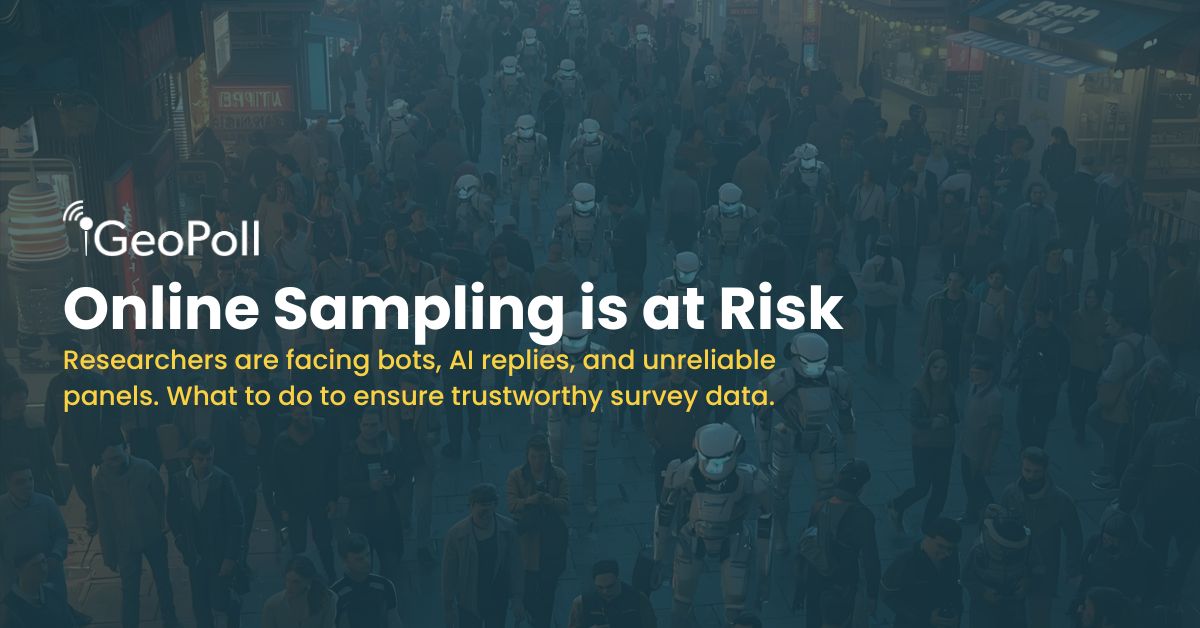
Over the last few decades, online sampling and online panels have become a cornerstone of modern research – fast, scalable, and cost-efficient. But in recent years, the industry has been grappling with a serious, structural threat that has gone up sharply in the last few months. A growing share of online survey responses is unreliable, artificially generated, or outright fraudulent.
Research clients are feeling it. Actually, a few have reached out to us at GeoPoll recently to say that other panel providers delivered datasets full of questionable responses. As an example, we audited a dataset from one of these projects and found respondents claiming to work for companies that, after cross-checking, did not exist. That is not a minor quality issue, but a failure of the most basic layer of respondent verification.
The problem is not isolated. It is becoming pervasive, and it threatens the trustworthiness of survey research if left unchecked.
In this article, we break down what is happening, why it is happening, and, most importantly, what the industry must do about it.
Why online sampling is under pressure
The challenges the industry is experiencing step from pressures on
The explosion of bots and automated respondents – Fraudulent actors can now generate large volumes of convincing survey completions using tools that simulate human behaviour, including normalised click paths, varied timing, and even device switching. The barrier to entry is low, the incentives are high, and the fraudsters are increasingly sophisticated.
AI-generated open-ended responses – One of the downsides of generative AI to the industry is that it has introduced a new challenge: artificial open-ended responses that sound perfectly human but contain no personal context. This is especially dangerous because open-ended questions were once reliable indicators of quality. Today, AI models can produce responses that are linguistically rich yet completely unauthentic, which makes manual review far more difficult.
Panel fatigue and low engagement – A third pressure point is panel fatigue. In many markets, respondents are oversurveyed and under-engaged. As genuine participation declines, some panel providers fill quotas through loosely vetted traffic sources, unverified accounts, or third-party supplies whose quality mechanisms are opaque. This is often where “junk” data enters the chain, responses that look complete but crumble under scrutiny.
Nonexistent profiles and artificial identities – Beyond fake companies, we are now seeing invented educational histories, geographic misrepresentation through VPNs, and household profiles that defy demographic reality. Incentive-driven fraud compounds this by enabling entire online communities to trade survey links, completion codes, and tips for bypassing checks.
The result is a landscape where bad data can be gathered at scale, faster than many traditional panels can detect it, compounded by technology.
Even from our own tests using the GeoPoll AI Engine, AI models can now generate human-like narratives, differentiated “voices”, realistic demographic profiles, and varied completion speeds. The reality is that as long as incentives exist, fraudulent responders will continue to innovate.
Meanwhile, many panel providers rely on legacy systems built for a world where fraud meant speeding or straight-lining. They were not designed to detect AI paraphrasing, synthetic behavioural fingerprints, cross-platform identity laundering, and real-time pattern anomalies
This mismatch creates structural vulnerability.
What this means for researchers and clients
Poor-quality sample data has obvious consequences, the immediate of which include:
Misleading insights
Incorrect targeting
Wasted budgets
Incorrect strategic decisions
Damaged credibility
But the deeper consequence is even more serious: If the industry does not rebuild trust in online sampling, brands and organizations will hesitate to rely on survey research at all. When decision-makers cannot trust the integrity of respondent data, they begin to question the value of surveys as a method. This is the real risk—an industry-wide credibility problem.
A reliable respondent ecosystem rests on three foundations: identity, location, and behaviour.
Respondents must be tied to real, verifiable identities. Their location must reflect where they actually are, not where their VPN says they are. And their behaviour must reflect natural human variation—not the automated consistency of scripts, bots, or artificially generated text.
These are basic principles, but in an era of synthetic identities and AI-driven fraud, they require much more rigorous systems to uphold.
How the industry should respond
Online sampling is not going away; if anything, demand will increase. But the industry must adapt. Fraud is evolving faster than legacy panel systems can respond, and researchers cannot afford to rely on outdated assumptions about respondent authenticity.
The future belongs to providers who treat data quality as a core capability, and not a back-office function. Those who invest in verification, diversify sampling modes, apply advanced fraud detection, and communicate transparently will set the new standard. The rest will continue to generate “junk” data and erode trust in research.
Rebuilding trust in online sampling will require a combination of technology, methodological discipline, and transparency.
Strengthen Identity Verification: Email-based registration is no longer sufficient. Providers need to move toward systems grounded in SIM-based verification, mobile operator partnerships, two-factor authentication, and device-level identity checks. Emerging markets with national SIM registration frameworks have a distinct advantage here.
Detect Fraud Behaviourally: Quality control must evolve beyond speeding and straight-lining. Modern systems should detect unusual device patterns, inconsistent browser fingerprints, abnormal timing sequences, proxy use, and other signs of automation. This has to happen pre-survey, not only during data cleaning.
Use AI to Fight AI: Just as AI can generate deceptive responses, AI can also detect them. Linguistic analysis, stylometric fingerprints, and semantic anomaly detection are becoming essential tools for flagging artificial or copy-pasted open-ended text.
Apply Human Oversight on High-Stakes Work: For sensitive audiences or high-value projects, manual review remains indispensable. Calling back a sample of respondents, checking claims when relevant, or auditing open-ended text can act as guardrails against fraud that slips through automated systems.
Reduce Reliance on Third-Party Traffic: Panels built on first-party respondent networks, such as mobile communities, app-based samples, and telco-linked panels, are inherently more secure than those that rely on opaque third-party supply. Direct relationships create accountability and allow for deeper verification.
Blend Modes When Necessary: Some populations or markets simply cannot be reliably captured through online traffic alone. Combining online surveys with CATI, SMS, WhatsApp, in-person intercepts, or panel phone lists reduces exposure to any single failure mode and strengthens representativeness. This why, at GeoPoll, we live for multimodal approaches to research.
Be Transparent With Clients: Clear reporting on quality checks, verification processes, and exclusion rates builds trust. As fraud grows more sophisticated, transparency becomes a competitive advantage.
How GeoPoll approaches online sampling to reduce these risks
These issues are increasingly common, but they are avoidable with the right systems. GeoPoll’s platforms and processes are deliberately designed to protect data integrity and put the voice of real humans first. Our model was built for the types of environments where online sampling is now struggling most. Our respondent network is anchored in mobile-first infrastructure, with SIM-linked verification and direct partnerships that ensure respondents are real people, reachable through real devices.
We complement this with multi-mode data collection – CATI, mobile web, SMS, WhatsApp, app-based sampling, and in-person CAPI – so no single sampling method carries the full burden of quality. Our now AI-powered fraud detection systems track behavioural anomalies, detect AI-like response patterns, and monitor unusual activity across surveys. And for complex or high-stakes studies, our teams perform human review of suspicious profiles or open-ended answers.
Contact us to learn more about how we make sure your data collection is valid.















-1024x683.jpg "Strait Outta Hormuz: Getting the Iran Oil Story Straight")