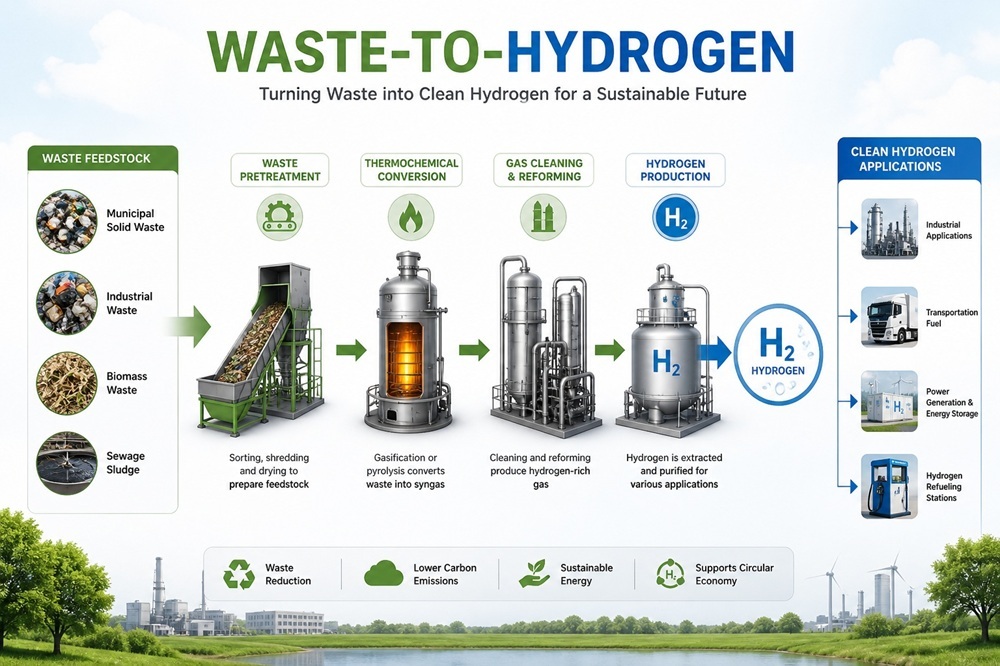
The Europe Waste-to-Hydrogen market is emerging as a key pillar in the region’s clean energy transition, converting municipal, industrial, and biomass waste into hydrogen fuel. Driven by circular economy goals and decarbonization policies, the market is gaining momentum through advanced gasification and thermochemical technologies. According to BIS Research, the sector is expected to grow rapidly through 2035, supported by strong policy incentives and innovation.
The Europe waste-to-hydrogen market is projected to reach $190.9 million by 2035 from $11.3 million in 2025, growing at a CAGR of 32.65% during the forecast period 2025-2035.
Why is the Europe Waste-to-Hydrogen Market Growing Rapidly?
The market is expanding due to increasing pressure to reduce carbon emissions and manage waste sustainably. Governments across Europe are promoting hydrogen as a clean fuel alternative, aligning with net-zero targets. Waste-to-hydrogen systems also support energy security by reducing dependence on fossil fuels. BIS Research highlights that integration into circular economy models and policy incentives are key growth accelerators.
What are the Key Drivers of the Market?
Circular economy adoption: Converting waste into usable hydrogen reduces landfill dependency.
Government incentives: EU funding and hydrogen roadmaps support project development.
Industrial decarbonization demand: Heavy industries are shifting toward low-carbon hydrogen solutions.
Technological advancements: Innovations in gasification, plasma conversion, and AI-based process optimization are improving efficiency.
Request A Sample for Europe Waste-to-Hydrogen Market – Focus on Application, Technology, Waste Type, and Country-Level Analysis and Forecast, 2025-2035
What are the Key Trends in the Europe Waste-to-Hydrogen Market?
Rise of modular and scalable plants for urban and industrial deployment
Integration of carbon capture technologies with hydrogen production systems
Digitalization and AI monitoring to optimize conversion efficiency
Partnership-driven ecosystems between technology providers and waste management companies
Focus on decentralized hydrogen production hubs closer to waste sources
What Challenges and Opportunities Exist in the Market?
Challenges:
High capital and operational costs for advanced conversion plants
Feedstock variability and waste sorting inefficiencies
Regulatory uncertainty across different European countries
Limited hydrogen infrastructure for storage and distribution
Opportunities:
Expansion of EU-funded hydrogen initiatives
Growing investment in green hydrogen ecosystems
Strong potential in urban waste management systems
Partnerships between public and private sectors to scale infrastructure
Click Here to Download the ToC
Conclusion
The Europe Waste-to-Hydrogen market represents a transformative opportunity at the intersection of waste management and clean energy production. With strong policy backing, technological innovation, and rising demand for low-carbon hydrogen, the market is set for significant expansion. Despite challenges such as cost and infrastructure gaps, its role in Europe’s decarbonization strategy will continue to strengthen in the coming decade.