Updated on July 11th, 2026 by Josh Arnold
ABM Industries (ABM) has a fantastic track record of paying dividends to shareholders. The company is part of the Dividend Kings, a group of stocks that have raised their payouts for at least 50 consecutive years. You can see all 58 Dividend Kings here.
We compiled a comprehensive list of all 58 Dividend Kings, including key financial metrics such as dividend yields, payout ratios, and price-to-earnings ratios. You can download the full list by clicking on the link below:

Dividend Kings have the longest track record when it comes to rewarding shareholders with cash returns. This article will discuss ABM’s dividend safety, valuation, and outlook.
Business Overview
ABM was founded in 1909 and has grown into an industry powerhouse. ABM Industries is a leading provider of facility solutions, including janitorial, electrical and lighting, energy solutions, facilities engineering, HVAC and mechanical services, landscape and turf management, and parking services. The company produces $9.2 billion in annual revenue and has a market cap of about $2.6 billion.
ABM has a long and impressive client list that includes hospitals, universities, public schools, data centers, manufacturing plants, and airports. The company’s expertise and many decades of experience in facility management have earned it a terrific reputation, making it a true industry leader.
ABM’s strategy is to compete in industries where it can win rather than competing everywhere. Over the decades, ABM has learned where it can compete successfully and where it cannot and has focused its efforts accordingly.
In 2007, ABM’s annual revenue was approximately $3 billion; however, it has more than tripled since then, currently standing at more than $9 billion. ABM has grown organically to some extent, but the vast majority of its growth has been achieved through acquisitions. Given ABM’s strategic direction regarding future cash usage, we can expect more acquisitions in the years to come.
ABM also has an exceptional dividend growth record. The company has paid more than 240 quarterly dividends and increased its dividend for 58 consecutive years.
Source: Investor Presentation
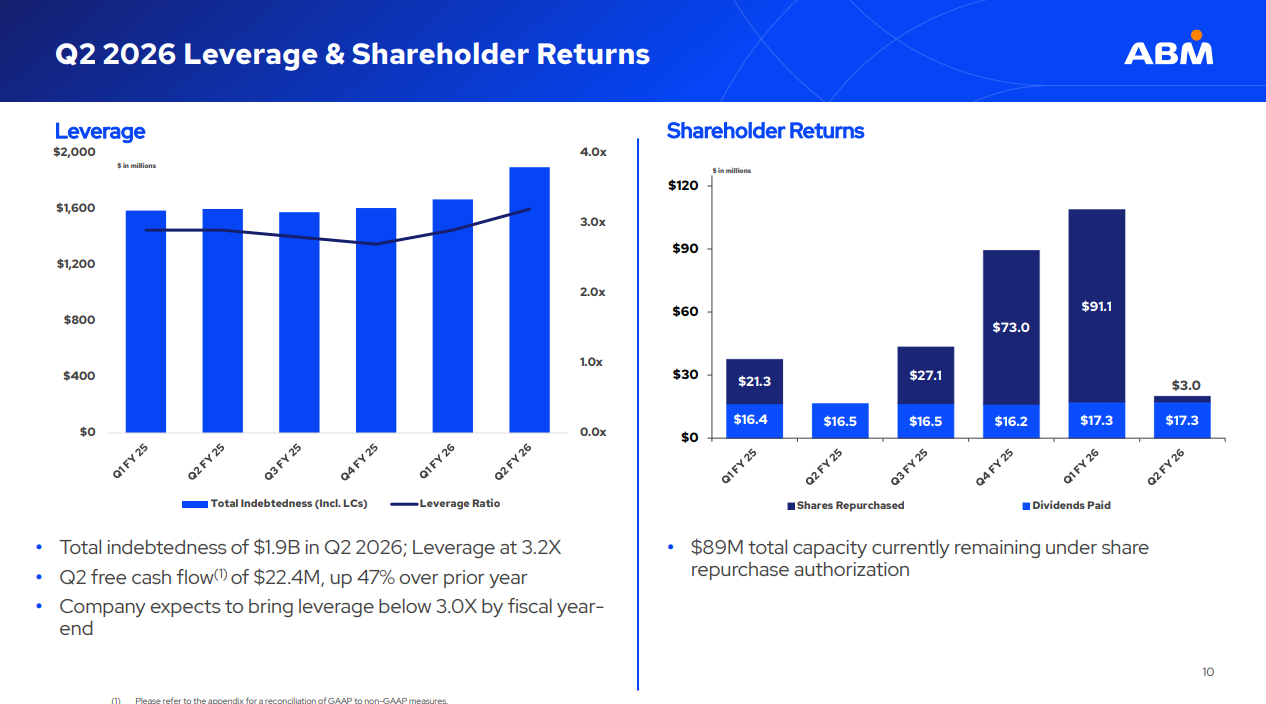
Given the remarkably low payout ratio of ~29% projected for 2026, its long-term growth prospects, and its resilience to recessions, ABM is likely to keep raising its dividend for many years to come. Additionally, the company has repurchased shares in recent quarters, which has helped drive higher earnings per share. This represents a departure from prior behavior, where capital returns were almost exclusively generated through cash dividends. Management has decided the stock is cheap, and is effectively deploying excess cash to keep a floor under the share price.
One source of potential earnings growth going forward is international expansion, as ABM has entered the U.K. market through the GBM and Westway acquisitions over the past few years. Going forward, continue to look for numerous transactions from ABM in terms of acquisitions and divestitures as it further shifts its mix. We note acquisitions are not constant, so it may be some time between purchases for ABM.
ABM is split into six segments that provide its customers a wide array of facility solutions: Business & Industry, Education, Aviation, Technology & Manufacturing, Healthcare, and Technical Solutions. The company’s revenue streams are highly diversified, with janitorial services comprising ABM’s most significant single revenue stream.
Growth Prospects
As we saw above, ABM’s stated strategy is to grow by acquisition. However, that’s not to say it ignores its ability to grow organically. When it has free cash flow to spend, it prioritizes organic growth. The company has deep expertise and an excellent reputation in the US for facilities management, and it looks to leverage that wherever possible. That means targeting national accounts first, where it can secure a significant amount of business all at once, as well as centralizing support services to improve margins.
ABM also explicitly calls out acquisitions in its strategy, although it prioritizes organic investments and dividends. Still, ABM’s recent history suggests that acquisitions are a crucial part of its overall strategy, and thus, we can expect ABM to continue growing both through acquisitions and organically.
ABM is still extremely focused on the US market, which presents potential opportunities for further international expansion. ABM could use its significant expertise in facilities management to gain access to global clients. The moves into the U.K. in recent years prove ABM is willing to take a chance; this may be the most significant growth avenue ABM has going forward.
Source: Investor Presentation
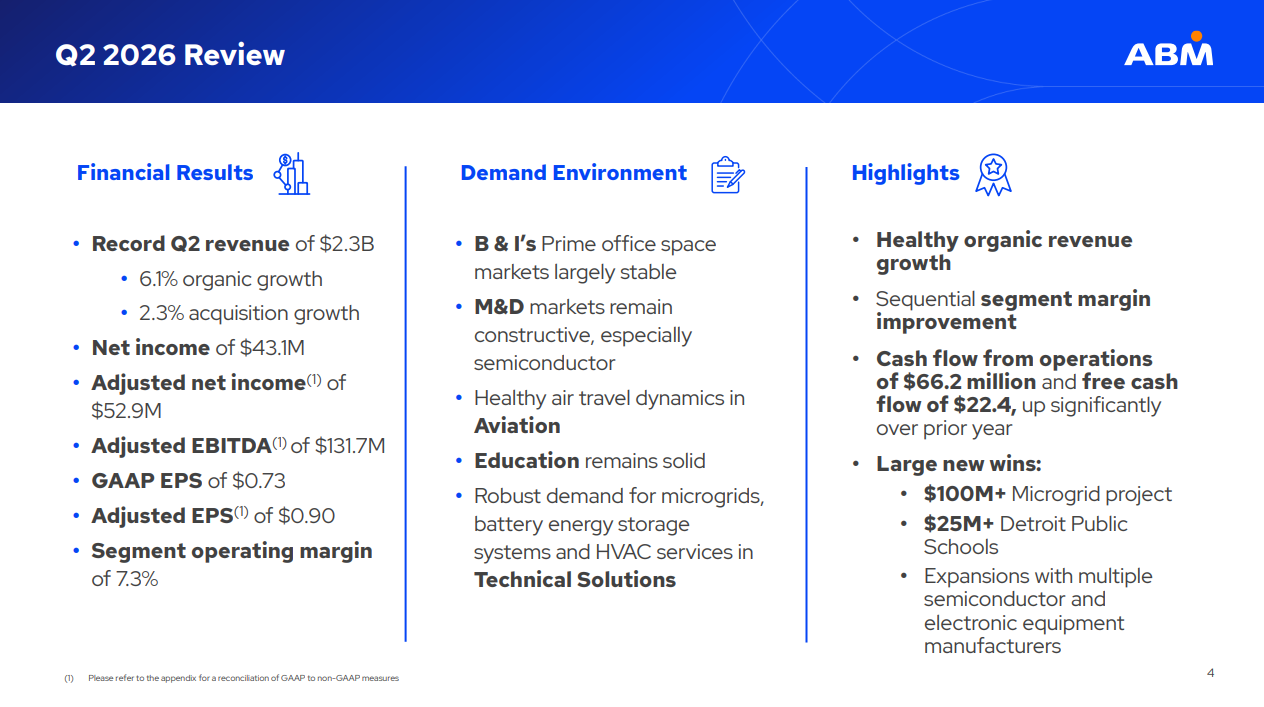
ABM reported fiscal Q2 2026 earnings on June 5th, 2026, and results were quite good once again. Revenue was $2.3 billion, up 10% year-over-year, and beating estimates by a very solid $90 million. Growth picked up sequentially as well, rising from a 6% growth rate in the prior quarter. However, EBITDA profit margin fell slightly year-over-year to 5.7% of revenue.
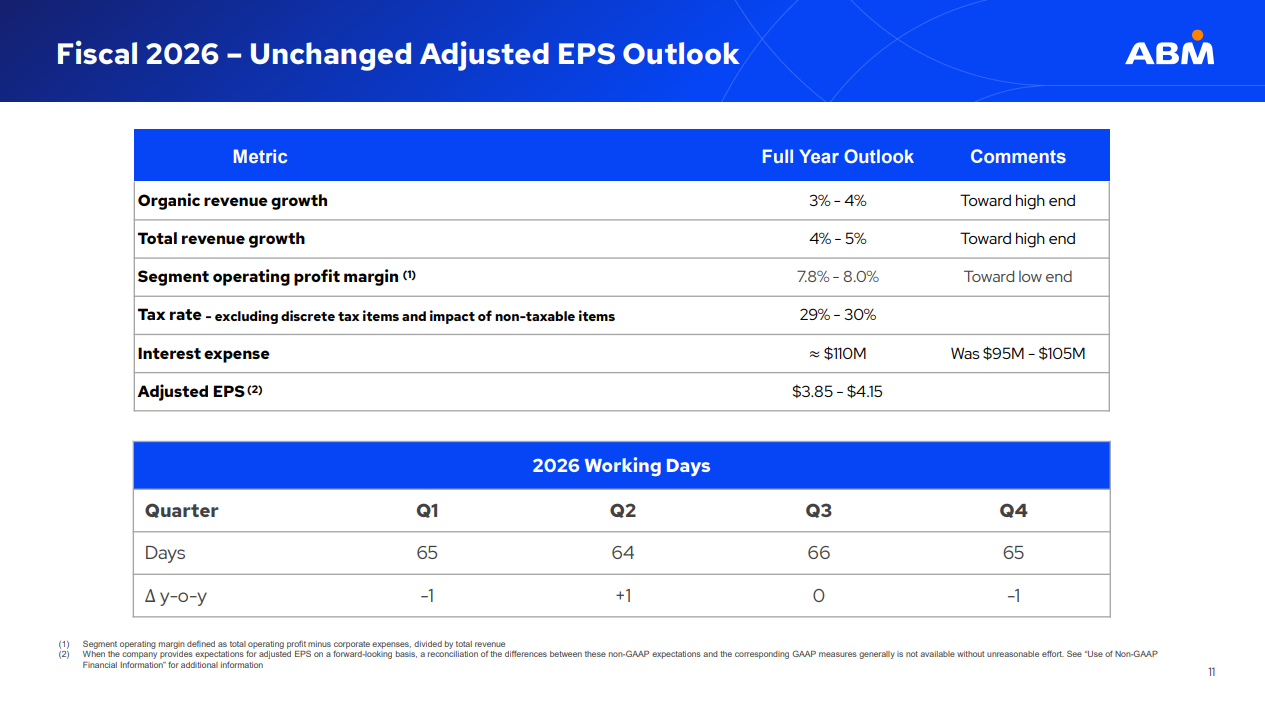
Earnings came to 90 cents per-share, which was also ahead of estimates. The company left its guidance unchanged for the fiscal year.
Source: Investor Presentation
With guidance still at $3.85 to $4.15 in adjusted earnings-per-share for this year, we have left our estimate at $4, the midpoint of management’s guidance. We note management guided for the high end of revenue growth, but the low end of profit margins. These factors should roughly offset each other, with earnings ultimately settling near the middle of the guidance range.
Competitive Advantages & Recession Performance
ABM’s competitive advantage lies in its size and the resulting economies of scale it enjoys. It has a 100+ year history of providing facility solutions for a wide array of customers, and that expertise is what sets ABM apart. It is a true industry leader in the facilities management space, and that affords it not only the ability to attract new clients more easily but also to expand relationships with the ones it already has.
In addition, since ABM operates in low-margin businesses, smaller competitors are at a disadvantage in terms of leveraging back-office and support costs. ABM may be in some competitive lines of work, but it is certainly better positioned than its competitors to overcome these obstacles.
ABM Industries is one of the largest companies in its industry, and its history of making acquisitions has further enhanced its scale advantages. ABM Industries is likely to continue making acquisitions to expand its size further.
Recessions are painful for ABM just like any other company, but its performance during the Great Recession was remarkable. ABM’s earnings-per-share during the Great Recession are below:
2007 earnings-per-share of $0.99
2008 earnings-per-share of $1.10 (11% increase)
2009 earnings-per-share of $1.33 (21% increase)
2010 earnings-per-share of $1.34 (0.7% increase)
Notably, ABM grew earnings per share each year during the Great Recession. Very few companies were able to accomplish this. Moreover, ABM once again proved its resilience in the coronavirus pandemic. It is truly a defensive, recession-resistant stock for this reason.
Thanks to an increase in high-margin work orders from resilient customers, ABM has easily offset the pandemic’s impact on its customers in the aviation industry and education. As a result, it is poised to grow its earnings per share to an all-time high level this year once again, and by a wide margin over 2025.
Overall, ABM enjoys thin operating margins and lackluster growth rates during normal economic times but is exceptionally resilient during rough economic periods.
This resilience is crucial, as it supports the stock’s long-term returns and makes it easier for shareholders to retain the stock during broad market sell-offs.
Valuation & Expected Returns
ABM is expected to generate earnings per share of $4 in its fiscal 2026. As a result, the stock is currently trading at a price-to-earnings ratio of just 11.2. This is significantly lower than the average price-to-earnings ratio of ~15.5 for the stock in the past 10 years. However, we consider 12 times earnings to be a reasonable estimate of fair value for this stock given lumpy growth in earnings in recent years.
The stock is nearly as cheap as it has been at any point in the past decade. If the stock trades at our assumed fair valuation level in five years, thanks to the expansion of its earnings multiple, it will generate a a fractional tailwind to total returns.
Moreover, the stock offers a 2.6% dividend yield. This yield is about double that of the S&P 500’s, so ABM is a solid income stock as well.
In addition, recent dividend raises have been very small, with typical increases in the 2% or 3% range. While ABM has an impressive history of paying dividends, it lacks a high current yield and dividend growth rate.
Lastly, we expect annual EPS growth of 6.0% over the next five years. Combined with a 2.6% dividend and a very small annualized expansion of the price-to-earnings ratio, total annual returns could approach 10% per year.
Final Thoughts
ABM is undoubtedly not a high-yield income or a high dividend growth stock. But what it lacks in excitement, it makes up for with consistency. ABM’s long and impressive history of paying a dividend should be respected, as the Dividend Kings are rare in comparison to the thousands of publicly traded stocks in the market.
ABM’s organic growth remains intact, and acquisitions contribute to its growth. Growth from here depends upon potential international expansion as well as margin gains, the latter of which has been hard to come by in recent years. In addition, the company has a relatively new tailwind of share repurchases.
With a low valuation and decent growth prospects ahead, total annual returns could be substantial, at 10% annually, over the next five years. ABM is a buy due to its high expected return and long history of dividend increases.
Additional Reading
The following databases of stocks contain stocks with very long dividend or corporate histories, ripe for selection for dividend growth investors.
Thanks for reading this article. Please send any feedback, corrections, or questions to [email protected].