Maintaining proper documentation is unlikely to be at the top of many advisors’ favorite activities. Nonetheless, accurate and thorough documentation not only can keep an advisor and their firm out of trouble with relevant regulators but also can help an advisor fulfill fiduciary responsibilities to their clients while providing evidence of their actions and recommendations in the case of a future client complaint. Which suggests that creating and maintaining relevant documents is not just a regulatory requirement but also could be a business imperative as well.
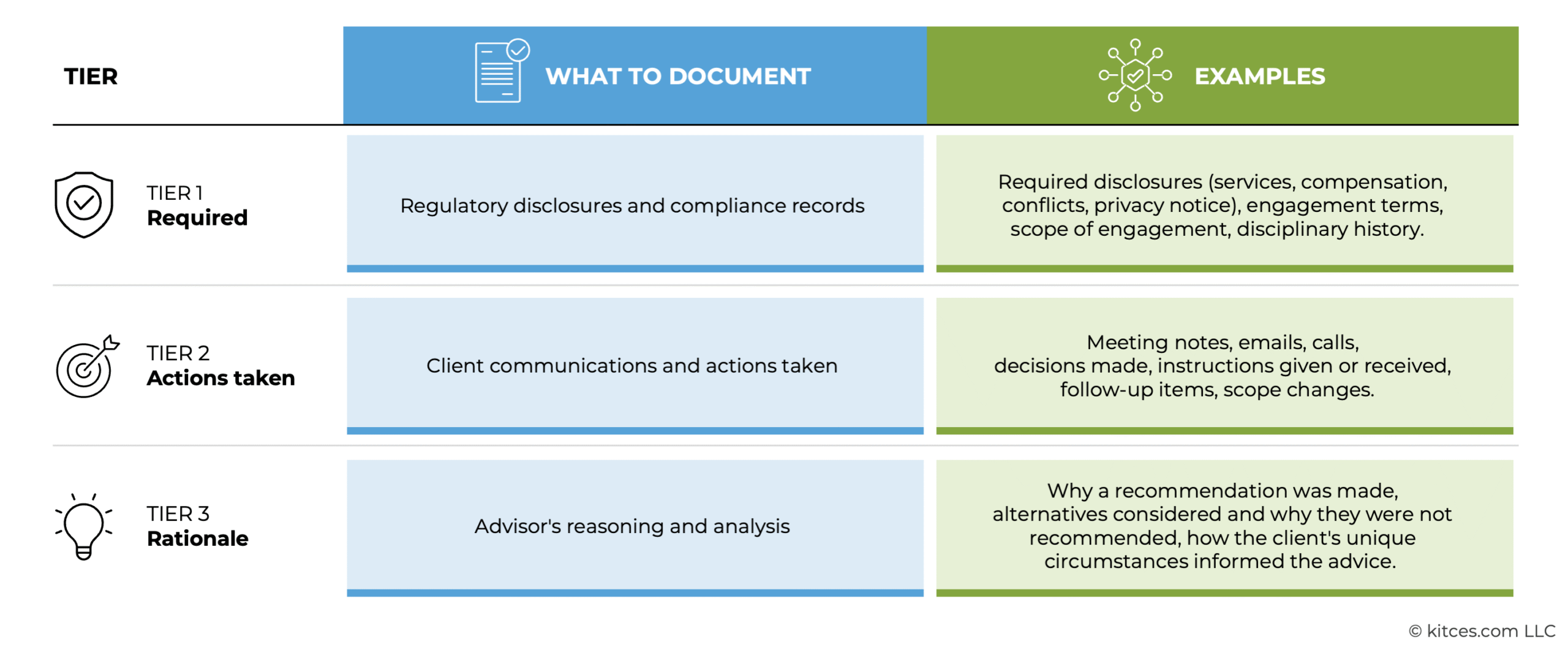
Broadly, documentation that is important to a financial advisory firm can be thought of in three tiers: documents that are required by the regulatory requirements of the practice (Tier 1), documents that describe actions taken and client communications (Tier 2), and documents that explain an advisor’s rationale for recommendations or actions (Tier 3).
Tier 1 documents that are required by regulators are likely to be those the advisor is most familiar with and can include a signed client agreement, Form ADV Part 2 delivery acknowledgment, conflict of interest disclosures, privacy notices, and other files as required by various governing bodies. The goal of this tier is to prove that the documentation required for legal and regulatory purposes was, in fact, delivered to the client, and these documents are often filed on a company intranet or in their CRM.
Next, Tier 2 documents catalogue interactions with a client and can include meeting notes, email communications, and copies of analyses delivered to the client. In this tier, a few of the important things to capture are what happened, when it happened, and who was involved. These details create a verifiable timeline of the client relationship that neither the advisor nor the client may be able to reconstruct with full accuracy from memory alone (which can be helpful evidence if a client [incorrectly] claims down the line that an advisor did or did not make a particular recommendation).
Finally, Tier 3 documents include the rationale for why an advisor recommended a specific action. While it is helpful to understand what recommendations were made (Tier 2 documents), describing the rationale behind them in writing can both provide the advisor with insight into their thinking if the recommendation is revisited down the line and also provide helpful background insights if another advisor or team member begins working with the client.
While financial advisory firms will likely already have Tier 1 documents established (though they might need to be updated from time to time), implementing a process across the firm for creating Tier 2 and Tier 3 documents can ensure these are produced consistently. For instance, building in time before client meetings (to record the thinking behind their recommendations) and after (to document decisions that were made and the reasons behind them) can ensure these tasks don’t slip through the cracks. Also, while some advisors might enjoy the writing process, firms might encourage those who are less adept at this task to take advantage of dictation tools (e.g., Windows Talk-to-Text and Pulse360) to organize their thoughts and avoid procrastinating this task.
Ultimately, the key point is that the benefit of maintaining proper documentation isn’t just a matter of staying in line with relevant regulations but also an opportunity to better serve clients and promote business continuity by maintaining accurate records of client communications and recommendations, as well as the reasons behind them!
Read More…