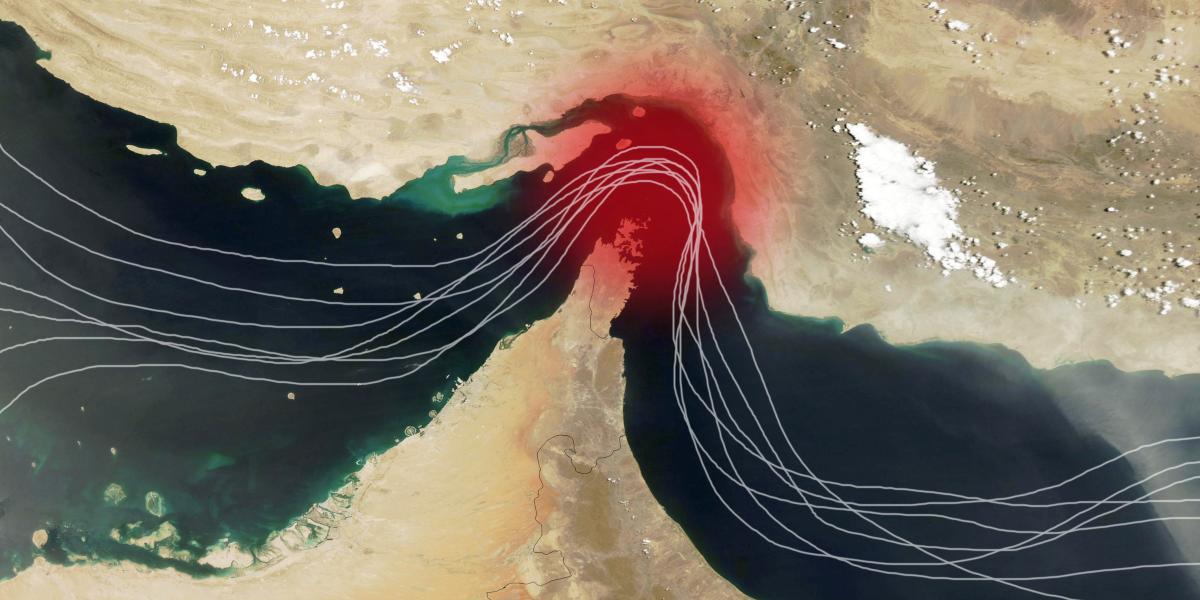
Since the ceasefire on April 8 and Trump’s apparent capitulation to Iran, it appears the Iranians will levy a toll on all oil passing through the Strait of Hormuz. The details are still unclear, but according to The Hill citing the Financial Times, the Iranian Republic will levy $1 per barrel of oil to be paid in bitcoin on all traffic out of the Persian Gulf.
The Iranian government obviously benefits from this, but who actually pays the toll? This question, what is known as tax incidence, is one important point of difference between the Austrian school and mainstream economics that remains widely overlooked, and the Hormuz toll is a good opportunity to highlight this difference and the Austrian, especially Rothbardian, approach to tax incidence. It is also an interesting political and economic question in its own right.
Toll Economics
The Hormuz toll imposed by the Iranians is paid immediately by the owners of the ships and cargoes of oil passing through. By the time of the ceasefire, there were about 2,000 vessels stuck in the Persian Gulf, but by no means all were oil tankers. For these cargoes, there can be no question of shifting the incidence of the toll. It is simply a total loss to them. However, now that the toll is established, it becomes effectively a calculable cost to the shippers of oil. Then the question emerges: can the businessmen who immediately pay the toll shift it to someone else and make them bear its burden? Here the laws of economics come into play. According to Rothbard’s first law of incidence, “no tax can be shifted forward.” That is, the person or company paying the tax cannot make the buyer of his product, and ultimately the final consumer bear its burden by raising his price. The price is set by demand and supply, and demand does not shift simply because a tax is imposed. In the short run, the stock in existence of the good is the relevant supply and the owner is willing to sell at any price. As we learn from total demand and stock analysis, only if the owner of the good exercises reservation demand, that is, if he has some alternative use for the good or if he speculates that the price (or in this particular case, the toll) might change to his benefit, will this not be the case In the case of a producer good like oil on board tankers, there are few alternative uses and little room for speculation, as not only the oil but also the tanker is immobilised so long as it cannot leave the Persian Gulf. Hence, in the short term, as we said, the companies who directly pay the toll will also bear the full burden.
In the long run, however, things look different and the incidence of the toll shifts. The shippers who directly pay the toll can shift the incidence backwards, specifically onto the producers of the oil. The price of oil at the well will permanently be below the world market price by the amount of the toll and the capital value of the oil well will be proportionately lower. The other producer goods in question will not be affected, since they can shift to alternative uses. Labourers can go elsewhere for a job and capitalists can invest in something else. Thus, even capital goods completely specific to Arabian oil wells (for instance, oil drills in situ), will not, in the long run, change in value. The oil well is the original factor completely specific to oil production, and so the incidence of the Hormuz toll will fall completely on the owners of the oil wells. Writes Rothbard, “[t]he excise tax is also a tax on incomes… [and] the impact falls most heavily on the factors specific to the taxed industry.”
We can then conclude that a barrel of oil at the well in Arabia will be priced at one dollar below the world market price and Arabian oil wells will fall proportionately in capital value. The Gulf Arabs who own the wells, and that means mainly state-owned companies like Saudi Aramco (Saudi Arabia), the Kuwait Oil Company (Kuwait), and the Abu Dhabi National Oil Company (United Arab Emirates), will bear the burden of the Hormuz toll. Effectively, the ruling classes in the Gulf states will have to split their oil revenues with the Iranians, if Iran successfully maintains the toll.
A Tolerable Toll
To this we can add that the toll will, by itself, likely cause no disruption in the world market for oil. This may appear surprising, but the only way a tax can impact buyers and consumers through a rise in price is if it causes a fall in supply. Usually, when a specific product is taxed, there will be an eventual rise in price as factors of production are shifted to other lines of production that are now comparatively more profitable. This causes the fall in production and supply and, eventually, a rise in the price of the product. The toll is a special case, however. Oil production will only fall if the toll lowers oil revenues enough that marginal oil wells become submarginal. Now, oil from the Gulf is not only high quality, it is also cheap to produce, at a total average cost of about 9.9 dollars per barrel in Saudi Arabia and 12.3 dollars per barrel in UAE and only 8.5 dollars per barrel in Kuwait. There may be marginal wells in Arabia that will go out of business due to the toll, I have not been able to find data on the marginal cost of production at specific wells. But assuming that the level of average costs is also indicative of the level of marginal costs in Arabia, the Arabs, acting in their own economic interest, would continue to produce oil at the same rate even at a world market price as low as 10-15 dollars. Oil wells in other regions have much higher costs of production and would go out of business long before the price of oil fell that low. The Iranian toll will thus realistically have no impact on global oil production and will therefore not affect the world market price of oil. Only if the Arabs withhold their oil from the market – perhaps because they expect their overlords in Washington and Tel Aviv to be able to open the Strait of Hormuz by force – would the global supply and world market price be affected. As the Iranians proved able to withstand a 40-day onslaught while maintaining control over the Strait of Hormuz, this seems pretty unlikely. It is much more likely that the Arabs will, however grudgingly, pay the toll.
The Iranians have also made a political coup by successfully imposing the toll: they do not harm their friends and sympathisers (mainly the Chinese and others dependent on cheap Arabian oil) or the wider global economy, and while they do not inflict direct damage on their enemy, they force its allies in the Gulf to give them a part of their oil rents. Assuming that the toll must be paid in Iranian currency, the rial, this will have the bonus of increasing demand for the rial and help stabilise the Iranian economy. This is however a minor point, as the main cause of inflation in Iran is the monetary policy of the Iranian government (Lloyd’s List also reports that payments have so far been made in yuan). If payment of the toll continues to be made in rial or yuan or bitcoin, this will be a blow to the crumbling petro-dollar and thus strike directly at the American regime.
Conclusion
While the destruction of capital and production structures will lead to lower supply and higher prices of oil for the foreseeable future, the toll itself does not hinder the flow of oil. It is not the cause of disruption in the global oil market. All the toll does is that it forces the Arabian rulers to share their revenues with the Iranians. The Gulf Arabs are de facto made to pay for hosting the Iranians’ enemy. Perhaps the Iranians calculate that the Arabs may begin to rethink their allegiances and enter into friendlier relations with Iran, especially since the Iranians’ decision to share the toll with neutral Oman suggests that they will not be unreasonable negotiators, should more Iran-friendly tones sound from across the Gulf. In the meanwhile, if the Strait of Hormuz opens and the toll remains effective, Iran will have large oil revenues for reconstruction. Perhaps the toll will then also be blamed for high oil prices, but without reason. The destruction of production facilities and refineries, of which the Iranians themselves are also guilty, is what has caused a fall in production for the immediate future.