Honduras may be a relatively small country but there is a huge amount riding on this Sunday’s election result — not just regionally but perhaps even globally.
First, it was Brazil.
In July, as readers may recall, the Trump administration imposed 50% tariffs on many Brazilian goods and imposed sanctions on a Brazilian Supreme Court justice — all in a bid to keep former President Jair Bolsonaro out of jail for plotting an attempted coup. According to Stephen Olson, visiting senior fellow at Singapore’s ISEAS–Yusof Ishak Institute, it was unprecedented for the US to impose a tariff on a foreign country to stop a judicial proceeding,
Bolsonaro’s son, Eduardo, had reportedly lobbied Washington to impose the tariffs against his own country, all in order to save his father’s skin. He now faces criminal charges of coercion.
Then, just two months later, it was Argentina’s turn.
As the Milei government faced the prospect of financial collapse and a humiliating defeat to the Peronists in the mid-term elections in late October, US Treasury Secretary Scott Bessent came to the rescue with a pledge of “large and forceful” American support — but only if the country voted for Milei.
As Charlie Garcia wrote in a recent op-ed for Market Watch, Washington mobilised all its economic power to buy the election, rescued some Wall Street bigshots along the way, many with close ties to Bessent, and left everyone else holding the tab:
One week later, the Treasury announced a $20 billion currency swap financed through America’s Exchange Stabilization Fund, which Argentina used to make its Nov. 1 IMF debt payment. The U.S. Treasury drew $900 million from America’s SDR account; Argentina’s holdings rose by the same amount.
Over subsequent weeks, the Treasury spent $400 million propping up the Argentine peso.
On Oct. 14, Bessent announced plans for an additional $20 billion private-debt facility, bringing the total package to a potential $40 billion.
U.S. President Donald Trump explicitly tied the bailout to Argentina’s election — widely viewed as a referendum on Milei. Said Trump: “If he wins, we’re staying with him, and if he doesn’t win, we’re gone.”
In the case of Argentina, the Trump administration’s election meddling paid off handsomely. On Oct. 26, Milei’s party won 41% of the vote versus 31% for the Peronists. In Buenos Aires province, where the libertarians lost by 13 points in September, they won by a half point. Milei’s coalition tripled its congressional representation. And the US now has first dibs on Argentine lithium, gas and military bases while forcefully reducing China’s influence in the country.
In the case of Brazil, by contrast, the meddling has actually been counterproductive (from the Trump administration’s perspective) given that it has boosted President Lula’s approval ratings, as we warned would happen in July. Lula is now in pole position in all the polls for next year’s presidential elections.
Meanwhile, Bolsonaro is in a prison cell, starting a 27-year sentence. And Trump — after a cosy meeting with President Lula last month on the side lines of the ASEAN summit — has effectively admitted defeat by removing the most important tariffs against Brazil. Asked a few days ago if he had any thoughts about Bolsonaro’s imprisonment, Trump said: “No, I just think it’s too bad.”
Trump’s Pick for Honduran President
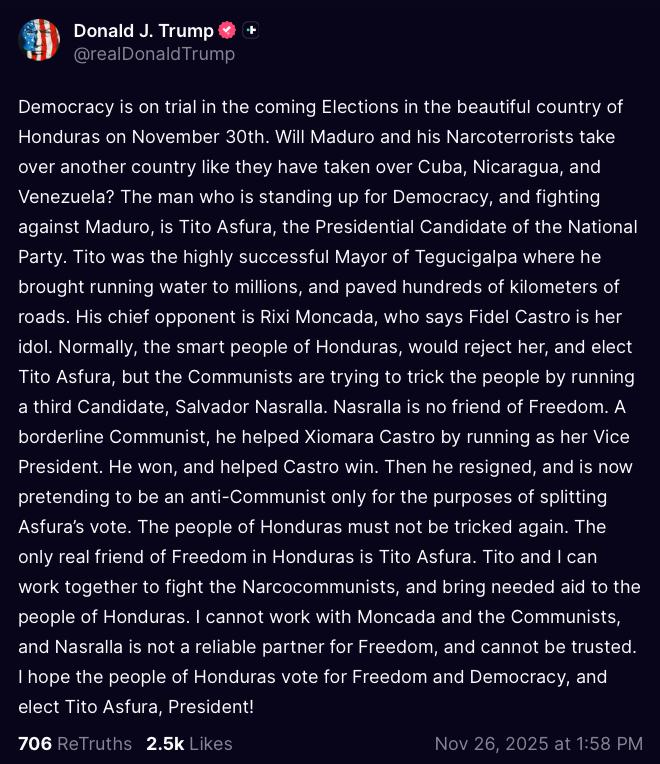
Now, it’s Honduras’ turn to face direct US meddling in its election process. With the country scheduled to go to the polls on Sunday to elect a new president, Trump just posted a long tweet endorsing Tito Asfura, the candidate of the right-wing National Party, while pillorying left-wing frontrunner Rixi Moncada as a “Communist” and centrist Salvador Nasralla as a “borderline Communist.”
The language of the Cold War is once again en vogue in the Trump 2.0 White House.
“Democracy,” Trump writes (or perhaps it was one of his speechwriters, or even Marco Rubio himself), “is on trial in the coming elections. Will Maduro and his narcoterrorists take over another country like they have taken over Cuba. Nicaragua, and Venezuela?”
Trump describes Asfura as “the only real friend of Freedom in Honduras”, and that “Tito and I can work together to combat narco-communists and provide the necessary aid to the Honduran people”.
Asfura is the leader of the National Party that governed Honduras with an iron grip from 2009 to 2021. Ironically (or perhaps not), its two presidents during that time, Porfirio Lobo Sosa and Juan Orlando Hernández, have both been accused of receiving bribes from Mexico’s Sinaloa cartel. The latter was even extradited to the US on drug charges and is currently in prison.
Meanwhile, Trump warns that he “cannot work with (Rixi) Moncada”, the candidate of the governing Liberty and Refoundation Party, whom he describes as a “communist” who cannot be trusted. The other main candidate, Salvador Nasralla is, in Trump’s words “a borderline Communist” who is “pretending to be an anti-Communist in order to split Asfura’s vote”.
This would be bad enough if it was just another case of President Trump running off at the mouth on a topic he evidently knows very little about. But that is clearly not the case.
Honduran politicians, including the presidential candidate Salvador Nasralla, converged on Washington last week to attend a Western Hemisphere Subcommittee hearing in the US Congress. The subcommittee is chaired by Representative María Elvira Salazar, another Floridian lawmaker who is desperate to see the back of left-wing governments in Latin America (more on her later).
As the Observatory of the Progressive International reports, the hearing was titled “Democracy in Danger: The Fight for Free Elections in Honduras”:
The hearing was framed in Washington as an “urgent” assessment of the situation in Honduras. In reality, the hearing sought to preemptively question the legitimacy of Honduras’s electoral institutions, to cast doubt on the democratic process, and to prepare the ground for claims of fraud before a single vote has been cast. This represents a dangerous escalation of foreign interference — one that threatens the integrity of the upcoming elections and echoes a long history of external interference in the country’s political life.
The playbook bears clear echoes of what happened last year with the presidential elections in Venezuela. Then, as now, senior local opposition figures, including, ahem, Nobel Peace Prize laureate Maria Corina Machado, and US lawmakers began sowing doubts about the election process before a single vote had been cast. If the opposition parties ended up losing, they said, it would all be down to fraud. As such, there was no intention of ever accepting the results.
Now, over a year later, Venezuela is facing the threat of US invasion on a whole host of pretexts that keep changing day by day, including last year’s supposedly “illegitimate” elections. Even the New York Times just reported that Machado is “pushing false claims about Maduro”, including that he helped rig the 2020 US presidential elections and controls two “narco-terrorist” organisations, Tren de Aragua and the Cartel de los Soles.
When even the New York Times is calling you out for spreading lies aimed at justifying a new US-led military misadventure, something is clearly amiss. One of the experts cited by the Times piece, John D. Feeley, a former U.S. ambassador to Panama, said the following about the Trump administration officials relying on Venezuelan opposition figures for information:
“It’s unbelievable how these guys are too stupid to read their own history and know that they’re headed for the same thing” [in reference to Iraq 2.0].
Small But Important
While Honduras may be a much smaller country than Venezuela, there is still a lot riding on Sunday’s election result — not just regionally but globally.
Honduras is strategically important due to its geographic location vis-a-vis migration routes, drug supply routes, as well as the US’ redoubled efforts to contain or simply remove left-wing, sovereign-minded governments in Central America.
Honduras was also one of the last countries in Latin America to be on the receiving end of an old school-style US-sponsored coup d’état. In 2009, the Honduran military kidnapped the country’s democratically elected president, Manuel Zelaya, and forcefully removed him not just from office but from the country.
Zelaya’s biggest crime was to push forward a land reform decree that would have redistributed large tracts and granted titles to long-established farmer cooperatives. He also raised the country’s desultory minimum wage by 60%. That was in 2008. The following year, the country’s military – with at least tacit support from the Obama administration – led a coup against him.
Following that coup, the US-aligned National Party won repeated elections until 2021, when Zelaya’s wife, Xiomara Castro (no relation to Fidel), won by a landslide, becoming Honduras’ first female president. Since coming to power she has officially established diplomatic relations with the People’s Republic of China after formally breaking ties with Taiwan.
In her first ever speech to the UN General Assembly, Castro condemned the violent US-sponsored military coup in Honduras in 2009, which overthrew her husband, and more generally US attempts to intervene in the affairs of other countries.
“The poor nations of the world can no longer stand coups d’état; we cannot stand the use of lawfare, nor colour revolutions, usually organised to plunder our vast natural resources,” she declared.
The Uncertain Future of Próspera
As readers may recall, Honduras has also served as an open-air lab for a controversial experiment in corporate governance: the legal establishment of semi-autonomous charter cities owned and run by foreign companies — all made possible by the two National Party presidents, Lobo Sosa and Orlando Hernández.
In fact, it was in his role as leader of Honduras’ Congress, when Lobo Sosa was president, that Orlando Hernández staged what he called a “technical coup” against the country’s Supreme Court of Justice by dismissing four magistrates from the Constitutional Chamber. Foreign Policy in Focus explains the reason why:
One ruling that found regulations to create Special Development Regions (REDs) — an initiative that would allow for the creation of private cities on Honduras’ territory — to be unconstitutional.
Legislative Decree No. 283-2010 promoted by then President Porfirio “Pepe” Lobo Sosa to create the special administrative areas that would be essentially governed by private companies…
One such area, going under the name Próspera, was established on Roatán, an island 40 miles off Honduras’ northern coast. Backed by US investors including Peter Thiel, Prospéra was described by the tech news website Rest of World as a “crypto-libertarian paradise”.
Próspera represents a new model of semi-autonomous, corporate-run city state that is all the rage among the tech overlord class. As Conor reported in June, so-called “freedom cities” — which are free from onerous national laws, regulations and oversight, and governed by “technomonarchies” (in Quinn Slobodian‘s words) — are being touted by the likes of Marc Anderssen, Elon Musk and Peter Thiel as a new kind of utopia.
They want to develop similar cities throughout the world, including the US. However, tiny, little Honduras may stand in the way of that.
One of Xiomara Castro’s first acts as president was to repeal the 2013 law passed by Lobo Sosa and the Hernández-controlled Congress that had allowed foreign investors to create charter cities in designated semi-autonomous ZEDEs (“employment and economic development zones”). The goal of the repeal was to eliminate the entire legal concept of ZEDEs in Honduras.
However, Próspera Inc. responded by suing the Honduran government in international court and by continuing to build. The lawsuit is ongoing and, as of now, Próspera remains operational. But there is still a cloud of uncertainty over its future. Imagine what could happen if a tiny little developing country like Honduras could scupper the plans of people like Thiel?
An “Almost Impossible to Believe Scenario”
As we reported last year, the amount of autonomy that Lobo Sosa’s government had granted to the owners of the ZEDEs was simply mind-boggling:
[T]he 2013 law clearly established that “each ZEDE will have its own internal security bodies (…), including its own police, crime investigation bodies, intelligence, criminal prosecution and penitentiary system.” The cities will also have an independent financial regime, and will not be subject to the exchange control of the Central Bank of Honduras; they are empowered to develop their own internal monetary policy.
Even before Castro’s election, local businesses were complaining that the law had granted too many privileges to foreign investors to the detriment of domestic capital. The US economist Paul Rohmer, the godfather of international charter cities who had initially worked with the Lobo Sosa government to develop ZEDEs, had disowned the project, warning that Honduras’ ZEDEs system was undemocratic, opaque, destined for collapse and shrouded in lies. As an article in The Intercept explains, the legal showdown between the Honduran government and the investors behind the charter cities presents an “almost impossible-to-believe scenario”:
A group of libertarian investors teamed up with a former Honduran government — which was tied at the hip with narco-traffickers and came to power after a U.S.-backed military coup — in order to implement the world’s most radical libertarian policy, which turned over significant portions of the country to those investors through so-called special economic zones. The Honduran public, in a backlash, ousted the narco-backed regime, and the new government repealed the libertarian legislation. The crypto investors are now using the World Bank to force Honduras to honor the narco-government’s policies.
In its ISDS suit, Próspera Inc. alleges that Honduras owes it more than $10 billion for breaking a “50-year legal stability guarantee” granting it sovereignty over Próspera, including the ability to create its own laws, courts, authorities and taxes.
In February 2024, Castro decided to withdraw her country from ICSID, the World Bank’s arbitration panel, arguing that the court was infringing illegally on Honduran sovereignty. By doing so, Honduras became the first Central American country to walk away from ICSID, the world’s most important forum for the settlement of differences between investors and States, with 149 signatory nations.
The outstanding cases are still pending, though. According to a 2023 article by Bretton Woods Project, “even if Honduras does withdraw from ICSID over Prospera’s claim, ISDS cases could still be brought against the country”:
It would still have to defend Prospera’s $11 billion claim, and any others filed within a six-month window of formal withdrawal notification. Honduras could also potentially be subject to further cases through one of the eight bilateral investment treaties it has signed that refers arbitration to ICSID.
The people and companies behind Próspera, including tech bros close to Trump, want their pay out — all eleven billion dollars of it. That is why what happens on Sunday is so important. An $11 billion fine would cripple an economy the size of Honduras (estimated GDP in 2024: $37 billion). It would also send a clear message to other governments around the world.
If Trump’s pick for president, Tito Asfura, wins on Sunday, he will presumably come to an agreement with the people and corporations behind Próspera, just as Trump has happily accommodated most of the tech bros’ demands since returning to White House. Asfura may even overturn Castro’s repeal of the 2021 law.
Contra Corriente reports that Asfura is being advised by Fernando Cerimedo, who also advised Milei and Bolsonaro, and is allegedly one of the masterminds behind the “Generacion Z” far-right protest movement in Mexico. Cerimedo is also closely tied to Roger Stone, Trump’s longest-serving political consultant and a major figure in the so-called “new right”.
One of the witnesses called to testify at the US congressional hearing on Honduras’ elections was Carlos Trujillo, a former US Ambassador to the Organization of American States (OSA) whose lobbying firm’s clients until recently included Próspera. Look what happened when Rep Joaquin Castro began questioning the legitimacy of testimony by a “registered foreign agent” and “a registered lobbyist” whose former clients have “so much at stake in Honduras’ elections”:
[It gets really interesting at the one-minute mark]
It’s worth highlighting Salazar’s words as she interrupted Castro’s questioning of Trujillo’s potential conflicts of interest:
Thank you, member. I’m sorry for interrupting. I think we are here for just one purpose: to ensure there are clean and fair elections in Honduras. Ambassador Trujillo may have many clients in Honduras but that does not mean he does not want the best outcome on November 30th, so I think we should just concentrate on finding out what’s really happening right now and preserve the integrity of those elections.
Lastly, while we’re on the subject of Salazar, below is another of her recent interventions, this time on the topic of Venezuela. Below that is a bonus clip of an interview by John Pilger of former CIA chief for Latin America Duane Claridge, who oversaw some of the agency’s worst crimes in the region during the Cold War.
It is a reminder that what is happening in Venezuela, Honduras, Mexico and Colombia has been going on for a very long time, almost as long as the US is old. But never before, or at least not for a long time, have the lies been quite so brazen or the narrative quite so disjointed.
Congresswoman Maria Elvira Salazar babbles some laughable falsehoods about Venezuela🇻🇪 supplying uranium to Hamas, Nicaragua, Cuba, and Iran…
Before excitedly getting to her main point: “And I’m telling you, that these people, the Venezuelans, have the largest reserves of oil… https://t.co/hvYQG5VSln pic.twitter.com/x6vWbF746X
— Going Underground (@GUnderground_TV) November 26, 2025












-1024x683.jpg "Strait Outta Hormuz: Getting the Iran Oil Story Straight")