Rising partisanship, distrust, inflamed tempers, and even tragic acts of political violence are becoming commonplace in the United States. Leaders prone toward collectivist ideals and central planning seize upon these opportunities, thriving on divisive sentiment.
Collectivism is antithetical to principles of liberty, individualism, and freedom. Collectivism is a political and economic philosophy that demands the subordination of individual rights to achieve the goals of a collective (e.g., a state, a group, or a class). This philosophy can encompass various political ideologies, including socialism, communism, nationalism, fascism, and corporatism, among others.
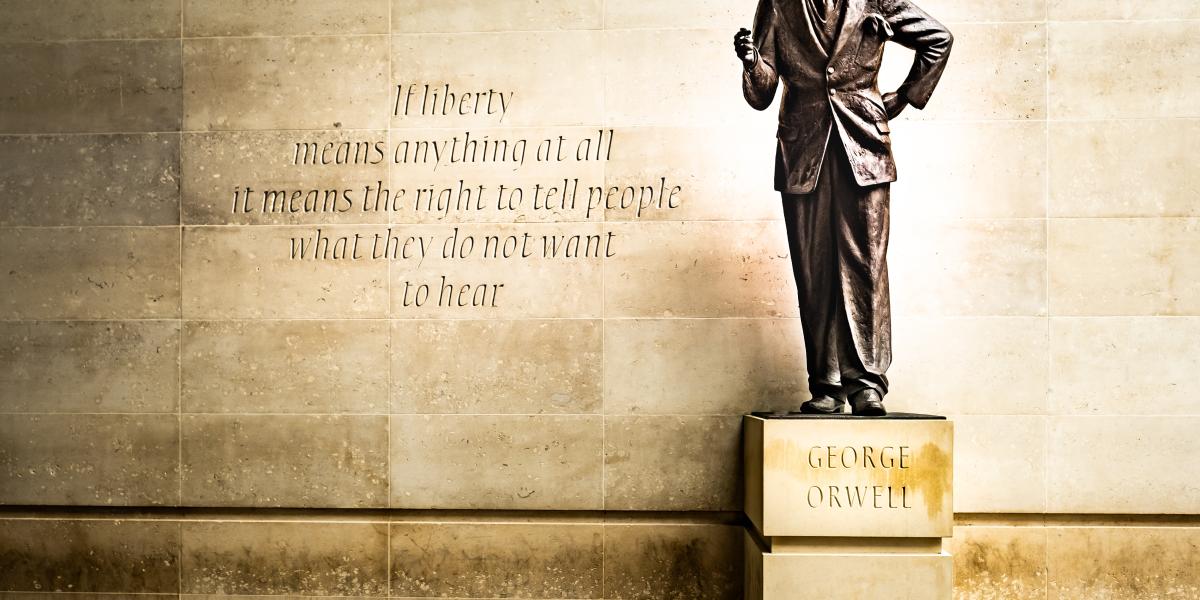
Many Americans remain unaware of the ubiquity of collectivist ideas and policies manifesting in the American body politic. George Orwell argued from first-hand experience in Homage to Catalonia that totalitarianism emerges from the political right and left—it is not confined to one party.
The following “symptoms” are not exhaustive, but they are recurring patterns by which collectivism takes hold. I challenge the reader to consider this point and reflect on policies from both Democrats and Republicans that resonate with the patterns described below.
Creation of a Moral Code
There is nothing inherently wrong with ascribing to a moral code. The Founding Fathers envisioned a morality centered on three values that derived from Judeo-Christian principles, emphasizing the intrinsic worth of human life: the right to life, liberty, and property. Bastiat argued that the sole purpose of the law was to defend these principles. These were God-given rights, not rights granted by a flawed human government.
Alternate moral codes also take on a religious sentiment, serving as the backbone of collectivist ideology. As Hayek notes in The Road to Serfdom, the totalitarian’s morality is transcendent and absolute. The greatest threat to the state is an authority higher than itself. Even a mere acknowledgement that humans have intrinsic moral value, independent of direction from an authority, undermines the power of central planners.
The collectivist moral code demands acceptance; tolerance does not suffice, it is non-committal and leaves room for debate. Allegiance and obeisance adopt a higher purpose and a sense of selflessness; this can lead to self-righteousness in the most devout followers. Individuals must see themselves as part of a broader collective higher purpose, striving for ascension; this requires fidelity. Any who do not comply or accept the moral code must be maligned and segregated. Once the people are persuaded to adopt the collective’s ethical code, absolute control can be justified as both necessary and virtuous.
Disregard of Barriers
Once the roots of the collectivist moral code begin to resonate, even before full adoption, tearing down barriers becomes justifiable. This will always be subtle at first—just a regulation here or an executive order there, often vindicated by populist or dogmatic rhetoric.
Checks and balances are supposed to ensure accountability. Partisanship has increasingly made it difficult for an acting president or party in power to advance an agenda; stagnation has become commonplace. This frustration tempts leaders to usurp the very system designed to check their authority.
Hayek points out that one strategy of collectivist rulers is to surround themselves with a small group of like-minded individuals who will help them drive policy. American politics is rife with this practice—filling cabinets with loyalists, challengers are considered enemies of the agenda and cannot be tolerated.
Societies are diverse, full of competing ideas and complex information provided by populations and humans making individual decisions; this is a lot to manage in a centrally-planned society. Central planners disregard this information and—in an act of arrogance and superiority—make decisions for their populations, pushing compliance from the top down.
Populist and Nationalist Language and Policy
Populism and nationalism exist in tandem. Populist discourse mobilizes groups into opposing ideologies, such as left versus right, and then attributes labels. For example, the left is “woke” or the right is “anti-immigration” or “racist.” Populism can also be displayed as a struggle between “the people” and “the elites.” These are tactics used to divide, galvanize support, and create collective identity.
Nationalism takes many forms, but broadly speaking, it fosters loyalty to a nation. Orwell noted that nationalism is not inherently positive; nationalism can be negative. Examples may be playing America as a global victim or demonizing America from within to drive a new vision for the country.
Populism and nationalism elevate moral superiority. The ethical code adopted by the group serves as justification for vilifying rhetoric and protectionist policies.
Conspiracy Theories
Rothbard saw the value in conspiracy theorists, primarily as challengers to state corruption. However, the kind of conspiracy theories he saw as useful were those aimed at exposing government abuse of power. Anti-state theories pose little harm and can even provide some benefit in uniting people in opposition to coercive government.
By contrast, state-driven conspiracies tend to fuel anti-capitalist narratives (i.e., profiteering or systemic biases), often based on tenuous evidence. These narratives become instruments to justify government interventionism and exercise regulatory power over private enterprise.
Conspiracies drive group loyalty over the pursuit of truth. Collectivists capitalize on conspiracies to elicit emotional responses, aiming to unify groups and legitimize government action in the market or against “plutocracies.”
Collectivist Brand Utilitarianism
Mises saw liberal utilitarianism as the best means to maximize outcomes in a free market. John Stuart Mill, while not sharing Mises’ free market views, also argued for utilitarianism as the standard for judging actions. There is great debate around the term and philosophy—which is outside the scope of this article.
Regardless, politicians hijack utilitarianism. The government routinely pushes and pirates solutions to projects and problems that are better resolved and belong in the market. To sell the public, optimistic projections of future metrics (“this bill will bolster the economy”) are presented as certainties. Histrionics and false humility at times may be necessary, as politicians insist that temporary pain is a “small price to pay” for promised future gains, the ends are claimed to justify the means.
The great fallacy of collectivist utilitarianism is that decisions and human actions are dynamic, the future is not static, and government policies are far from adaptable. Humans, in general, are poor predictors of outcomes, but a small, centralized group attempting to plan for millions of people magnifies this weakness exponentially.
Redistributionism
Taxes, tariffs, subsidies, eminent domain, welfare, and so on, all take wealth from one party and transfer it to another. This wealth is transferred to a centralized body, which then redistributes it or uses it for government spending (usually a combination of both). Many call it taxation, but Rothbard and others call it theft. Bastiat labeled it legal plunder. However described, it represents an attack on property rights, distorting economic signals and limiting consumer choice. Governments, rather than individuals, decide how people’s money will be spent.
This redistributionism is cloaked in philanthropic rhetoric or justified with promises to pay down debt and stimulate the economy. As Bastiat warned, forced charity defeats the purpose of charity; it is no longer charity, it is plunder.
Conclusion
Hayek warned that collectivism empowers the worst among us. As seen, collectivist ideology can permeate political parties; this is not a partisan issue. Americans who stand on the principles of liberty must reject collectivist rule; this starts by identifying and rejecting policies and politicians that advance it.
Though Americans may find themselves increasingly divided, unity must be sought in one thing above all: the defense of liberty. David Hume cogently warned, “It is seldom that liberty of any kind is lost all at once.”