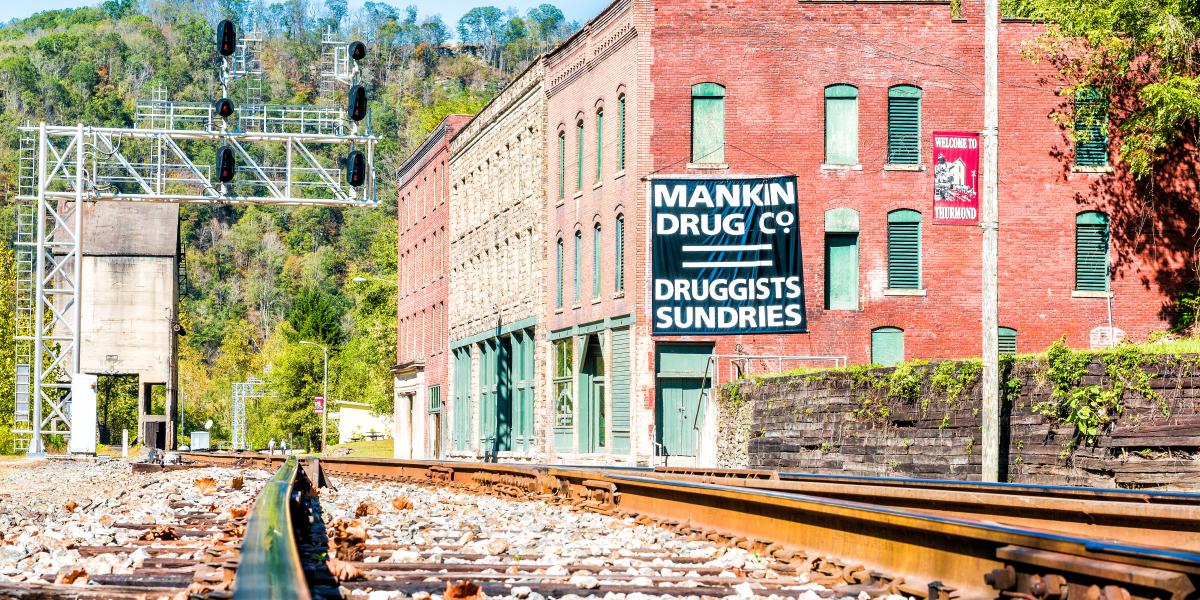
Consider what Appalachia gave America before America returned the favor in pill form.
The region supplied the coal that powered two industrial revolutions and two world wars. It supplied, per capita, more military volunteers than almost anywhere else in the country—a tradition that held through Vietnam and into Iraq and Afghanistan. It fed American steel mills, timber yards, and chemical plants. Its people worked in the dark, underground, and underpaid, and when the work was done, they came home to churches and kin and the kind of densely-interlocking community life that sociologists now study as sort of an artifact of a vanished world. Many of these communities now record the highest drug-related deaths in the developed world.
This isn’t a story about weakness. It’s a story about what happens when every institution that once made hardship survivable is now removed at the same time, and the market for chemical sedation expands to fill the void.
What Made Appalachia Resilient
Appalachian life was never economically prosperous by national standards, but it was institutionally rich in ways that don’t show up in GDP. Family networks provided informal insurance. Churches delivered more continuity across generations. Labor unions, whatever their economic distortions, gave men a collective identity organized around contribution rather than consumption. Local businesses kept capital circulating within communities rather than extracting it upward. These overlapping structures—what sociologists call “institutional density”—are the actual load-bearing walls of a functioning society. Remove them, and what remains looks like a community but behaves as a waiting room.
The critical insight—one that the standard policy literature still largely resists—is that economic systems shape social behavior not only through the forms of life they make possible. Stable employment anchors family formation, family formation anchors civic participation, and civic participation anchors the informal accountability that keeps communities from dissolving into isolated individuals. These aren’t independent variables, but a single system, and when you pull on one thread long enough, everything eventually unravels together.
The Institutional Collapse
Deindustrialization is usually described in economic terms: coal mining jobs in the US fell from roughly 220,000 in the early 1980s to under 90,000 by 2012—and under 50,000 by 2016—with the most dramatic decline concentrated in the Appalachian region, where underground mines were shuttered at an accelerating pace as natural gas and surface mining made them uneconomical. Retail consolidated under national chains. Manufacturing migrated overseas. The population migrated to cities. What this description misses is the institutional wreckage that follows in the wake of economic decline.
When a mine closes, it does not merely eliminate paychecks. It eliminates the social scaffolding that those paychecks sustained. The union hall closes, the diner where men gathered before their morning shift closes, the church built by mining families begins losing members to Pittsburgh and Columbus. The school board that once drew from a stable, rooted population now draws from a dwindling and increasingly desperate one. Tax revenue falls, the local hospital cuts services, and healthcare is suddenly administered by a regional system headquartered elsewhere. Piece by piece, the community loses its capacity for self-governance—not because anyone took it away, but because the economic foundations that made it viable quietly withdrew.
This is what economists mean when they argue that spontaneous order can’t be reconstructed from above. It either grows from the conditions that support it, or it does not grow at all.
The Loss of Purpose
Here is the part that the public health writings approach gingerly but rarely state plainly: addiction expands where necessity contracts. The communities most devastated by opioids were not primarily communities in pain in the clinical sense. They were communities whose members had been structurally removed from any role that made them feel necessary. The man who once worked underground—who came home exhausted but essential, who coaches his kid’s baseball team and knew the pastor by name—had a life organized around the experience of being needed. When that structure collapsed, what replaced it wasn’t leisure. It was a formless, purposeless availability that the pharmaceutical industry proved extraordinarily good at exploiting.
As research on the neurobiological link between social isolation and opioid use disorder has shown, the endogenous opioid system itself plays a central role in the formation and maintenance of social bonds—meaning that communities stripped of social connection are, in a literal biological sense, primed for opioid dependency. Chemical dependency expands not simply where people are poor, but where people are poor and purposeless—where the social roles organized around labor, family, and community have ceased to confer the experience of mattering.
The Market That Followed
Into this opening stepped Purdue Pharma, owned by the Sackler family. It would be satisfying and fair to assign the blame for the opioid epidemic primarily to corporate villainy. In 2007, the Purdue Frederick Company, a Purdue affiliate, pleaded guilty to felony misbranding charges for falsely marketing OxyContin as less addictive, less subject to abuse, and less likely to cause dependence than other pain medications. Then in 2020, Purdue Pharma itself pleaded guilty to defrauding the DEA and paying illegal kickbacks to prescribers, resulting in more than $5 billion in criminal penalties. But the corporate fraud does not by itself explain the scale of what followed. Fraud requires a system willing to be deceived.
That system existed. The pain management consensus—endorsed by medical associations and eventually mandated by hospital accreditors—had redefined undertreated pain as a public health emergency, which meant the physician who hesitated to prescribe was the negligent one. Fee-for-service reimbursement rewarded the fifteen-minute prescription appointment over the hour-long conversation. And the DEA’s own distribution databases, released after a year-long legal battle by the Washington Post, showed that America’s largest drug companies saturated the country with 76 billion oxycodone and hydrocodone pills between 2006 and 2012—with the highest per-capita flows concentrated in the coalfields of West Virginia, Kentucky, and Virginia.
This is what regulatory capture looks like at an industrial scale: not a conspiracy, but a convergence of incentives in which every institution receives a short-term benefit for ignoring a long-term catastrophe. According to the HHS Overdose Prevention Strategy, more than 840,000 Americans died of drug overdoses between 1999 and 2019, with opioids involved in the majority of those deaths. The agencies and oversight infrastructure existed. It simply faced the wrong direction.
The Government’s Failed Response
The policy response to the crisis reproduced the same logic that created it: federal grants funded treatment programs, NGOs proliferated, and public health bureaucracies expanded. Naloxone distribution saved lives that would otherwise have been lost, and it deserves full credit for that. But crisis mitigation is not community reconstruction. And no one in Washington was ever going to appropriate funds for the things that actually needed rebuilding: the dense, informal, voluntary web of institutions through which people hold each other accountable and give each other reasons to stay.
Hayek’s insight about the limits of centralized knowledge applies with a particular force here. A federal program can distribute Naloxone. It can’t distribute the specific, irreplaceable knowledge that a pastor accumulates over thirty years in one congregation, a foreman accumulates over twenty years on one factory floor. The problem isn’t that the bureaucrats were incompetent. The problem is that bureaucratic competence functions at the wrong level of resolution for the problem it was trying to solve.
What Recovery Actually Requires
Genuine recovery won’t arrive via programs. It will arrive the way all durable social order arrives: from the bottom up, through the gradual re-emergence of locally-owned institutions. Small businesses that keep capital circulating within communities. Vocational programs designed around actual regional labor demand rather than credential accumulation. Occupational licensing reform—the Institute for Justice documents that the average lower-income occupation now requires nearly a year of government-mandated education and experience before a person can legally work, with seventy-one occupations imposing greater burdens than entry-level EMT training. These barriers are not consumer protection, they are moats that prevent exactly the low-capital entrepreneurship that struggling communities most need: Community banks, family-supporting, voluntary welfare structures rather than family-penalizing ones, recovery institutions accountable to neighbors rather than to grant administrators in another city.
None of this is ideological. All of it is the practical recognition that what was lost was not primarily economic but institutional, and that what needs to be rebuilt is not primarily a program but a set of conditions under which people can once again be genuinely necessary to the people around them.
The Reckoning
The synthetic opioid crisis that has succeeded the prescription phase is in many ways worse: fentanyl is now involved in the majority of overdose deaths, fifty times more potent than heroin, manufactured in milligrams and distributed in quantities measured in micrograms, impervious to the supply-side enforcement that ended the prescription phase. The drug has changed. The conditions that make people reach for it have not.
Appalachia gave America its coal, its soldiers, its timber, and its labor for more than a century. What it received in return, ultimately, was a well-administered process of institutional dissolution and a pharmaceutical industry that found in the resulting despair a remarkably scalable market.
Appalachia was not destroyed by its neighbors or by some diffuse national will. It was hollowed out by specific institutional choices: by regulators who faced the wrong direction, by pharmaceutical executives rewarded for creating dependency, by policymakers who replaced local authority with distant admiration, and by an economic consensus that confused the efficient extraction of value with the creation of it.
Bad institutions, badly incentivized, happened to Appalachia. That distinction mattered—because, unlike blaming a country as a whole, it points towards something that can gradually be fixed.
You can’t spend a century removing the institutions that give people purpose, accountability, and mutual necessity, and then be surprised when they reach for something that makes the absence feel like nothing at all.