No Result
View All Result
  • Login
Tuesday, May 5, 2026
FeeOnlyNews.com
  • Home
  • Business
  • Financial Planning
  • Personal Finance
  • Investing
  • Money
  • Economy
  • Markets
  • Stocks
  • Trading
  • Home
  • Business
  • Financial Planning
  • Personal Finance
  • Investing
  • Money
  • Economy
  • Markets
  • Stocks
  • Trading
No Result
View All Result
FeeOnlyNews.com
No Result
View All Result
Home Economy

Straight Whiskey and Dirty Politics

by FeeOnlyNews.com
7 months ago
in Economy
Reading Time: 4 mins read
A A
0
Straight Whiskey and Dirty Politics
Share on FacebookShare on TwitterShare on LInkedIn


In the early 20th century, America was buzzing with Progressive Era reforms aimed at taming the excesses of industrialization. One landmark was the Pure Food and Drugs Act of 1906, hailed as a victory for consumer safety. It banned poisonous ingredients in food and drink, required accurate labeling, and cracked down on imitations. But when it came to whiskey, was it truly about protecting the public from deadly adulterants? Or was it a classic case of dirty politics, where special interests use government power to disadvantage competitors?

Economists have long debated the origins of regulation through two lenses: public interest theory and public choice theory. Public interest theory sees regulation as a noble response to market failures like asymmetric information, where consumers don’t have the expertise to spot hidden dangers. Public choice theory, pioneered by scholars like James Buchanan and Gordon Tullock, flips the script: regulations often emerge from rent seeking, where powerful industry groups lobby for rules that boost their profits at the expense of consumers and competitors. Oftentimes, rent seeking is most successful when there is at least a semblance of a public interest concern to bolster the argument for regulation among those hoping to shape it.

In my recent paper in Public Choice, coauthored with Macy Scheck, “Examining the Public Interest Rationale for Regulating Whiskey with the Pure Food and Drugs Act,”  we explore a case in which the historical evidence leans heavily toward the explanation offered by public choice theory. Straight whiskey distillers, who age their spirits in barrels for flavor, pushed for regulations targeting “rectifiers,” who flavored neutral spirits to mimic aged whiskey more cheaply. The rectifiers were accused of lacing their products with poisons like arsenic, strychnine, and wood alcohol. If true, the regulation was a lifesaver. But was it?

Whiskey consumption boomed in the decades before 1906, without federal oversight. Sales of rectified whiskey were estimated at 50–90% of the market. From 1886 to 1913, U.S. spirit consumption (mostly whiskey) rose steadily, dipping only during the 1893–1897 depression. If rectifiers were routinely poisoning customers, you’d expect markets to collapse as word spread, an example of Akerlof’s “market for lemons” in action. No such collapse occurred. 

Chemical tests from the era tell a similar story. A comprehensive search of historical newspapers uncovered 25 tests of whiskey samples between 1850 and 1906. Poisons turned up infrequently.  Some alarming results came from dubious sources, like temperance activists. One chemist, Hiram Cox, a prohibitionist lecturer, claimed to find strychnine and arsenic galore—but contemporaries debunked his methods as sloppy and biased.

Trade books for rectifiers, which contained recipes, reveal even less malice. These manuals, aimed at professionals blending spirits, rarely list poisons. When poisons did appear, their use was in accordance with the scientific and medical knowledge of the time. Many recipe authors explicitly avoided known toxins, noting it was more profitable to keep customers alive and coming back.

We examined home recipe books for medicine and food. We found that the handful of dangerous substances that were included in whiskey recipes were often recommended in home medical recipes for everything from toothaches to blood disorders. This suggests people, including regulators, did not know of their danger at that time. 

Strychnine was found in niche underground markets where a small number of thrill-seekers demanded its amphetamine-like buzz, or in prohibition states where bootleggers had no viable alternatives. But rectifiers avoided it; it was expensive and bitter.

What about reported deaths and poisonings? That is our final piece of evidence. Newspapers of the day loved sensational stories such as murders or suicides. Yet a keyword search for whiskey-linked fatalities from 1850–1906 yielded slim pickings outside of intentional acts or bootleg mishaps. Wood alcohol, which was listed in no recipes, caused the most issues, but often in isolated cases, like a 1900 New York saloon debacle where 22 died from a mislabeling. 

Overall, adulterated whiskey was hardly a serious safety concern.

Harvey Wiley, the USDA chemist who championed the Pure Food and Drugs Act, admitted under questioning that rectified ingredients weren’t inherently harmful—they just weren’t “natural.” His real motive? Rectified whiskey was a cheap competitor to straight stuff. Wiley’s correspondence, unearthed by historians Jack High and Clayton Coppin, shows straight distillers lobbying hard and framing regulation as a moral crusade while eyeing market share. President Taft’s 1909 compromise allowed “blended whiskey” labels but reserved “straight” for the premium, aged variety— a win for the incumbents.

The lesson? Regulations are rarely the product of pure altruism. As Bruce Yandle’s “Bootleggers and Baptists” model explains, moralists (temperance advocates decrying poison) team up with profiteers (straight distillers seeking barriers to entry) to pass laws that sound virtuous but serve narrow interests. The Pure Food and Drugs Act may have curbed some real abuses elsewhere, but for whiskey, it was more about protecting producers than consumers. Cheers to that? Not quite.


Daniel J. Smith is the Director of the Political Economy Research Institute and Professor of Economics at the Jones College of Business at Middle Tennessee State University. Dan is the North American Co-Editor of The Review of Austrian Economics and the Senior Fellow for Fiscal and Regulatory Policy at the Beacon Center of Tennessee. 


Source link

Tags: DirtyPoliticsstraightWhiskey
ShareTweetShare
Previous Post

AI Could Take Your Job, But It Can’t Take Your Real Estate

Next Post

This is How “Hard Money” Loans Work (Banks for Investors) (Rookie Reply)

Related Posts

Coffee Break: Armed Madhouse – Endangered Warships

Coffee Break: Armed Madhouse – Endangered Warships

by FeeOnlyNews.com
May 5, 2026
0

The vulnerability of surface ships to aerial attack was established decisively during the Second World War, when aircraft rendered even...

Remembering the Costs of War

Remembering the Costs of War

by FeeOnlyNews.com
May 5, 2026
0

April marks the time when the guns of war began to fall silent across the South in 1865, after four...

Links 5/5/2026 | naked capitalism

Links 5/5/2026 | naked capitalism

by FeeOnlyNews.com
May 5, 2026
0

Buried electrical pathways across the US reveal new clues about Earth’s interior and power grid risks Phys.org Darkness Can Move...

The War On Crypto Was Always About Control

The War On Crypto Was Always About Control

by FeeOnlyNews.com
May 5, 2026
0

The U.S. Treasury has now frozen $344 million in cryptocurrency tied to Iran, according to Treasury Secretary Scott Bessent, who...

Europe’s Inflation Spiral Is Fueling The Depression Into 2028

Europe’s Inflation Spiral Is Fueling The Depression Into 2028

by FeeOnlyNews.com
May 5, 2026
0

Eurozone inflation is accelerating again at the worst possible moment for Europe. Consumer prices rose 3% in April compared to...

Abundance Bro Seth London’s Caper Is Top Notch Dark Money Scheme

Abundance Bro Seth London’s Caper Is Top Notch Dark Money Scheme

by FeeOnlyNews.com
May 4, 2026
0

Venture capitalist and Abundance bro Seth London’s ambitious dark money scheme employing powerful consultants Lis Smith is best of class,...

Next Post
Inside Warren Buffett’s 2025 investments: Lennar, Chevron and Constellation

Inside Warren Buffett's 2025 investments: Lennar, Chevron and Constellation

Bitcoin Faces Macro Strain and Technical Headwinds — Is a Fresh Low Coming?

Bitcoin Faces Macro Strain and Technical Headwinds — Is a Fresh Low Coming?

  • Trending
  • Comments
  • Latest
The 27 Largest US Funding Rounds of March 2024 – AlleyWatch

The 27 Largest US Funding Rounds of March 2024 – AlleyWatch

April 17, 2026
Wells Fargo Transfer Partners: What to Know

Wells Fargo Transfer Partners: What to Know

April 16, 2026
Week 14: A Peek Into This Past Week + What I’m Reading, Listening to, and Watching!

Week 14: A Peek Into This Past Week + What I’m Reading, Listening to, and Watching!

April 6, 2026
The 16 Largest Global Startup Funding Rounds of March 2026 – AlleyWatch

The 16 Largest Global Startup Funding Rounds of March 2026 – AlleyWatch

April 21, 2026
The Justice Department Indicts the Ministry of Love

The Justice Department Indicts the Ministry of Love

May 2, 2026
LPL’s Mariner Advisor Network deal fuels already hot year for RIA M&A

LPL’s Mariner Advisor Network deal fuels already hot year for RIA M&A

April 16, 2026
California Sues State Farm due to Violations with Wildfire Claims

California Sues State Farm due to Violations with Wildfire Claims

0
CLARITY Act: US Senator Expects Trump To Sign Major Crypto Bill By July 4

CLARITY Act: US Senator Expects Trump To Sign Major Crypto Bill By July 4

0
9 Stealthy Ways to Prepare for a Career Change After 50 (Without Tipping Off Your Boss)

9 Stealthy Ways to Prepare for a Career Change After 50 (Without Tipping Off Your Boss)

0
TASE readying for big wave of IPOs this month

TASE readying for big wave of IPOs this month

0
Coffee Break: Armed Madhouse – Endangered Warships

Coffee Break: Armed Madhouse – Endangered Warships

0
Alarm bells raised over fintech firm’s bank purchase

Alarm bells raised over fintech firm’s bank purchase

0
CLARITY Act: US Senator Expects Trump To Sign Major Crypto Bill By July 4

CLARITY Act: US Senator Expects Trump To Sign Major Crypto Bill By July 4

May 5, 2026
California Sues State Farm due to Violations with Wildfire Claims

California Sues State Farm due to Violations with Wildfire Claims

May 5, 2026
Anthropic CEO warns ‘moment of danger’ as Mythos exposes vulnerabilities

Anthropic CEO warns ‘moment of danger’ as Mythos exposes vulnerabilities

May 5, 2026
Florida Senior Resource: SHINE Counselors Help Compare Medicare Plans—Saving Some Enrollees Hundreds Each Year

Florida Senior Resource: SHINE Counselors Help Compare Medicare Plans—Saving Some Enrollees Hundreds Each Year

May 5, 2026
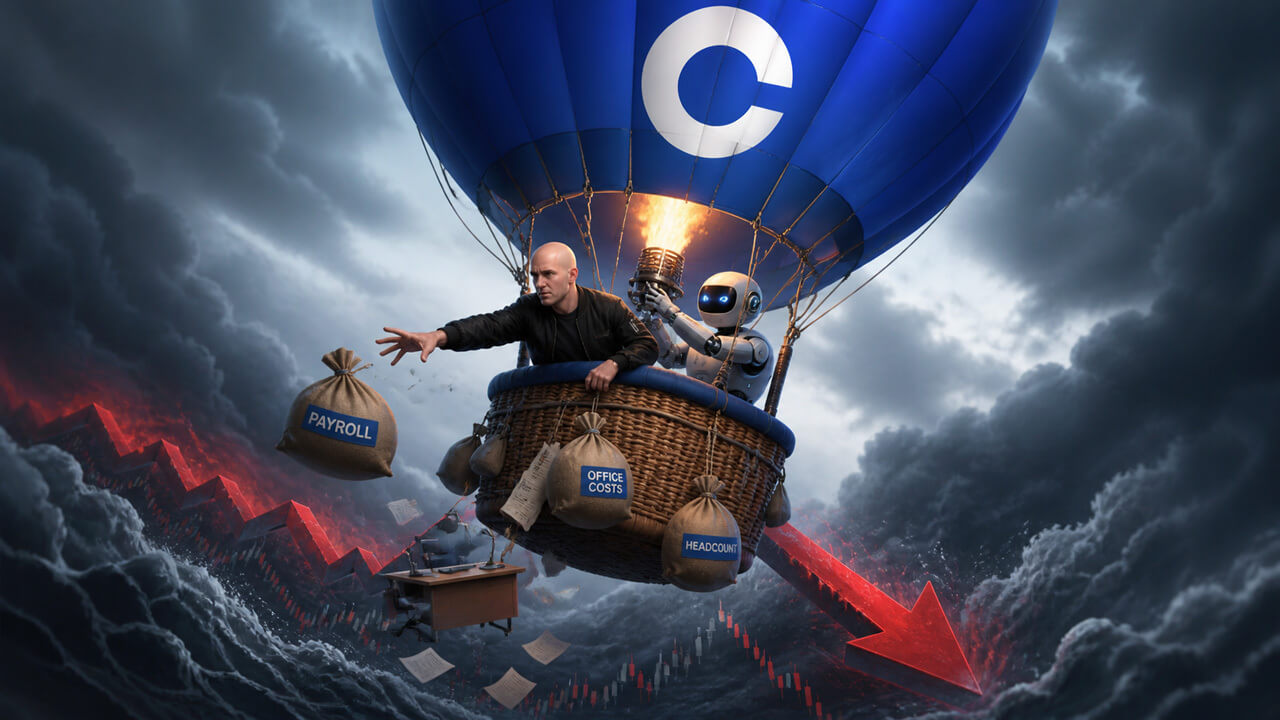
Coinbase cuts 14% of staff as Armstrong ties cost reset to AI and market volatility

Coinbase cuts 14% of staff as Armstrong ties cost reset to AI and market volatility

May 5, 2026
Americans are giving less. July 4th can be a day to change that

Americans are giving less. July 4th can be a day to change that

May 5, 2026
FeeOnlyNews.com

Get the latest news and follow the coverage of Business & Financial News, Stock Market Updates, Analysis, and more from the trusted sources.

CATEGORIES

  • Business
  • Cryptocurrency
  • Economy
  • Financial Planning
  • Investing
  • Market Analysis
  • Markets
  • Money
  • Personal Finance
  • Startups
  • Stock Market
  • Trading

LATEST UPDATES

  • CLARITY Act: US Senator Expects Trump To Sign Major Crypto Bill By July 4
  • California Sues State Farm due to Violations with Wildfire Claims
  • Anthropic CEO warns ‘moment of danger’ as Mythos exposes vulnerabilities
  • Our Great Privacy Policy
  • Terms of Use, Legal Notices & Disclaimers
  • About Us
  • Contact Us

Copyright © 2022-2024 All Rights Reserved
See articles for original source and related links to external sites.

Welcome Back!

Sign In with Facebook
Sign In with Google
Sign In with Linked In
OR

Login to your account below

Forgotten Password?

Retrieve your password

Please enter your username or email address to reset your password.

Log In
No Result
View All Result
  • Home
  • Business
  • Financial Planning
  • Personal Finance
  • Investing
  • Money
  • Economy
  • Markets
  • Stocks
  • Trading

Copyright © 2022-2024 All Rights Reserved
See articles for original source and related links to external sites.