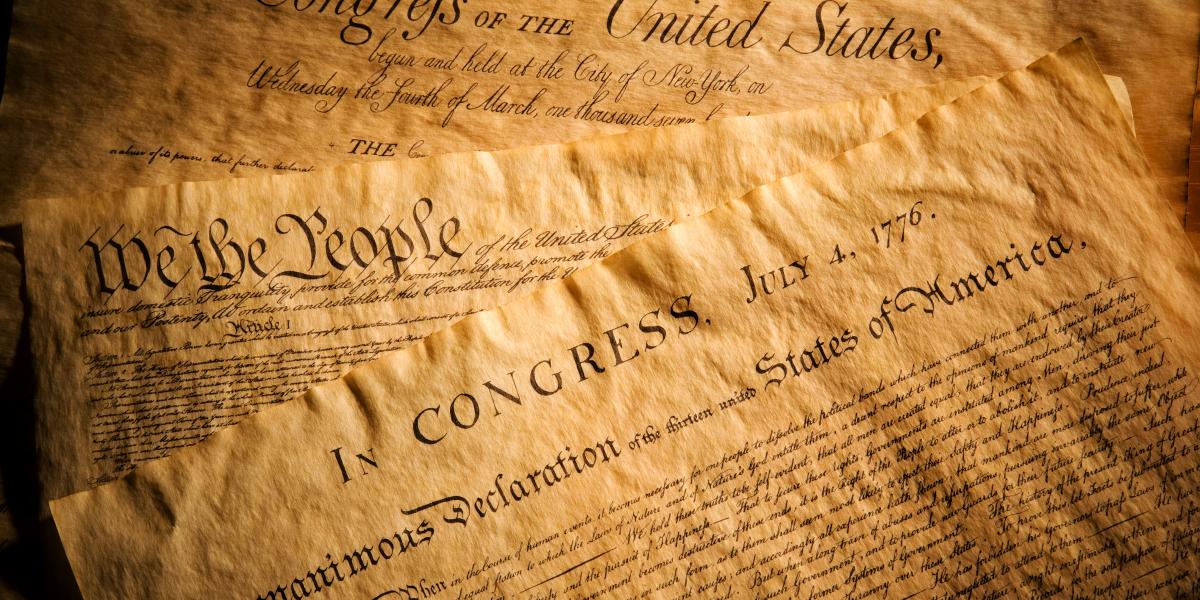
As the Left and the neocons advance against us to take away our liberties, many people appeal to the Constitution. Isn’t it unconstitutional for the President to involve us in foreign wars? The Constitution vests the warmaking power entirely in Congress. All sorts of things are denounced as unconstitutional, usually on good grounds. We should not avoid arguments of this type, which are often of some use in blocking radical left judges from reading their own agenda into the Constitution. As the great Murray Rothbard noted, for example, “In my opinion, the Jeffersonian strict construction theory of the ‘necessary and proper’ clause is obviously the meaning most appropriate to the text: ‘necessary’ always means, in logical discourse, those steps that are truly essential and not just what some congressmen think to be conducive to the final result.”
But ultimately, the Constitution is a weak reed. As Rothbard also noted in the posthumously published Volume 5 of Conceived in Liberty, the Constitution was a triumph for those who wanted a large central government. It was a blow to those who believed in states’ rights and civil liberties. Here is what Rothbard says: “The Constitution was unquestionably a high-nationalist document, creating what Madison once referred to as a ‘high mounted government.’ Not only were the essential lines of the nationalistic Virginia Plan Report carried out in the Constitution, but the later changes made were preponderantly in a nationalist direction. Of the fundamental changes, only the equality of states in the Senate and their election by state legislatures, the former bitterly protested by the determined large state nationalists, was a concession to the opposition. In contrast, on the nationalist side congressional selection of the president was changed to chosen by popular election, admission of new states was made purely arbitrary, and the amendment power was transferred from the states to the Congress. While it is true that the general congressional veto over state laws and the vague broad grant of powers in the original Virginia Plan were whittled down to a list of enumerated powers, enough loopholes existed in the enumerated list: the national supremacy clause; the dominance of the federal judiciary; the virtually unlimited power to tax, raise armies and navies, make war, and regulate commerce; the necessary and proper clause; and the powerful general welfare loophole; all allowed the virtually absolute supremacy of the central government. While libertarian restraints were placed on state powers, no bill of rights existed to check the federal government. And slavery, albeit not explicitly named in the document, was cemented into American society by the nationalists’ twenty-year guarantee of the slave trade, in the three-fifths clause ‘representing’ slaves in Congress, and in the compulsory fugitive slave clause. The northern nationalists were willing, if shamefacedly, to agree in exchange for the right to regulate commerce and thus grant themselves commercial privileges, while the southern nationalists were willing to concede regulation of commerce in confident expectation of an early slave-state preponderance in Congress for the South and Southwest. Both wings of nationalists looked forward to a central government that could pursue an aggressive foreign policy, either on behalf of commercial interests to pry open the West Indies trade, or on behalf of interests in the western lands to push Britain out of the Northwest or Spain out of the southwestern Mississippi.”
But what about the Bill of Rights? Doesn’t it protect individual rights and limit the power of the federal government? Rothbard was not impressed. He says about the Bill of Rights: “The Ninth and Tenth Amendments were signed to give the stark rebuttal to the cynical Wilson-Madison-Hamilton argument that a bill of rights impairs people’s rights by permitting encroachment in unenumerated rights that would supposedly belong to the people. The Tenth Amendment specifies that ‘the powers not delegated to the United States by the Constitution, nor prohibited by it to the States, are reserved to the States respectively, or to the people.’ This amendment specifies that the national government is one of strictly delegated powers, and that powers not so delegated belong to the states or to the people. In other words, the power not specifically delegated or prohibited to the federal government cannot be assumed by that government and are reserved to the states. For many years the Tenth Amendment was the great weapon of the states-rightists and other anti-nationalists in their argument that the states (or the people of the states) are really sovereign, rather than the national government. This amendment did in truth transform the Constitution from one of supreme national power to a partially mixed polity where the liberal anti-nationalists had a constitutional argument with at least a fighting chance of acceptance. However, Madison had cunningly left out the word ‘expressly’ before the word ‘delegated,’ so the nationalist judges were able to claim that because the word ‘expressly’ was not there, the ‘delegated’ can vaguely accrue through judges’ elastic interpretation of the Constitution. This loophole for vague ‘delegated’ power allowed the national courts to use such open-ended claims as general welfare, commerce, national supremacy, and necessary and proper to argue for almost any delegation of power that is not specifically prohibited to the federal government—in short, to return the Constitution basically to what it was before the Tenth Amendment was passed. The Tenth Amendment has been intensely reduced, by conventional judiciary construction, to a meaningless tautology.”
Rothbard sums up his opinion of the Constitution in this way: “Overall, it should be evident that the Constitution was a counterrevolutionary reaction to the libertarianism and decentralization embodied in the American Revolution. The Antifederalists, supporting states’ rights and critical of a strong national government, were decisively beaten by the Federalists, who wanted such a polity under the guise of democracy in order to enhance their own interests and institute a British-style mercantilism over the country. Most historians have taken the side of the Federalists because they support a strong national government that has the power to tax and regulate, call forth armies and invade other countries, and cripple the power of the states. The enactment of the Constitution in 1788 drastically changed the course of American history from its natural decentralized and libertarian direction to an omnipresent leviathan that fulfilled all of the Antifederalists’ fears. With the ratification of the Constitution and the Bill of Rights, the new government was now a fact and the Antifederalists would never again agitate for another constitutional convention to weaken American national power and return to a more decentralized and restrained polity. From now on American liberals, relying on the Bill of Rights and the Tenth Amendment, would go forth and do battle for Liberty and against Power within the framework of the American Constitution as states’-righters and Constitutionalists. Their battle would be a long and gallant one, but ultimately doomed to fail, for by accepting the Constitution, the liberals would only play with dice loaded implacably against them. The Constitution, with its inherently broad powers and elastic clauses, would increasingly support an ever larger and more powerful central government. In the long run, the liberals, though they could and did run a gallant race, were doomed to lose—and lose indeed they did.”
But doesn’t the Supreme Court act as a check on the federal government, by sometimes ruling that Congress or the President has violated the Constitution? The problem with this is one that John C. Calhoun long ago pointed out: the Court can legitimize the federal government by affirming that what it has done is constitutional. What else would you expect—it is a branch of the federal government. As Rothbard pointed out in a review of a book by the leftist Yale Law School professor Charles L. Black, Jr., “Black is perhaps the first since Calhoun to realize that judicial review is not simply a welcome check on government power. More important is the function of judicial review in validating, in legitimatizing, government power, and in inducing the public to accept it. . . Now, judicial review, beloved by conservatives, can of course fulfill the excellent function of declaring government interventions and tyrannies unconstitutional. But it can also validate and legitimize the government in the eyes of the people by declaring these actions valid and constitutional. Thus, the courts and the Supreme Court become an instrument of spearheading and confirming federal tyranny instead of the reverse. And this is what has happened in America—so that the Constitution itself has been changed from a limiting to an aggrandizing and legitimizing instrument.”
Let’s do everything we can to promote a correct understanding of the Constitution, using it to defend liberty but also recognizing its limits, as the great Murray Rothbard has taught us.