

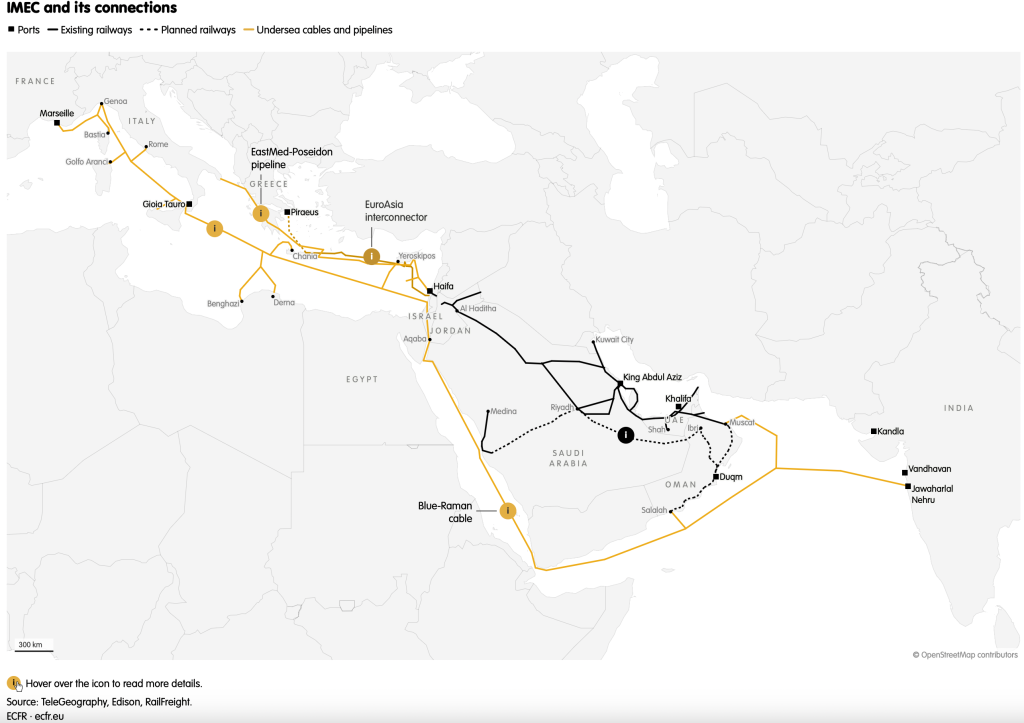
The India-Middle East-Europe Corridor (IMEC) plan was introduced at the September 2023 G20 Summit in New Delhi. The network of railroads, ship-to-rail, road transport routes, energy pipelines and high-speed data cables connecting South Asia, the Gulf and Europe was in theory supposed to be some sort of answer to China’s Belt and Road Initiative (BRI). It never made much sense as a logistics corridor as it involves moving cargo via ships from India to the UAE, putting them onto trains going through the UAE, Saudi Arabia, Jordan and Israel, and then back onto ships to go from Israel to Europe.
It looked like IMEC, like so many responses to the BRI, was going to fade into obscurity, but the Trump “America First” administration enthusiastically backed it with Donald calling it calling it the “‘greatest trade routes in all of history.”
Yet the new administration shifted the focus away from trade to more of a digital corridor with compute power flowing outwards from the Persian Gulf. We covered that well-traveled terrain in a piece on Monday. Conspicuously absent in many of the write-ups on the US AI strategy in the Persian Gulf, however, is what role Israel fills.
If the US is providing the chips and other tech, and the Gulf is bringing the capital and energy to the table, what is Israel offering?
IMEC was at least partially viewed as an effort by the US to help embed Israel and ultimately have it control regional supply chains along the route. And we continue to see progress on that front with recent deals, such as the following:
Netanyahu approves a $35 billion natural gas export deal to Egypt, the biggest in Israeli history AP
Germany signs second $3.1 billion Arrow missile deal with Israel Calcalist
UAE revealed as secret buyer in $2.3 billion Israeli Elbit Systems arms deal The New Arab
But more than that is a much darker role that doesn’t get much press in the proclamations about the “greatest trade route in history.” Here are two other recent pieces that hint at Israel’s “contribution”:
AI-powered surveillance firms are gunning for a share of the Gaza spoils +972 Magazine
Israel’s ‘Algorithmic War’ & ‘Algorithmic Assassinations’ in Lebanon continue unabated Conflicts Forum
Dovi Frances, an Israeli-American founding partner of the Los Angeles-based venture capital firm Group 11 and a major Trump backer recently touted Israel’s position thusly:
“We are 0.4% of the world’s population, and we lead 20% of global innovation. We have 350 international R&D centers, and 10% of our workforce in high-tech contributes 18–20% to GDP.” Frances also noted that 15–25% of Fortune 500 CEOs are Jewish or Israeli, and that Israel currently has 46 unicorns—companies valued at over one $ billion —the highest rate in the world relative to its population.”
But much of the country’s tech success is built on the backs of oppressed Palestinians. Israel is at the forefront of using AI to surveil, control, and murder human beings, and it has the “opportunity” that other countries don’t to constantly test and fine tune that technology on a captive population.
The reality is that Israel is incentivized to keep brutalizing its neighbors in order to maintain its niche advantage in AI surveillance and AI-directed killing. This is at least partly why American tech firms partner with Israel and buy up Israeli start ups, and it’s a business model that is increasingly coming to American shores.
During the campaign, Silicon Valley figures like Elon Musk and Marc Andreessen helped shape the President-elect’s tech policy agenda. To “take the lead over China” on AI, campaign allies said the new administration will discard Biden’s AI guardrails (they did) and go full steam ahead on autonomous weapons, intelligence, and cybersecurity (they are). To meet the vast energy demands of data centers, Trump has called for a boom in fossil fuel production (that’s where the Gulf comes in).
And in Israel, Dovi Frances was the one tapped by Netanyahu to set up an AI National Directorate in Israel to make sure the country is a global AI superpower. Seeing the way Israel uses AI, that should be setting off alarm bells. Instead the esteemed leaders of Silicon Valley are stumbling over themselves to get in on the action. From Globes:
Senior figures who are familiar with the plan that has been presented by Frances to Netanyahu say that the two men are expecting the involvement of several senior personalities in the international business community to help realize the plan. Some of these personalities are close to President Donald Trump including Elon Musk, Peter Thiel, who founded PayPal with Musk, OpenAI cofounder Ilya Sutskever who after leaving the ChatGPT developer has founded SST, a new AI company that will be based in San Francisco and Tel Aviv.
Here again is Frances writing shortly after Trump’s election about what was coming for the Middle East (much of which is on schedule):
Gulf investors have quietly begun to join Israeli-related tech companies’ cap tables, injecting capital into Israeli firms, often without public announcement. These activities—both sales and investments—highlight the growing economic ties between Israel and the Gulf and the immense interest from both sides in fostering deeper technological collaboration.
Under the Trump administration, with the expansion of agreements to include Saudi Arabia, Israeli AI companies could serve as platforms for entire industries in the Gulf, including education, banking, healthcare, and cybersecurity.
…The political instability in the Middle East, the AI revolution, and the US political landscape are not isolated from each other—they are intertwined.
Two months ago, I met with Donald Trump in Washington, DC, where we discussed the AI revolution and how his administration, if re-elected, could help Israel maintain its technological superiority in the region.
That is the vision for the region and for IMEC. An AI superiority invitation from Europe to India written in the blood of genocide. And there are efforts to take the IMEC model global. In December the US State Department also unveiled Pax Silica, an effort to form a political-economic alliance in the field of AI and its supply chains and counts Japan, South Korea, Singapore, the Netherlands, the UK, Israel, the UAE, and Australia as participants.
Others are eager to join the party.
A quote that really stood out to me and summed up the lure of IMEC and Israel’s role in this AI geopolitical bloc came way back In February when an Israeli business delegation visited New Delhi. The guest list included representatives from over 100 Israeli companies in the areas of cybersecurity, digital health, AI, and big data. During the visit India’s Minister of Commerce and Industry, Piyush Goyal said the following:
“Israel’s capabilities in innovation and security are extraordinary, and the technology demonstrated in ‘Operation Beepers‘ [a reference to Israel’s clandestine operation on the Hezbollah terror group in September 2024] is truly inspiring and unique — we want it here too.”
They just might get it.
In India, while negotiators from Washington and New Delhi are still searching for a trade deal that will see Trump’s tariffs come down, that hasn’t stopped the AI money from flowing. Microsoft recently announced a $17.5 billion AI investment in India. Amazon is throwing throwing $35 billion into AI projects across the country. Google is dropping $15 billion in partnerships with two of India’s biggest conglomerates, the Adani Group and Bharti Airtel. Meta, too, is investing, and taken altogether it’s one of the biggest capital inflows into a single sector in India’s history.
That might all sound kind of strange considering New Delhi and Washington are at odds these days over Trump’s economic strong arming and ongoing pressure from the US over India’s close economic relationship with Russia. Yet, it fits in neatly with the all the other American AI moves in the Persian Gulf. Guy Laron writing at American Affairs Journal:
…[IMEC] has now been repurposed into a privatized artery connecting Gulf compute to Indian talent. This made perfect sense. India has long been seen as the world’s back office: a land of coders, clerks, and call centers. But today it plays a far more strategic role in the AI supply chain. Its 1,600 Global Capability Centers (GCCs), which employ 1.66 million professionals, have moved well beyond basic IT and customer service.14 These fully owned subsidiaries of multinational corporations now handle advanced functions: software engineering, data analytics, AI research, cybersecurity, and even core product development. In effect, they are how the corporate West operationalizes its digital ambitions at scale and at lower cost. The GCC sector already accounts for over a third of India’s services exports and is growing rapidly.15
As these centers begin working with more sophisticated AI models, India and its vast digital labor force will become increasingly dependent on the Gulf’s infrastructure to train and deploy that AI at scale. This gives India a dual role within Trump’s AI corridor: a global labor hub and a regional client of Gulf-based compute power.
Plenty of Questions and Problems
Let’s start with the most obvious: how well are data centers going to operate in 60 Celsius (140 Fahrenheit) heat? The recommended temperature range for data centers is 18 C to 27 C, according to the American Society of Heating, Refrigerating and Air-Conditioning Engineers. Temperatures exceeded 50 C this past summer in the UAE.

Average annual surface temperature. Source: Rest of World.
Rest of World, in a recent analysis of global data center locations, notes that long-term solutions in the Middle East could include using nuclear energy and hydrogen fuel cells, and building data centers underground to handle extreme heat.
The Middle East doesn’t have the massive amounts of water needed to cool them.

That means they need to rely on two-phase immersion cooling systems, which can help save water, though it can be expensive and they have problems.
“If you crack the cooling challenge in the Gulf … you unlock the one missing piece in an otherwise world‑class AI ecosystem,” Mohammed Soliman, director of the strategic technology programme at the Middle East Institute, told The National.
That’s a rather large missing piece, however, and as far as I can tell, the expectation seems to be that future tech advances will figure it out. Perhaps AI will unlock the code to beat the laws of physics, but that seems like a risky bet.
Until then, the Middle East data centers are stuck gobbling up even more fossil fuels to cool the plants and to run desalination plants for the water necessary to the process.
Not that the Silicon Valley oligarchs, Gulf monarchs, and DC think tankers care, but this is all horrible news for global warming. Personally, I think there’s enough evidence and a track record to conclude that the US ruling class is embracing global warming as partner in their goal to destabilize and plunder. Persian Gulf data centers fit in nicely there.
What will be asked of the US in the coming years as the Gulf becomes an integral part of its AI dominance strategy and effectively buys off Washington? How much more will the US support the Gulf Kingdoms’ regional—and global aspirations?
The US is already supporting another genocide, this one a UAE-led effort in Sudan. Somalia/Somaliland is about to go up in flames with the US and its allies like Israel and the UAE providing much of the gasoline.
How will the US protect these precious data centers and the desalination plants that provide water to cool them should conflict come home to the Gulf? They sure would make attractive targets if/when a wider war with Iran begins. Ansar Allah in Yemen, too, has shown the capability to hit critical infrastructure in the UAE and KSA.
At the moment, the two US Gulf partners are engaged in high stakes proxy wars as blowback has begun to the UAE’s more “assertive” role in partnership with Israel in the wider region. In Yemen, Saudi Arabia recently bombed a large Emirati weapons shipment coming into the country and for the first time directly calling out the UAE’s role in backing Yemen separatist forces. The two are also on opposite sides in the war in Sudan with disastrous consequences for the country and the wider region in Africa. And their rivalry is also playing out in Somalia where Israel just further complicated the deadly game by recognizing Somaliland.
Perhaps a most fitting conclusion to this whole scheme would be the US’ two biggest AI partners—the UAE and KSA— blowing up each other’s data centers in a conflict, both of them using American-made bombs with US missile defense systems failing to offer their promised protection.
Do a bunch of American grifters with short attention spans care if it all goes up in smoke as long as they got rich in the process? And lastly, what happens to this whole geopolitical strategy when the AI bubble goes pop?

















-1024x609.jpg "President Trump Exposes America’s Election Integrity Disaster")


