I was watching a panel at Consensus a few weeks ago. The discussion was about UX – the argument being that confusing interfaces and jargon are what’s holding crypto back. It’s a common diagnosis across many industries that try to combine accessibility with technical products. But, while the likes of Circle et al. were pushing that narrative, I couldn’t help but feel like that was the easy thing to blame.
Standardisation Is the Key
Let me tell you a different story first. It’s a tangent, but bear with me as it sets the scene.
The Republic of Genoa built one of the most sophisticated trading networks the medieval world had ever seen. They planted outposts across the Black Sea and the Mediterranean – physical on-ramps into distant markets, each one a node in a growing commercial web.
But what made it work wasn’t the outposts. It was standardisation. Genoa introduced the genovino – a gold coin, fixed standard – and suddenly trade across all those disparate nodes became predictable, trusted, and scalable. When the Ottomans closed the routes and the outposts were gone, Genoa didn’t collapse. It pivoted. Became the financial backbone of the Spanish Empire. Channelled capital into an entirely new phase of expansion.
Crypto is somewhere in the early chapters of that story. We need to recognise that we are still in the early adoption phase. We are in this trading post phase – isolated exchanges, fragmented stablecoin issuers, inconsistent rails. The infrastructure exists, in pieces. But there is no genovino. There is no standard. And until there is, we’re not going anywhere fast.
Compliance Is the Hard Part
Speaking on my own panel in Miami last month, the main message I kept coming back to was this: compliance is hard. And it resonated. And converted. By the end, it had become the unofficial tagline of the event.
I say that not to be self-congratulatory. I say it because the room’s reaction told me something – that people in this industry know compliance is the problem, and they’re slightly relieved when someone just says it plainly.
Read more: Crypto Media Traffic Drops 33% While Stablecoins, Transfers, DEX Trading Increase
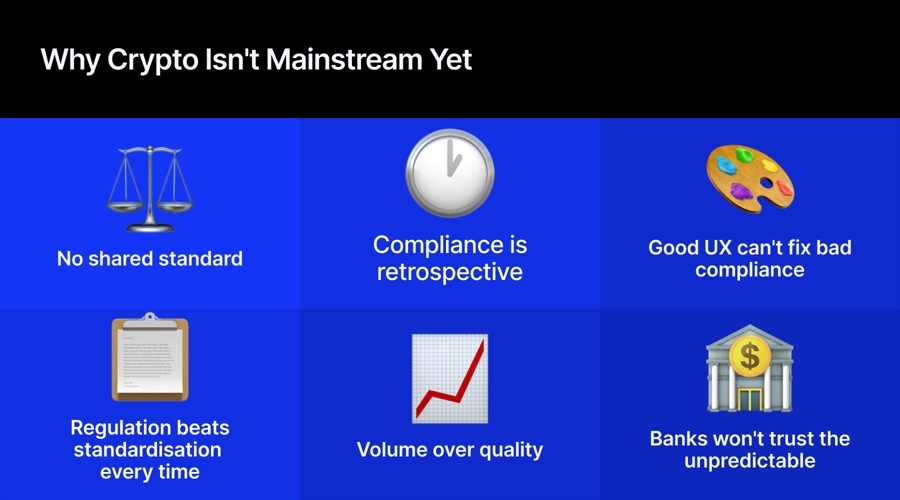
There’s an analogy that you can’t polish everything. The cleanest interface in the world is rendered useless if that transaction is sitting in a manual compliance queue – someone eyeballing it, deciding whether it looks legitimate – and the promise of frictionless payment is already broken. Good UX doesn’t matter if the transaction is just blocked. Or waiting. As a provider, I can’t promise execution until compliance clears it. That’s where the entire frictionless narrative falls apart.
On top of that, most compliance right now is retrospective. A day later, someone realises they processed something suspicious. By then, the money is out of the system. It’s not even a risk assessment if the horse has already bolted. It becomes a clean-up operation.
On the Floor, the Mood Was Different
25,000 people at Consensus. Eric Trump on the main stage, practically shouting that bitcoin is going to a million dollars. “We’ve won.” The Bermuda premier took the stage to make his pitch too – come here, light-touch regulation, a great place to do business. There was a real energy.
ERIC TRUMP BLASTS TRADFI, PITCHES CRYPTO AS ECONOMIC SHIELD
At Miami 2026 Consensus earlier this year, Eric Trump criticized traditional banks, claiming his family was “debanked” and pointing to systemic bias in financial institutions.
He promoted crypto as… pic.twitter.com/PgmboyIvx7
— CryptosRus (@CryptosR_Us) May 15, 2026
But in the actual meetings, a quieter theme kept surfacing of people wanting quantity over quality. Process everything, show growth, demonstrate you can handle the flow. Some stablecoin orchestrators are just going by default – process anything, to anywhere, from anybody – to create volumes they can point to.
I understand the investor pressure behind that. You need numbers to raise, you raise to grow. But the logical endpoint is criminals in the system, enforcement action, and another round of industry-wide trust collapse. We’ve seen this cycle before and we know how it ends.
The Guillotine Problem
There’s a recurring timeline that continues to hold banks back from trusting this industry.
Regulation arrives. There’s a period of panic. Companies realise they’re not ready. There’s no agreed standard against which to measure readiness, so the panic is unstructured. The guillotine comes down. Some businesses survive, and some don’t. Banks watch this repeat every two or three years and draw the only rational conclusion available to them: this space is unpredictable, and unpredictable is a risk they can’t price.
We can all look as glossy as we want, but the issue here is that standardisation fails to precede regulation.
SWIFT didn’t come from nowhere. The top players in global banking lobbied for it together because they understood a shared standard would advance the whole industry. Nobody in stablecoins is having that conversation. USDC and Tether aren’t agreeing on terms.
So What Actually Needs to Happen
AI has the power to unlock compliance operations at the speed regulation requires. Checking a passport, OCR-ing a proof of address, making a go/no-go call on a transaction in real time – these are repeatable tasks. An agent does it in two seconds. The human makes the final decision, and the AI mines the data. We’re already doing early versions of this. It’s not a distant prospect.
But the deeper fix is harder. The industry needs to grow up. Stop fighting. Agree that one thing will advance everything – and that thing is standardisation. Someone needs to write the paper. A legitimate, compliant, highly accessible stablecoin looks like this. The standard.
Even as I say it, I hear how utopian it sounds. But I think the banks are the ones who eventually sit down and do it – not because they want to, but because they’ll have to. Three to four years from now, they’ll agree on an interoperable standard the same way they built SWIFT. When that happens, the Genoa pivot happens. The infrastructure built in the trading post phase becomes the foundation for something much larger.
But right now, the industry needs to come back to the ground a little. Reset. Then build the next balloon and go up again. Substance first.
I was watching a panel at Consensus a few weeks ago. The discussion was about UX – the argument being that confusing interfaces and jargon are what’s holding crypto back. It’s a common diagnosis across many industries that try to combine accessibility with technical products. But, while the likes of Circle et al. were pushing that narrative, I couldn’t help but feel like that was the easy thing to blame.
Standardisation Is the Key
Let me tell you a different story first. It’s a tangent, but bear with me as it sets the scene.
The Republic of Genoa built one of the most sophisticated trading networks the medieval world had ever seen. They planted outposts across the Black Sea and the Mediterranean – physical on-ramps into distant markets, each one a node in a growing commercial web.
But what made it work wasn’t the outposts. It was standardisation. Genoa introduced the genovino – a gold coin, fixed standard – and suddenly trade across all those disparate nodes became predictable, trusted, and scalable. When the Ottomans closed the routes and the outposts were gone, Genoa didn’t collapse. It pivoted. Became the financial backbone of the Spanish Empire. Channelled capital into an entirely new phase of expansion.
Crypto is somewhere in the early chapters of that story. We need to recognise that we are still in the early adoption phase. We are in this trading post phase – isolated exchanges, fragmented stablecoin issuers, inconsistent rails. The infrastructure exists, in pieces. But there is no genovino. There is no standard. And until there is, we’re not going anywhere fast.
Compliance Is the Hard Part
Speaking on my own panel in Miami last month, the main message I kept coming back to was this: compliance is hard. And it resonated. And converted. By the end, it had become the unofficial tagline of the event.
I say that not to be self-congratulatory. I say it because the room’s reaction told me something – that people in this industry know compliance is the problem, and they’re slightly relieved when someone just says it plainly.
Read more: Crypto Media Traffic Drops 33% While Stablecoins, Transfers, DEX Trading Increase
There’s an analogy that you can’t polish everything. The cleanest interface in the world is rendered useless if that transaction is sitting in a manual compliance queue – someone eyeballing it, deciding whether it looks legitimate – and the promise of frictionless payment is already broken. Good UX doesn’t matter if the transaction is just blocked. Or waiting. As a provider, I can’t promise execution until compliance clears it. That’s where the entire frictionless narrative falls apart.
On top of that, most compliance right now is retrospective. A day later, someone realises they processed something suspicious. By then, the money is out of the system. It’s not even a risk assessment if the horse has already bolted. It becomes a clean-up operation.
On the Floor, the Mood Was Different
25,000 people at Consensus. Eric Trump on the main stage, practically shouting that bitcoin is going to a million dollars. “We’ve won.” The Bermuda premier took the stage to make his pitch too – come here, light-touch regulation, a great place to do business. There was a real energy.
ERIC TRUMP BLASTS TRADFI, PITCHES CRYPTO AS ECONOMIC SHIELD
At Miami 2026 Consensus earlier this year, Eric Trump criticized traditional banks, claiming his family was “debanked” and pointing to systemic bias in financial institutions.
He promoted crypto as… pic.twitter.com/PgmboyIvx7
— CryptosRus (@CryptosR_Us) May 15, 2026
But in the actual meetings, a quieter theme kept surfacing of people wanting quantity over quality. Process everything, show growth, demonstrate you can handle the flow. Some stablecoin orchestrators are just going by default – process anything, to anywhere, from anybody – to create volumes they can point to.
I understand the investor pressure behind that. You need numbers to raise, you raise to grow. But the logical endpoint is criminals in the system, enforcement action, and another round of industry-wide trust collapse. We’ve seen this cycle before and we know how it ends.
The Guillotine Problem
There’s a recurring timeline that continues to hold banks back from trusting this industry.
Regulation arrives. There’s a period of panic. Companies realise they’re not ready. There’s no agreed standard against which to measure readiness, so the panic is unstructured. The guillotine comes down. Some businesses survive, and some don’t. Banks watch this repeat every two or three years and draw the only rational conclusion available to them: this space is unpredictable, and unpredictable is a risk they can’t price.
We can all look as glossy as we want, but the issue here is that standardisation fails to precede regulation.
SWIFT didn’t come from nowhere. The top players in global banking lobbied for it together because they understood a shared standard would advance the whole industry. Nobody in stablecoins is having that conversation. USDC and Tether aren’t agreeing on terms.
So What Actually Needs to Happen
AI has the power to unlock compliance operations at the speed regulation requires. Checking a passport, OCR-ing a proof of address, making a go/no-go call on a transaction in real time – these are repeatable tasks. An agent does it in two seconds. The human makes the final decision, and the AI mines the data. We’re already doing early versions of this. It’s not a distant prospect.
But the deeper fix is harder. The industry needs to grow up. Stop fighting. Agree that one thing will advance everything – and that thing is standardisation. Someone needs to write the paper. A legitimate, compliant, highly accessible stablecoin looks like this. The standard.
Even as I say it, I hear how utopian it sounds. But I think the banks are the ones who eventually sit down and do it – not because they want to, but because they’ll have to. Three to four years from now, they’ll agree on an interoperable standard the same way they built SWIFT. When that happens, the Genoa pivot happens. The infrastructure built in the trading post phase becomes the foundation for something much larger.
But right now, the industry needs to come back to the ground a little. Reset. Then build the next balloon and go up again. Substance first.