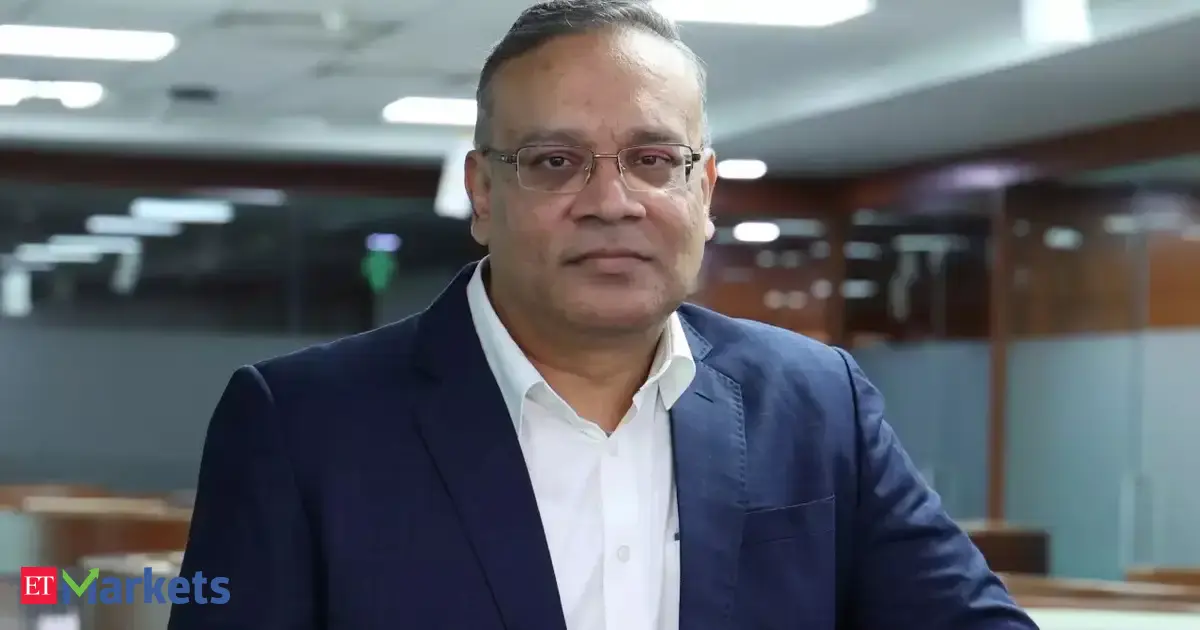
In an interaction with Kshitij Anand of ETMarkets, he highlighted that while large banks are now delivering near index-like earnings growth, the real momentum is shifting toward the capital market ecosystem—including AMCs, brokers, and exchanges.
Against this backdrop, the newly launched BFSI fund is designed to capture this transition, with a strong tilt toward capital market-linked businesses, complemented by selective exposure to well-capitalised banks and NBFCs.
Agarwal also emphasised that the fund will follow a high-conviction, growth-oriented approach with a focused portfolio, aligning with the broader DNA of Motilal Oswal AMC. Edited Excerpts –
Kshitij Anand: Well, it was indeed a historic deal which will not just boost ties, but is also about sentiment turning positive both for domestic investors as well as for FIIs. So, how should Indian investors interpret this?
Prateek Agarwal: So, it is not only this deal; this has been a season of deals. Over the last few months, we have seen a spectrum of deals happening. To our mind, it opens up good opportunities for a lot of manufacturing from India. The uncertainty that would have been there before the deal was signed is now gone.
Now, just see it this way—we have competitive strengths in manufacturing. Make in India has been a policy initiative for a long, long while. And now, if you have deals with the two largest economic blocs globally, the US and the EU, I think for a Make in India-type initiative, it is a dream come true.
Kshitij Anand: Absolutely. And in fact, as you rightly pointed out, in the last 30 days, you could say that we have struck two deals—one with the EU and the other with the US. So, how does this improve India’s position compared with other emerging markets from an investment point of view?
Prateek Agarwal: So, if you were setting up a factory to supply to the West, we are competitive on labour costs, like many countries in the Asian region. But now, if you see, our duty rates are slightly better than others. If we look at our immediate neighbours or other manufacturing destinations, we have got a slightly better deal.
More importantly, we have several India-specific advantages in terms of the depth of manpower we have and the trained workforce that allows us to scale up manufacturing without too much cost pressure for a substantial period of time.
Most other economies—if they see one or two years of strong growth in manufacturing—the labour cost advantage they started with tends to diminish because the depth of the labour force is not there. India has that very large advantage. It is a home-country advantage.
We are the most populous country globally, with over 140 crore people, so supplying to the Indian market itself provides a lot of scale. And with that scale, supplying to the West becomes even more viable. So, it is something that is very positive.
Now, for investors, just think of it this way—until recently, when most other countries had a deal and we did not, it seemed like we were on the wrong side of, let us say, the US. Now, this deal takes away that concern. People know that all is good, and it is business as usual.
Every large market globally has had a life before striking a deal with the US—when they were not doing so well—and a life after they did the deal. We do hope something similar could happen here.
Now, just think of it—global newspapers should be carrying not one deal, but two deals. At the same time, another concern in India—currency depreciation—has also reversed. We were talking about it: once a deal happens, confidence returns, and you may see a sharp appreciation in the currency—and that has happened. These two factors are positive for attracting foreign flows and reviving the interest of foreign investors in the country.
Kshitij Anand: In fact, my next question was also around rupee depreciation as well as the reversal of foreign investor money, which was more than ₹1.6 lakh crore in 2025. In FY26 as well, we have seen quite a bit of outflows from FIIs. But yes, you rightly pointed out that once the deal is struck, there would be some reversal on that front.
Now, Motilal Oswal recently announced the launch of the Motilal Oswal Financial Services Fund. I understand it is an open-ended scheme that will invest in the financial services sector. The NFO has already opened on January 27 and will probably close on February 10, 2026. If you could take us through the details of the fund and why now, at this point in time?
Prateek Agarwal: So, let us understand this. We are growth investors—one of our kind in the country. We see this period as a phase where a lot of structural change is happening. So why now and not three months earlier? We have had a launch calendar in place, and we have been rolling out funds accordingly.
However, our BFSI fund, I believe, will look very different from others. If you think about growth, large banks, for example, used to drive growth once upon a time. Today, they deliver near index-like earnings growth. And our belief is that markets follow earnings growth. Now, in the financial space, the baton is passing to capital markets. We think the current period marks a shift away from banks toward capital market-linked businesses.
So, our fund construct is expected to have a higher allocation to the capital market ecosystem, which would include AMCs, brokers, and exchanges. That is one key differentiator.
Second, within banks, given the current environment, there are institutions that are getting well capitalised. They benefit from improving ratings and strong equity liquidity on their books, which enables them to grow well. We would want exposure to such entities within banks and NBFCs.
Lastly, with fundraising becoming more challenging, wholesale funding is something most banks are resorting to. This is levelling the playing field between players with strong distribution and those who earlier lacked it. So, there is some tactical positioning there as well.
Overall, our portfolio construct will be very growth-oriented, in line with the DNA of the house, along with a tightly focused portfolio. Typically, our portfolios range between 20 and 35 names, and you can expect something similar here. If I have to put a number, it would be around 25 stocks, with individual holdings of roughly 3% to 5%.
Kshitij Anand: Absolutely. Growth-oriented companies will be a key part of the fund, which is also in line with the broader policy push, including the Budget’s focus on growth, government capex, and initiatives supporting Make in India and the overall financial ecosystem.
Now, let me come back to understanding what the India–US trade deal means for India’s standing in global equity allocations versus other emerging markets.Prateek Agarwal: So, we have been among the worst-performing emerging markets over the last 12–13 months, and that has resulted in a sharp valuation correction during this period. Markets like Korea, for instance, may have delivered around 80% returns, while India has delivered only single-digit returns over the same timeframe. Most other markets have been in the vicinity of 20% or more.
Now, when you have global headlines talking about one deal on one day and another deal the next day, it is bound to draw global investor attention toward India. It corrects several factors that were earlier seen as concerns.
Think of it this way—within emerging markets, the prevailing narrative was that India is underperforming, so capital should move to better-performing markets. That was the talk of the town. Now, with improved valuations and key positives falling into place, India’s story starts to look much more compelling.
As a result, we should expect some reversal in investor sentiment, possibly quite soon. Global investors may start reallocating, and domestic investors, too, could gain confidence from improving market buoyancy.
Kshitij Anand: And I am sure this is another question from an investor’s perspective—looking at the Budget, which Indian sectors are likely to benefit the most from it or from the trade agreement that we have seen?
Prateek Agarwal: So, we have been saying repeatedly that not having a trade deal impacted a very small part of the economy and the market. What got impacted was gems and jewellery, which is practically not represented in the market.
It also impacted clothing to a very small extent, and segments like shrimp exports, which again form a very small part of the market.
Hence, if you look at it, the first-order benefit is to textiles, shrimp exports, and jewellery—though jewellery is not meaningfully represented in the market. A few niche manufacturing companies may also see better prospects. But beyond that, the key change is in sentiment.
Earlier, sectors like electronics and pharmaceuticals were completely exempt. Globally, duty structures for steel, aluminium, and copper remain similar and continue to do so. However, in India, there was always an overhang that adverse changes could happen, and that uncertainty has now been removed.
Now, the doors are open, and this is just the first part of the deal. A larger agreement could follow in the future, potentially making us part of a broader trade bloc, which would be even more positive. But even this step, by removing uncertainty, is a significant boost for the Make in India initiative.
Kshitij Anand: Rightly put, because the key overhang was uncertainty, and with the deal coming through, that concern has been addressed. As you mentioned, only a small part of India Inc. was directly impacted. My next question builds on that—could this deal influence earnings growth for Indian companies over the next few years?
Prateek Agarwal: As sentiment improves, the confidence to invest also rises. In the immediate term, companies operate with existing capacities, so the impact may be limited. However, the long-term impact could be much more significant. Benefits will likely be seen across the value chain, especially if we eventually secure lower duty rates for metals like steel, aluminium, and copper.
Additionally, given current valuations and the fact that emerging market funds were earlier underweight on India, any reversal in that trend could bring in fresh capital flows. This, in turn, can strengthen the rupee—as we are already seeing—and ease concerns around rising bond yields, especially in the context of higher borrowing outlined in the Budget. Increased foreign inflows improve liquidity and can put downward pressure on bond yields, thereby broadening market participation.
Moreover, when the currency is volatile or weakening, leveraged players such as hedge funds and ultra-HNIs tend to stay cautious, as forex volatility impacts leverage significantly. If currency stability improves, these participants can re-enter more actively, which becomes a strong tailwind for growth-focused investors like us.
Kshitij Anand: And as we have discussed, we have seen two historic deals—one with the EU and the recent one with the US. From a portfolio perspective, does this strengthen India’s long-term investment story? Which sectors should investors focus on? Should it be growth-oriented sectors like financial services, or something else? How should one approach this at this point in time?
Prateek Agarwal: I think the biggest takeaway is that Make in India gets a significant boost. The Budget also shifted the narrative again. While the FY25–26 Budget had elements supporting consumption—through tax cuts and other measures—this Budget has once again brought capex to the forefront.
Second, having strong trade deals with two of the largest global economic blocs is a major positive for India’s manufacturing ambitions. That is the first-order impact. Yes, certain companies may benefit more immediately, but the broader theme clearly favours Make in India.
Beyond that, banks are likely to benefit as credit demand rises. If bond yields soften, NBFCs also stand to gain. Many of the concerns that existed earlier are now being addressed, making the outlook more broad-based.
Our sense is that there was significant pessimism in the market earlier. In fact, despite several positive developments, markets were unable to fully reflect them due to bearish sentiment. These two deals, coming in quick succession, could help break that negative sentiment.
Finally, if you look at money flows into the market, much of it has been driven by SIPs, and even that has moderated. This suggests that a significant amount of capital is still on the sidelines. As confidence returns, we should see stronger inflows into mutual funds and increased direct participation from retail investors as well.
Kshitij Anand: Now that we are talking about a positive environment and sentiment has improved, are there any risks that Indian investors should still be aware of despite this positivity?
Prateek Agarwal: When the deal had not happened, my usual advice to investors was to invest gradually over the January to March period. It tends to be a very good investment window in this country, albeit a volatile one, because of year-end considerations such as advance tax payments before March 15, the Budget, and the uncertainty surrounding it. So, the idea was to spread investments across this period and, if a deal materialised, shift from SIPs to lump sum investments. That has been my consistent view.
Now that the deal has happened, one phase of volatility that could still be expected is around the March 15 advance tax deadline, which, in many ways, marks the closing of books for several entities as they prepare for the new fiscal year. There could be some temporary weakness during this period, and investors can use that as an opportunity.
At the same time, it is important to recognise that much of the negative news is already priced in. Q2 numbers were good, and Q3 performance—barring one or two companies—has also been strong. As we move ahead, the low base of last year should support year-on-year growth in Q3 and Q4. Overall, there is a lot to look forward to.
(Disclaimer: Recommendations, suggestions, views, and opinions given by experts are their own. These do not represent the views of the Economic Times)