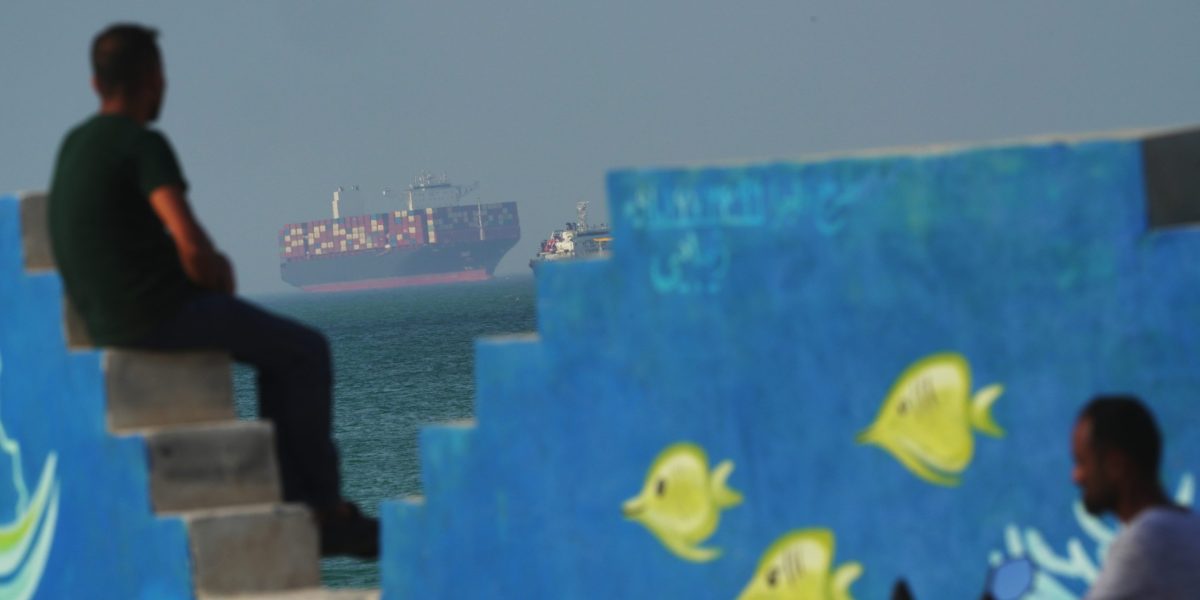
Since the first tanker pushed through it, the Strait of Hormuz has been treated as a static math problem. You tallied the hulls, weighed the warheads and assumed you knew the score. If you could map the Fifth Fleet’s tonnage against the IRGC’s mine density, you had a working theory on who held the leverage and what a barrel of crude ought to cost. For decades, we looked at those 21 miles of water and saw a cage made of steel.
That logic is now an artifact. The “grey hull” era of deterrence didn’t end with a kinetic explosion. It just quietly stopped being the thing that mattered. What’s happening in the Gulf isn’t a traditional naval confrontation. It’s the violent, accelerating breakdown of a global system that destroyers aren’t equipped to target.
[A note on sourcing: Several of the data points below come from Windward, whose CEO co-authored this piece, and from the maritime data sector in which co-author Erik Bethel’s firm, Mare Liberum, is an active investor. We have flagged these instances and stand behind the underlying figures, which are corroborated by satellite and open-source intelligence. Readers should weigh that context accordingly.]
Run the numbers. When U.S. and Israeli strikes on Iran kicked off on February 28, traffic through the world’s most critical oil artery didn’t just slow — it cratered by 97% in a single week, according to Windward’s Q1 2026 shipping risk report. Upwards of 800 ships were left idling west of the chokepoint, effectively paralyzed. Of the 142.5 million barrels loaded in March, a staggering 128 million never cleared the gap. By late April, with the ceasefire fraying and tankers still taking hits mid-transit, the Strait is, in the authors’ assessment, closed to commercial traffic.
The missiles and drones make for good headlines, but they’re a distraction. The real story is that the Strait has gone dark. Not in some poetic sense, but literally. The Automatic Identification System (AIS) — the network that’s supposed to be the “gold standard” for commercial tracking — has stopped telling the truth.
AIS was designed in the 1990s as a collision-avoidance tool, so ships wouldn’t run into each other in fog or at night. It has since become the backbone of how the world sees maritime trade: insurers, regulators, commodities desks, port authorities and central banks all price, enforce and plan against the signals flowing out of ships’ transponders. The catch is that AIS is self-reported. The ship tells the world where it is and who it is, and the world believes it. There is no independent verification baked into the system. In peacetime, that works, because lying serves no one. In Hormuz right now, it is being weaponized.
Ships are vanishing into digital black holes only to materialize hours later on the other side of Hormuz with the transit completed in total silence. On April 21, Windward’s platform identified 296 vessels off Bandar Abbas. Of these, only 74 were transmitting AIS signals — a cooperative rate of roughly 25%.
Others are caught in the crossfire of GPS spoofing attacks — fake satellite signals, broadcast from shore, that fool a ship’s navigation into thinking it’s somewhere it isn’t. The result is a fleet of tankers whose screens show them circling inland airports or drifting across the Iranian desert. Windward identified at least 30 jamming clusters across Saudi Arabia, Kuwait, the UAE, Qatar, Oman and Iran. Some have gone further, broadcasting the identity numbers of hulls that were scrapped years ago. These are zombie ships — very real tankers operating under the digital signatures of vessels that no longer exist.
Even the destination fields, meant to tell port authorities where a hull is headed, have been repurposed into desperate pleas. Instead of a port of call, the screens read: “India Ship, India Crew.” “China Owner and All Crew.” It’s not data anymore; it’s a prayer. Please don’t shoot.
Data suggest AIS is now underreporting Hormuz traffic by half. In Q1 alone, nearly a million GPS jamming incidents hit over 1,100 vessels. Satellite imagery recently caught seven VLCCs — 14 million barrels of capacity — off Iran’s coast with zero digital footprint. Iran claims 11 million barrels exported during a blockade where commercial feeds show a graveyard. Both are true. That is the problem.
Here’s why this should worry anyone whose job depends on a functioning global economy. Our entire maritime architecture is built on the naive hope that data is honest. It’s a costly delusion. Insurers are now benchmarking war-risk premiums against vessel tracks that are often little more than digital fiction — and in the Strait, those premiums haven’t just risen, they’ve tripled, adding a $250,000 surcharge to every supertanker transit. But insurance is just the most visible edge of it. Commodity traders price crude on the same feeds. OFAC enforces sanctions on them. Refiners in Asia schedule deliveries against them. Central banks fold them into inflation models. Pull the thread and a surprising amount of the world’s financial plumbing ties back to satellite signals from ships that, at the moment, are lying about where they are.
The shadow fleet — roughly 2,100 tankers already seasoned in sanctions-dodging — has spent years rehearsing for this. But the scale has shifted. Selective invisibility isn’t just a niche trick for moving illicit crude anymore; it is now the ambient condition of the world’s busiest oil corridor.
This isn’t a temporary spike to wait out. When the data signal itself is compromised, you’re looking at a permanent tax on everything downstream — from charter rates to asset values and insurability. The smart money is fusing AIS with satellite and behavioral analytics to find the truth. The rest are flying on instruments, unaware that the gauges are lying to them.
The bigger implication for governments is overdue: Maritime data is no longer a commercial nicety — it is critical infrastructure. When a fifth of the world’s oil moves through a digital blind spot, awareness must be funded and defended accordingly.
Three shifts are required:
1. Abandon AIS as “Ground Truth”: Stop treating a 1990s collision-avoidance tool as wartime intelligence. Cross-validating with satellite, radar, and behavioral patterns must be the baseline, not a premium add-on.
2. Shift Verification Upstream: The burden shouldn’t fall on the port that catches a fraud. Flag registries and insurers must bear the cost of legitimacy. If a flag state can’t track its own fleet, it shouldn’t be a flag state.
3. Treat Spoofing as a Cyberattack: A “zombie” ID is a forged credential; a spoofed GPS signal is reckless endangerment. We have frameworks for digital intrusions — salt water shouldn’t be a loophole.
The ships in Hormuz that matter most right now are the ones nobody can see. Until that changes, every risk model touching the world’s most important waterway — a London underwriter’s premium, a Tokyo refiner’s hedge, a Treasury sanctions package — is being built on data that has quietly stopped telling the truth.
The missiles make the news. The silent transponders are the crisis.
The opinions expressed in Fortune.com commentary pieces are solely the views of their authors and do not necessarily reflect the opinions and beliefs of Fortune.