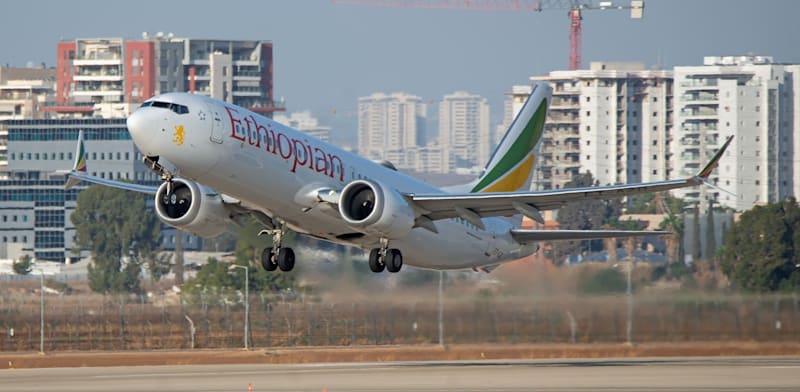
At a time when the security situation is very tense and some airlines are cancelling flights to Israel, Ethiopian Airlines announced at the end of last week that it would expand its activity on the Tel Aviv-Addis Ababa route during August. The airline, which is represented in Israel by TAL Aviation, will operate five additional weekly flights between Sunday and Thursday, bringing the total number of weekly flights to 26 (in each direction).
Ethiopian Airlines connects Israel directly to a large aviation hub in Africa, from which connecting flights can be taken to destinations all over the continent. This is partly attributable to the relations between the two countries, but first and foremost it has to do with developments that Ethiopian Airlines has undergone in recent years.
Revolution in service doubled revenue
“I started to follow this airline thirty years ago,” says Yehuda Zafrani, an expert on aviation and tourism. “At first, I would tell people to avoid two companies: Turkish Airlines and Ethiopian. Every passenger came back with another complaint. But these two airlines have undergone a real revolution. Turkish is now a major world airline, and Ethiopian is on the way there.”
Last July, Ethiopian Airlines was ranked 43rd in the world for the number of its daily flights – 456. The airline operates more than 170 aircraft, among them Boeing 787 Dreamliners (which it will use on some of its flights to Tel Aviv).
The company’s revenue doubled in five years from $3.7 billion in the 2019-2020 financial year to $7.6 billion in 2024-2025. Operating profit almost tripled, from $370 million in 2019-2020 to $1 billion in 2024-2025.
The change in Ethiopian Airlines’ fortunes stemmed mainly from a decision by its owner, the government of Ethiopia. “The change began at the beginning of the previous decade, when the government decided to put Ethiopia on the map,” explains Zafrani. “They understand that to do so they needed a strong international airline. If in the past Ethiopian Airlines was a local airline, today it can be said that it’s altogether international, with flights to over 160 destinations. To get there, they brought in European managers, and they were not afraid to introduce changes.”
To establish Ethiopia as an aviation hub, construction began at the beginning of this year of a new airport at Bishoftu, at an investment of $12.5 billion. The airport is due to be completed by 2030. It will be the largest in Africa, planned to serve 110 million passengers a year.
Where does the money come from? “There’s a great deal of investment in Ethiopia,” Zafrani says. “Businesspeople are always looking for places to grow, and if you look at Europe, you realize that the possibilities there are narrowing. In Africa, there’s plenty of room for business. In Nigeria, too, for example, there’s a great of money, and the world is there, but because of the character of the country this doesn’t reach its citizens. As soon as there’s a president who decides to move forward, it can happen.”
To understand the state of investment in Ethiopia, it’s enough to look at the Invest in Ethiopia 2026 business forum which took place in February. The forum ended with investment commitments of over $13 billion. Chinese companies led, with commitments worth $10.5 billion, mainly in renewable energy sources, manufacturing, and heavy industry.
In addition to the investment and the change of mindset, Ethiopian Airlines took advantage of its strategic position. “They are right in the heart of Africa,” Zafrani explains. “Take Israel for example. In the past there were no flights from here to Africa. Ethiopian took the route and realized that it had potential. It’s first of all business potential – there a great deal of business between Tel Aviv and Africa. But there’s also tourism potential. Israelis love Africa, from safaris in Kenya, to Zanzibar, to Addis Ababa. They’ve discovered it as a destination. Add to that the relations between the two countries, and you have a recipe for success.”
Zafrani says that Israelis began to discover Ethiopian Airlines in the past ten years, among other things because through them they can fly to India and the Far East at fairly low prices. “You must also remember that this is an airline that didn’t stop flying here through all the wars; it only adds flights. It says yes to Israelis.”
Does the fact that Ethiopia itself is at war help in their decision not to abandon us?
“First of all, yes. But beyond that, this is an airline that puts the financial equation at the top of its considerations. If El Al flies, it will fly as well. There are airlines that take alarm at every peep and fold. Ethiopian has the mentality of a strong company.”
Besides all this, the growth in the number of flights is of course connected to demand on the Israeli side. According to data from Israeli travel agency Ophir Tours, the monthly average number of searches for Ethiopia has risen by 22% in a year (despite a decline in the past few months), while for Zanzibar the rise is 132%.
“We have seen demand rise slowly but steadily,” says TAL Aviation Israel managing director Guy Thaler. “We have risen from 18 weekly flights in June to 21 in July, and at the summer peak in August we’ll have 26 flights weekly. The international airport at Addis Ababa has become one of the most important and most efficient hubs in the world, and it offers very quick connections.”
How much will a flight cost? According to the lastminute.co.il website, for the next three months the average fare for a direct flight with Ethiopian Airlines from Tel Aviv to Addis Ababa is $775. For a flight with a connection at Abu Dhabi, Etihad offers an average fare of $734.
Where do Israelis fly to from Ethiopia
Thaler: “The continuation destinations divide mainly between the East, destinations in demand such as Thailand, Japan and India, and Africa itself: vacation and safari destinations such as the Seychelles, Zanzibar, Kenya, South Africa, and Mauritius. Some also continue to destinations in North and South America.
“The travelers, incidentally, are very varied: vacationers and families on their way to vacations in the summer and on holidays; businesspeople with interests in Africa and Asia; backpackers; and of course the Ethiopian community in Israel and others visiting Ethiopia itself.
“Ethiopian Airlines has proved itself as one of the foreign airlines most loyal to Israel. The current growth in the frequency of flights directly derives from travelers’ confidence in us and the growing need of Israelis for possibilities for exiting the country.”
Published by Globes, Israel business news – en.globes.co.il – on July 27, 2026.
© Copyright of Globes Publisher Itonut (1983) Ltd., 2026.






-1024x683.jpg "‘Bernie Bros’ vs the World – What Are Democrats Doing?")