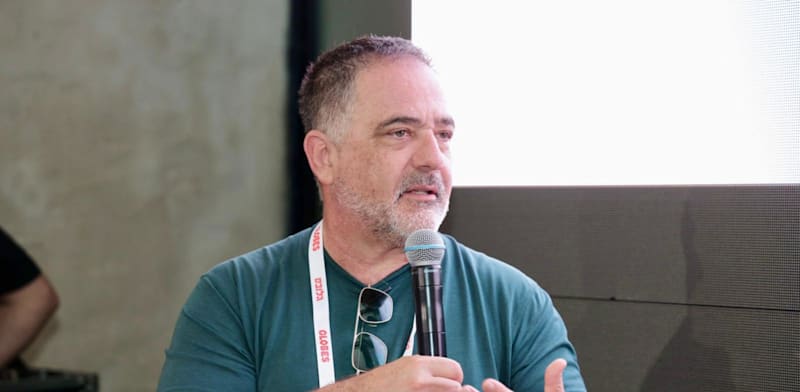
The AI revolution is changing the rules of the game in the tech industry but according to Cato Networks founder and CEO Shlomo Kramer, the changes taking place today are much broader than technology itself.
Speaking to “Globes” News Editor Bar Lavi at the Globes TECH IL conference, Kramer talked about the impact of AI on the cybersecurity market, on investments, on the job market and on the future of Israel’s tech industry. “This is the biggest technological revolution I have ever seen,” Kramer said. “I have been through personal computers, the Internet, mobile and the cloud, but this time it is a much more significant change. In every technological revolution, a new order is usually created that allows society to adapt. This time the pace is so fast that this part has not yet had time to happen.”
He stressed that cybersecurity will be one of the main beneficiaries of the revolution. “No one will deploy AI without protecting it,” he said. “Companies that succeed in providing solutions with the right architecture will benefit from the change. Others will have to make adjustments.”
Kramer also referred to the relative stagnation in investments recorded in parts of the venture capital market and claimed that it is largely due to investor behavior during a period of panic around AI. “If I invest and I can get a return on Anthropic or on companies that are in the first circle around the AI revolution, why would I look for other startups? 60%, 70%, even 80% of the money in the venture capital world today flows into those areas and everything else is drying up.”
Kramer observes that investors are still struggling to understand who the winners and losers of the new era will be. “Later-stage investors still don’t understand who is the dinosaur and who is the mammal. Until they understand that, they won’t invest. So there is a certain stagnation in the market. I think it is a temporary situation.” When asked if this is a bubble, he replied yes, but only in the economic sense. “I don’t doubt the potential of the technology. I think its impact is simply being priced in too quickly. It will take longer for it to enter companies’ financial statements in a normal way. There is real value that needs to be proven and productivity that needs to be demonstrated.”
“Israel is becoming very expensive to employ engineers”
One of the main topics that came up in the interview was the strengthening shekel and the impact on Israeli tech companies. Kramer explained that for companies that sell in dollars but pay salaries in shekels, this is a significant challenge. “If you take a tech company, 60% to 70% of the expenses are on personnel. The product and engineering teams are usually in Israel, and the situation that has arisen makes engineers in Israel the most expensive in the world.” According to him, more and more companies are already geographically dispersing their development activities. “We are hiring more people in Prague and London,” he said.
RELATED ARTICLES
Cato Networks buys Israeli GenAI co Aim Security
Cato Networks raises $359m at $4.8b valuation
His company just raised $238m, so what’s eating Shlomo Kramer?
When asked if there is a slowdown in hiring employees in Israel, he replied: “Not this year. But next year we will recalculate the road ahead.” Kramer assessed that the current environment is particularly difficult for early stage startups. “It is definitely a hostile environment,” he said, but added that the company’s success still depends mainly on the quality of the product and the idea.
He said the solution is not necessarily direct government intervention. “I don’t believe in direct government assistance to industry at this point. I believe in creating the right ecosystem for companies, and the exchange rate is part of that business environment.”
Despite predictions that AI will lead to workforce cuts, Kramer was circumspect. “We’re seeing layoffs,” he said, “but I’m not sure how much of that is related to AI.”
He also believes the increase in productivity brought by AI could have an impact on the office real estate market in the future. “AI in the development sector brings significant productivity. If you need 10% to 20% fewer employees, that also means less demand for office space,” he said.
“The rumor about a sale is complete lie. An IPO is a question of when”
Towards the end of the interview, Kramer addressed market rumors that Cato Networks is in talks to sell the company. “The rumor came to me through phone calls and letters,” he said. “It’s a complete lie. There is no process, no conversations, and nothing. I don’t know who is spreading this lie and what their goal is.” On the other hand, when it comes to a future IPO, Kramer is very clear. According to him, the company continues to grow at a rapid rate and will become a public company in the future.
“We grew by 43%, almost twice the growth rate of the market, and this year we expect to grow at a similar rate. We will examine the private market and the public market, but ultimately we will be a public company.” When asked if it was only a question of time, he replied simply: “Yes.”
In conclusion, he was asked what he would recommend to young people considering entering the tech industry in the age of AI. “I would advise people to do something they are good at,” he said. “If you are good at a certain field, go for it. If you do it enough, the passion will come. I think there is a bright future for the tech industry, just in different forms, and maybe even more interesting ones.”
Full disclosure: Globes is grateful to the partners that helped in holding the TECH IL Conference: Phoenix Group, Phoenix ESOP, Ondas Israel, Microsoft Israel R&D, Fischer (FBC), Voicenter, Cyberstarts, and the Israel Innovation Authority.
Published by Globes, Israel business news – en.globes.co.il – on June 17, 2026.
© Copyright of Globes Publisher Itonut (1983) Ltd., 2026.












-1024x683.jpg "Strait Outta Hormuz: Getting the Iran Oil Story Straight")