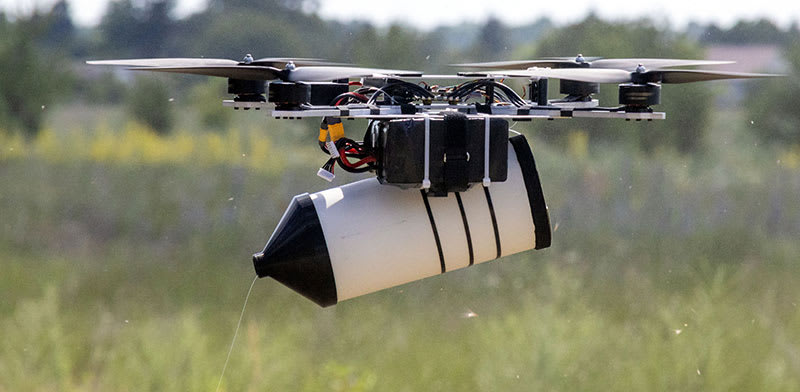
The threat of Hezbollah’s fiber-optic drones has claimed the lives of three soldiers and a civilian over the past month, and injured many more fighters, and the IDF has admitted that there is no comprehensive solution to the problem. Just last week, Prime Minister Benjamin Netanyahu chaired a discussion on the subject, in which it was decided to allocate NIS 2 billion from the Defense Ministry’s budget for efforts to find solutions, “Globes” has learned.
The fiber-optic drones are almost completely immune to communications jamming and advanced electronic warfare means, which makes them a lethal weapon for which there is no effective answer, and not only in Lebanon – the army in Ukraine faces a similar threat.
The length of the drone’s optical fiber ranges from 10 to 20 kilometers on average and allows commands to be transmitted between the operator and the drone, which is why it flies at a higher speed than a drone based on wireless communication. These drones are also much cheaper. A “Globes” investigation found that such a drone costs only about $300 on Chinese website AliExpress.
Hezbollah’s extensive use of these droners has put Israel’s security forces under great pressure to find a quick fix to the problem, but a solution does not yet exist. Thus, dozens of solutions are being tested simultaneously by different units. The IDF announced at the end of last week that it would equip its combat units with wire mesh, and these were distributed to the forces, to covering 158,000 square meters, and at the same time an additional purchase of about 188,000 square meters was made. The hope there is that in addition to the physical obstacle, technological capabilities and interception means will be able to disrupt the lethality of the drones.
Attempt to develop systems that will reduce lethality
During the discussion held with the prime minister last week, it became clear once again that there is no holistic solution, and the approach of the Ministry of Defense is to try to develop and acquire a variety of systems that can together reduce lethality. However, due to differences between the Ministry of Defense and Ministry of Finance over the defense budget, which has already reached NIS 143 billion this year, and the Ministry of Finance fears that it will be breached, Netanyahu decided to allocate NIS 2 billion from the approved Ministry of Defense budget, to expedite development and acquisition of such systems.
RELATED ARTICLES
Ondas Israel unit to protect World Cup venues from drones
Elbit drones to undergo Canadian trials – report
IDF to issue tender for 12,000 Israeli-made assault drones
Lowental Hybrid engines to extend missions of Elbit drones
The budgetary source, it emerged comes from a small NIS 4 billion fund set up and reserved in the Ministry of Defense budget for the Prime Minister’s prioritization, and the NIS 2 billion that will now be diverted comes in part from this fund.
However, budgetary allocations are one thing, reality is another. As long ago as 2017, the drone threat was defined as critical. In response to an inquiry by the State Comptroller’s inquiry back then, Netanyahu told the media that “the issue of drones is recognized and being addressed, and the State of Israel is one of the pioneers in the world in providing a response to the problem.”
The same statement also noted that the Netanyahu held a discussion on the issue in May 2017, and in June a cabinet meeting was held – in addition to professional discussions within the framework of the National Security Council. “The Prime Minister instructed the National Security Council, together with the Ministry of Defense and the Ministry of Public Security, to promote national preparedness for the issue of drones. Netanyahu has already contacted other countries that are facing the same problem,” a statement said.
The cabinet assigned the responsibility for finding solutions to the Ministry of Defense, along with establishing a new unit in the Magan administration. In 2021, the Comptroller showed how the terrorist organizations Hamas and Islamic Jihad in Gaza, as well as Hezbollah in Lebanon and Iran, had equipped themselves with drones, but with the exception of Ben Gurion Airport, the government’s preparations yielded no solutions.
In 2017, the last time the Israeli government recognized the threat of drones, NIS 150 million was allocated to the project. Due to a dispute, work was frozen for six months, and the budget shrank, according to the State Comptroller, to NIS 80 million, after the police and Shin Bet withdrew from the project. This time, it is hoped that not only will the entire budget be used, but that there will also be one body managing it – a body with teeth.
Published by Globes, Israel business news – en.globes.co.il – on May 18, 2026.
© Copyright of Globes Publisher Itonut (1983) Ltd., 2026.






-1024x699.jpg "Trump’s China Summit: More Isolation and Economic Erosion Ahead for Iran")