About 20,000 Israelis are still stranded abroad, according to the Ministry of Transport. Since the start of the war, about 100,000 Israelis have already successfully returned to the country. The vast majority of those left abroad are in distant locations, mainly in Southeast Asia and North America, the Ministry of Transport says. Bringing Israelis home from such places requires the use of wide-body aircraft, which are capable of carrying between 270 and 320 passengers per flight.
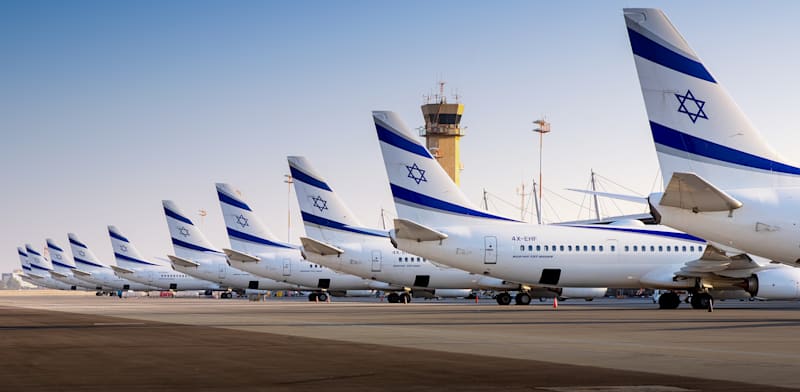
The only Israeli airline that can carry out the mission on a significant scale is El Al, which has the largest fleet of wide-body aircraft in Israel, including Dreamliners and Boeing 777s designed for long-haul flights. This is in contrast to other Israeli companies, which mainly operate narrow-body aircraft suitable for short and medium-haul flights.
While almost the entire operation could be managed by El Al alone, the journey back to Israel is not easy. According to the current plan for operating Ben Gurion airport during the war, the number of both inbound and outbound flights is limited. Only one wide-body aircraft is allowed to land in Israel per hour, or alternatively two narrow-body aircraft.
At the same time, there are also restrictions on outbound flights, partly due to the desire to cut the time that aircraft and passengers spend on the ground. For passengers waiting for a return flight, a bottleneck has been created for several reasons. If each wide-body aircraft returns an average of about 300 passengers, returning about 20,000 Israelis requires about 65-70 flights.
However, in practice, passengers are not evenly distributed between locations, and sometimes the number of passengers at each locations does not match the capacity of the available aircraft or the number of slots that can be operated from it. Even when a slot is available for takeoff in Israel or for landing at Ben Gurion Airport, this does not necessarily guarantee that there is a slot available at the other end of the flight.
A string of operational restraints
Every flight requires coordination between different airports around the world, airlines, and civil aviation authorities, so a restriction on one side could delay the entire flight. This creates a chain of operational constraints that slows down the pace of rescue flights.
There is also another restriction. According to the Home Front Command guidelines, there is a limit on the number of passengers who can be at Ben Gurion Airport at the same time. The restriction is intended to reduce security risks and prevent a situation in which a large number of passengers there during security alerts and incidents.
RELATED ARTICLES
Club Med lets stranded Israelis stay on for free
War exposes Wizz Airs Achilles heel on Israel hub
easyJet cancels all Israel flights until October
Over 100,000 Israelis stranded abroad
Attempts are being made to accelerate the pace of repatriating Israelis, with efforts focusing mainly on the two central hubs where passengers are concentrated. In the case of Southeast Asia, the Ministry of Transport announced last week an operation in which commercial flights to destinations in the region will be increased.
According to the data presented by the ministry, about 8,000 Israelis are expected to return to Israel as part of the operation. The return of passengers will be carried out by increasing flights to major destinations such as Bangkok and Phuket, while giving priority to long-haul flights that bring a large number of passengers on each flight. This means that more slots will be given to wide-body aircraft.
At the same time, another move is afoot affecting passengers in the US, but this time in the opposite direction. Thousands of US citizens whose flights from Israel were canceled following the war were left stranded in Israel with no way to return home. To deal with the situation, a special arrangement has been set up between the Ministry of Transport, the US Department of State and the US Embassy in Jerusalem. As part of the arrangement, El Al will operate special flights from Tel Aviv to New York for US citizens. The planes will take off carrying US passengers and return to Tel Aviv with Israelis.
Repatriating US citizens
The move to repatriate US citizens stranded in Israel has sparked sharp criticism. According to the current plan of operations at Ben Gurion airport, flights departing from Israel are not allowed to take off with more than 100 passengers.
This is due to security considerations. The Israeli authorities want to reduce the time that planes spend on the ground as much as possible. While landing and disembarking passengers from the plane are relatively quick processes, the security check process and boarding passengers for an outbound flight is much longer, and therefore extends the time that the plane and passengers spend at the airport. The time a plane spends on the ground is considered the most dangerous during which there is no protection in the event of an alert.
In practice, a situation has arisen in which planes can land in Israel when they are filled with hundreds of passengers but cannot take off with the same capacity. However, following US intervention, El Al planes have been allowed to be filled with American passengers on departing flights.
The Israel Airports Authority (IAA) explained that following a request from the US, five flights were exempted from the usual restrictions. The IAA stressed this was an isolated decision to allow the evacuation of US citizens.
Israel Open Sky Civil Headquarters has appealed to the government claiming that the restrictions on outbound flights violate the rights of Israeli citizens to leave, especially when at the same time an exception is made for flights for US citizens.
Published by Globes, Israel business news – en.globes.co.il – on March 16, 2026.
© Copyright of Globes Publisher Itonut (1983) Ltd., 2026.