No Result
View All Result
  • Login
Wednesday, July 15, 2026
FeeOnlyNews.com
  • Home
  • Business
  • Financial Planning
  • Personal Finance
  • Investing
  • Money
  • Economy
  • Markets
  • Stocks
  • Trading
  • Home
  • Business
  • Financial Planning
  • Personal Finance
  • Investing
  • Money
  • Economy
  • Markets
  • Stocks
  • Trading
No Result
View All Result
FeeOnlyNews.com
No Result
View All Result
Home Startups

Psychology says people who keep a paper calendar beside their phone aren’t resisting technology—they trust the version of time they can see all at once more than the version that disappears behind a screen

by FeeOnlyNews.com
3 hours ago
in Startups
Reading Time: 5 mins read
A A
0
Psychology says people who keep a paper calendar beside their phone aren’t resisting technology—they trust the version of time they can see all at once more than the version that disappears behind a screen
Share on FacebookShare on TwitterShare on LInkedIn


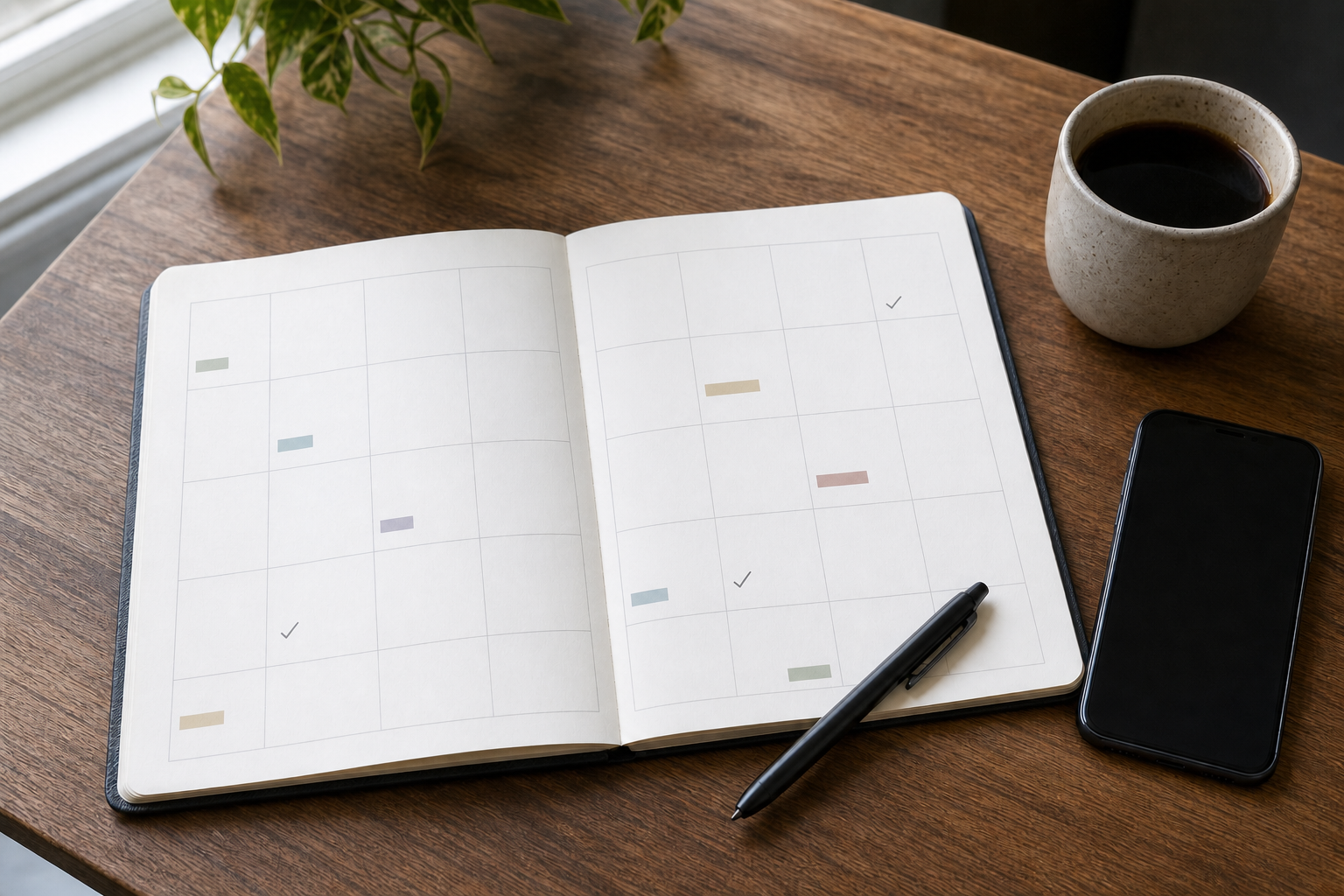
There is a particular kind of desk that looks as if it belongs to two eras at once. A smartphone handles messages, maps, calls and appointments. Beside it sits a paper calendar, open to the whole month, with crossings-out, arrows and small blocks of handwriting.

The easy interpretation is that its owner has failed to move on. But the two objects are doing different jobs. The phone is built for access, alerts and coordination. The paper calendar is built for overview. One carries time everywhere. The other keeps time visible when nobody thinks to open an app.

For people who use both, paper is not necessarily a vote against technology. It can be a vote for a particular representation of time: stable, spatial and available in one glance.

The difference may be the size of the view

The clearest evidence comes from a research report by Yanliu Huang, Zhen Yang and Vicki Morwitz in the Journal of Consumer Psychology. Across three studies, the researchers compared planning with paper calendars and mobile calendars. They found that participants using paper developed higher-quality plans and were more likely to complete them.

The proposed mechanism was not nostalgia, handwriting style or hostility to phones. Paper users tended to take a broader, big-picture perspective on the activities they were organising. That broader view was associated with better planning and greater plan fulfilment.

The most revealing result came when the interface changed. Mobile users who were given a mode that also provided a broad perspective improved the quality of their plans. The advantage belonged less to paper as a material than to what the format made simultaneously visible.

This is one research programme, not settled consensus about how everyone should organise a life. The studies examined particular planning tasks and outcomes. They do not show that paper users possess a distinct personality, or that a wall calendar will transform an overloaded schedule. But they offer unusually direct support for the everyday observation behind the title: a person may keep paper beside a phone because they trust the overview.

A screen is a window, not the whole landscape

A phone calendar can contain years of information, yet display only a small portion at a useful level of detail. Day view shows the hours but hides the month. Month view shows the shape of the month but often truncates the content. Moving between them requires taps, swipes and a change of scale.

Human-computer interaction researchers have been examining this problem for years. Philipp Hund, John Dowell and Karsten Mueller argued for a unified, continuous and multi-granular digital calendar after noting that switching among daily, weekly and monthly layouts can cause a loss of context and orientation. Their experimental interface used scrolling and zooming to preserve continuity across different time scales.

That work is a reminder that digital calendars are designed objects, not neutral containers. A screen imposes a viewport. Software decides which dates remain visible, when detail disappears and how many actions it takes to move from this afternoon to next month.

Paper imposes constraints too. Space runs out. Recurring events must be copied. Rescheduling creates mess. But the marks remain in fixed positions. Wednesday is always to the right of Tuesday. A deadline near the bottom of the page does not disappear when another app sends a notification.

The calendar becomes part of the room

Visibility matters because remembering to consult a reminder is itself a memory task. A digital calendar may contain the appointment and deliver an alert at precisely the chosen time. It can still spend the rest of the day absent from view.

Research on everyday remembering shows why people mix systems. In a study of memory aids, digital calendars were the most commonly reported tool, but paper lists and paper calendars were also used by a majority of participants. Some used both. The researchers noted that the formats provide different benefits for external memory, including persistent physical displays and automated notifications.

A paper calendar beside a phone turns an intention into part of the environment. It does not wait behind an icon. Every time its owner reaches for a coffee, sits down to work or picks up the phone, the month remains available in peripheral view.

This is a form of cognitive offloading, the ordinary practice of putting information into the world so it does not need to be actively held in memory. Both paper and digital calendars do it. Their difference is how the stored information returns. The phone is good at calling attention at a selected moment. Paper is good at remaining quietly available across many moments.

Spatial cues can become memory cues

A calendar is not simply a list of dates. It is a map. People remember that the appointment was in the upper-right part of the page, that the busy week formed a dense band of ink, or that two deadlines sat almost on top of each other.

An adjacent experiment from researchers in Japan asked participants to record schedule information using a paper notebook, tablet or smartphone. Later memory tests and brain imaging suggested that the paper group encoded richer spatial information and retrieved some schedule details more accurately. The study was small and does not establish that paper is universally superior, but it points to a property screens can struggle to reproduce: information on a physical page has a stable place.

The temptation is to convert this into a story about handwriting making the brain work harder. That is too simple. A digital stylus can involve handwriting, while a printed calendar may involve very little. The more relevant distinction for this article is spatial persistence. The page does not reflow, scroll away or reorganise itself.

Digital calendars solve problems paper cannot

None of this makes paper the objectively better system. Digital calendars are vastly better at coordinating groups, accepting invitations, handling recurring events, changing time zones, searching old entries and delivering reminders away from the desk.

A Microsoft Research survey of 621 employees found substantial use of both forms for personal and household scheduling: 51 per cent primarily used a digital work calendar for those events, while 38 per cent primarily used paper. The finding is old enough that today’s proportions may differ, but it shows that paper survived well into the digital-calendar era because scheduling requirements are varied.

The hybrid arrangement makes practical sense. The phone can hold the authoritative record, sync changes and sound alarms. Paper can show the month, the load and the spaces between commitments. Keeping both creates a risk of inconsistency, but many people accept the maintenance cost because each format compensates for the other’s weakness.

There is also a cultural difference in what the systems encourage. Sociologist Judy Wajcman has argued that electronic calendars embody a more quantitative, spreadsheet-like orientation to time, one increasingly linked to automated scheduling and optimisation. Her analysis of the digital architecture of time management does not mean digital tools force everyone to treat life as a database. It does show that software carries assumptions about what time is for and how it should be controlled.

Trust follows what remains available

When someone says they trust a paper calendar, they may not be making a claim about reliability in the technical sense. Phones back up data, repeat reminders and update automatically. Paper can be lost, damaged or forgotten.

The trust is often perceptual. They trust themselves to notice what is already open. They trust the shape of the month to reveal a crowded week before they accept another commitment. They trust a fixed surface not to conceal tomorrow while displaying today.

That preference should not be turned into a virtue. A paper calendar can become decorative while an unglamorous digital alert gets the task done. Nor does using one prove that someone is thoughtful, organised or resistant to distraction.

Still, the calendar beside the phone says something precise about tools. More capacity is not the same as more visibility. The phone may contain every appointment a person has made. The paper earns its place because, for planning, the version of time spread across the desk can be easier to believe than the version waiting behind glass.




Source link

Tags: arentCalendarDisappearsPaperpeoplePhonePsychologyresistingScreentechnologytheyTIMETrustversion
ShareTweetShare
Previous Post

How to Stop Losing Money on Channel Claims

Next Post

Korea’s AI stock rout is becoming a lesson in leveraged excess

Related Posts

Most people assume Dubai became rich from oil, but oil now accounts for less than 1% of the emirate’s GDP — down from 50% in the 1980s — with tourism, trade, and aviation doing the work instead

Most people assume Dubai became rich from oil, but oil now accounts for less than 1% of the emirate’s GDP — down from 50% in the 1980s — with tourism, trade, and aviation doing the work instead

by FeeOnlyNews.com
July 14, 2026
0

Dubai is routinely treated as an oil city because it is wealthy, Gulf-based and visually associated with the wider United...

Across 1,252 people in 10 studies, researchers found that even a five-minute dose of green exercise lifted mood and self-esteem

Across 1,252 people in 10 studies, researchers found that even a five-minute dose of green exercise lifted mood and self-esteem

by FeeOnlyNews.com
July 13, 2026
0

How little time outdoors does it take to feel better? In 2010, two researchers at the University of Essex tried...

The Weekly Notable Startup Funding Report: 7/13/26 – AlleyWatch

The Weekly Notable Startup Funding Report: 7/13/26 – AlleyWatch

by FeeOnlyNews.com
July 13, 2026
0

The Weekly Notable Startup Funding Report takes us on a trip across various ecosystems in the US, highlighting some of...

The Greenland shark drifts through Arctic water at the pace of a slow walk and doesn’t reach sexual maturity until roughly 150 years old, meaning individuals cruising the North Atlantic today were already swimming when the American Revolution began

The Greenland shark drifts through Arctic water at the pace of a slow walk and doesn’t reach sexual maturity until roughly 150 years old, meaning individuals cruising the North Atlantic today were already swimming when the American Revolution began

by FeeOnlyNews.com
July 13, 2026
0

A Greenland shark moves through the black water off Baffin Island at roughly one foot per second — about the...

Psychology suggests people who answer a casual text within seconds but take days to reply to an emotional one aren’t necessarily inconsistent or uncaring — low-stakes messages run on habit, while vulnerable ones demand empathy, reflection and the risk of saying the wrong thing

Psychology suggests people who answer a casual text within seconds but take days to reply to an emotional one aren’t necessarily inconsistent or uncaring — low-stakes messages run on habit, while vulnerable ones demand empathy, reflection and the risk of saying the wrong thing

by FeeOnlyNews.com
July 12, 2026
0

It is easy to read response time as character. Someone replies instantly to a meme, a logistics question, a restaurant...

A 2025 MIT report estimated that roughly 95% of task-specific enterprise generative-AI initiatives had yet to produce measurable business returns. The researchers argued that the main obstacle was not the underlying models, but tools that failed to learn from feedback, fit existing workflows or solve clearly defined operational problems.

A 2025 MIT report estimated that roughly 95% of task-specific enterprise generative-AI initiatives had yet to produce measurable business returns. The researchers argued that the main obstacle was not the underlying models, but tools that failed to learn from feedback, fit existing workflows or solve clearly defined operational problems.

by FeeOnlyNews.com
July 12, 2026
0

The useful reading of the MIT finding is not that generative AI has failed. It is that enterprise AI has...

Next Post
Korea’s AI stock rout is becoming a lesson in leveraged excess

Korea’s AI stock rout is becoming a lesson in leveraged excess

China posts slowest GDP growth since 2022 as investment slumps

China posts slowest GDP growth since 2022 as investment slumps

  • Trending
  • Comments
  • Latest
House backs an emergency brake on elder fraud

House backs an emergency brake on elder fraud

June 26, 2026
Entry-Level Rentals Are Disappearing—Here’s How Landlords Can Fill the Gap

Entry-Level Rentals Are Disappearing—Here’s How Landlords Can Fill the Gap

June 18, 2026
Salesforce, RightCapital, And YCharts Launch Their Own New AI Capabilities (And More Of The Latest In Financial #AdvisorTech – July 2026)

Salesforce, RightCapital, And YCharts Launch Their Own New AI Capabilities (And More Of The Latest In Financial #AdvisorTech – July 2026)

July 6, 2026
Your Next Forever Stamp Purchase Will Soon Cost More. See the New Price

Your Next Forever Stamp Purchase Will Soon Cost More. See the New Price

July 11, 2026
*HOT* Neutrogena Beach Defense Sunscreen as low as .98 shipped!

*HOT* Neutrogena Beach Defense Sunscreen as low as $1.98 shipped!

July 9, 2026
LPL surges in JD Power advisor satisfaction rankings

LPL surges in JD Power advisor satisfaction rankings

July 9, 2026
Rafa offer for sale nets FIMI NIS 500m

Rafa offer for sale nets FIMI NIS 500m

0
Goldman Sachs Group Q2 2026: .98 EPS Tops Estimates — Deep Dive

Goldman Sachs Group Q2 2026: $20.98 EPS Tops Estimates — Deep Dive

0
China posts slowest GDP growth since 2022 as investment slumps

China posts slowest GDP growth since 2022 as investment slumps

0
NEAR Governance Vote To Scrap Gas Rebates Puts Developer Incentives Under Review

NEAR Governance Vote To Scrap Gas Rebates Puts Developer Incentives Under Review

0
Target’s problems aren’t what you think they are

Target’s problems aren’t what you think they are

0
What to Do When a Pharmacy Says Your Drug Needs Prior Authorization

What to Do When a Pharmacy Says Your Drug Needs Prior Authorization

0
China posts slowest GDP growth since 2022 as investment slumps

China posts slowest GDP growth since 2022 as investment slumps

July 14, 2026
Korea’s AI stock rout is becoming a lesson in leveraged excess

Korea’s AI stock rout is becoming a lesson in leveraged excess

July 14, 2026
Psychology says people who keep a paper calendar beside their phone aren’t resisting technology—they trust the version of time they can see all at once more than the version that disappears behind a screen

Psychology says people who keep a paper calendar beside their phone aren’t resisting technology—they trust the version of time they can see all at once more than the version that disappears behind a screen

July 14, 2026
How to Stop Losing Money on Channel Claims

How to Stop Losing Money on Channel Claims

July 14, 2026
SEC email address mix-up for comments on semiannual reporting proposal causing confusion

SEC email address mix-up for comments on semiannual reporting proposal causing confusion

July 14, 2026
How to Check Your Social Security Earnings Record for Costly Errors

How to Check Your Social Security Earnings Record for Costly Errors

July 14, 2026
FeeOnlyNews.com

Get the latest news and follow the coverage of Business & Financial News, Stock Market Updates, Analysis, and more from the trusted sources.

CATEGORIES

  • Business
  • Cryptocurrency
  • Economy
  • Financial Planning
  • Investing
  • Market Analysis
  • Markets
  • Money
  • Personal Finance
  • Startups
  • Stock Market
  • Trading

LATEST UPDATES

  • China posts slowest GDP growth since 2022 as investment slumps
  • Korea’s AI stock rout is becoming a lesson in leveraged excess
  • Psychology says people who keep a paper calendar beside their phone aren’t resisting technology—they trust the version of time they can see all at once more than the version that disappears behind a screen
  • Our Great Privacy Policy
  • Terms of Use, Legal Notices & Disclaimers
  • About Us
  • Contact Us

Copyright © 2022-2024 All Rights Reserved
See articles for original source and related links to external sites.

Welcome Back!

Sign In with Facebook
Sign In with Google
Sign In with Linked In
OR

Login to your account below

Forgotten Password?

Retrieve your password

Please enter your username or email address to reset your password.

Log In
No Result
View All Result
  • Home
  • Business
  • Financial Planning
  • Personal Finance
  • Investing
  • Money
  • Economy
  • Markets
  • Stocks
  • Trading

Copyright © 2022-2024 All Rights Reserved
See articles for original source and related links to external sites.